
Unlocking supply chain visibility software for Smarter Logistics
Ever feel like your products just vanish into thin air between the warehouse and your customer's doorstep? That's the logistics "black box" problem, and it's a massive source of stress for any business.
Supply chain visibility software is designed to solve exactly that. Think of it less like a static map and more like a live GPS for your entire inventory, showing you where everything is, in real-time, from the factory floor to the final delivery.
What Is Supply Chain Visibility Software?
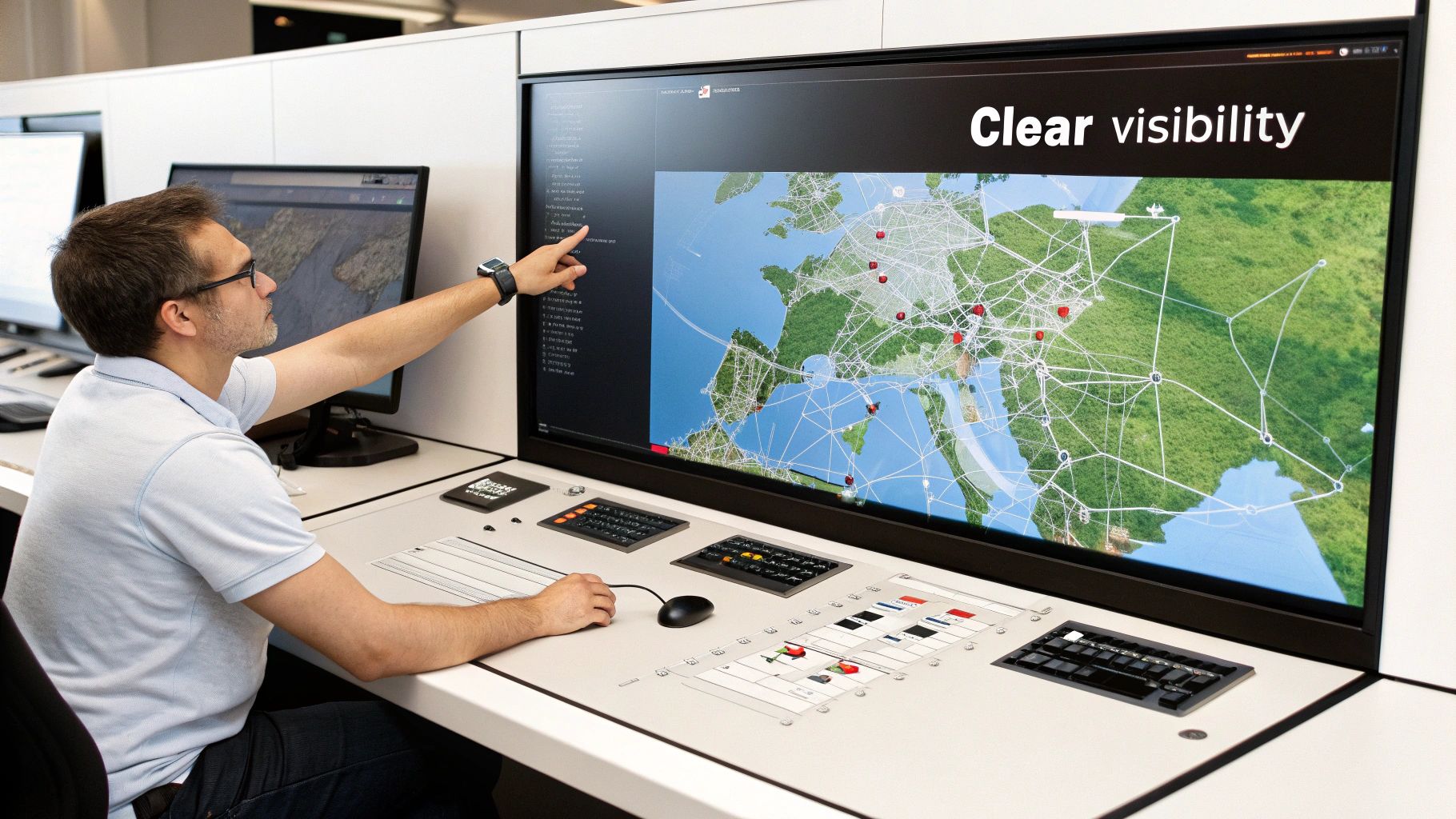
Without this kind of software, you're essentially trying to navigate a ship through a dense fog with only sporadic, often-delayed radio updates. You only find out about a problem long after it's happened. Supply chain visibility software cuts through that fog.
These platforms act as a central hub, pulling in data from every corner of your logistics network—carriers, warehouses, suppliers, and even the GPS on a delivery truck. All that scattered information is unified into a single, easy-to-understand dashboard.
This changes the game entirely. You stop asking "Where's my order?" and start proactively managing the entire delivery experience from start to finish.
A New Way of Working: From Manual Tracking to Full Visibility
The shift from a fragmented, manual process to a unified, software-driven one is dramatic. It moves your team from putting out fires to preventing them in the first place.
| Aspect | Traditional Approach (Without Software) | Modern Approach (With Visibility Software) |
|---|---|---|
| Data Access | Siloed and fragmented across multiple carrier portals and emails. | Centralized in a single, real-time dashboard. |
| Problem Solving | Reactive: You find out about delays after a customer complains. | Proactive: Alerts notify you of potential issues before they happen. |
| Customer Updates | Manual, often inaccurate, and time-consuming for support teams. | Automated, precise, and self-service for the customer. |
| Decision-Making | Based on outdated reports and guesswork. | Driven by live data and predictive analytics. |
This evolution is what turns logistics from a pure cost center into a powerful tool for customer satisfaction and operational excellence.
From Reactive to Proactive Operations
At its core, this software creates a single source of truth for your entire operation. It connects the dots between different tracking systems, letting you monitor a massive container on an ocean freighter and a single package out for local delivery with the same level of clarity. For a better sense of the technology that powers this, it's helpful to understand how inventory monitoring systems work behind the scenes.
This new level of insight empowers your team to:
- Anticipate Disruptions: Spot potential hold-ups—like bad weather or customs delays—before they derail a delivery.
- Communicate with Confidence: Give customers accurate, up-to-the-minute tracking information, which builds trust and dramatically cuts down on support tickets.
- Make Smarter Decisions: Use real-time data to choose better shipping routes, select the most reliable carriers, and manage inventory more effectively.
It's no surprise the demand for this is exploding. The global market for supply chain visibility software is expected to hit USD 25.47 billion by 2035, growing at a staggering rate of 26.45% annually. This massive growth reflects how critical operational control has become in a world of complex global trade and demanding e-commerce customers.
A modern supply chain is no longer a straight line but a complex, interconnected web. Without total visibility, you're not managing logistics—you're managing chaos. This software provides the clarity to turn that chaos into a real competitive advantage.
Ultimately, visibility software helps you deliver on your promises. It gives you a clear view of every moving part, enabling you to build a more resilient, efficient supply chain and keep your customers happy. A key piece of this puzzle is the ability to follow individual shipments, which is a core part of any system for global logistics tracking.
Core Features That Power Modern Logistics
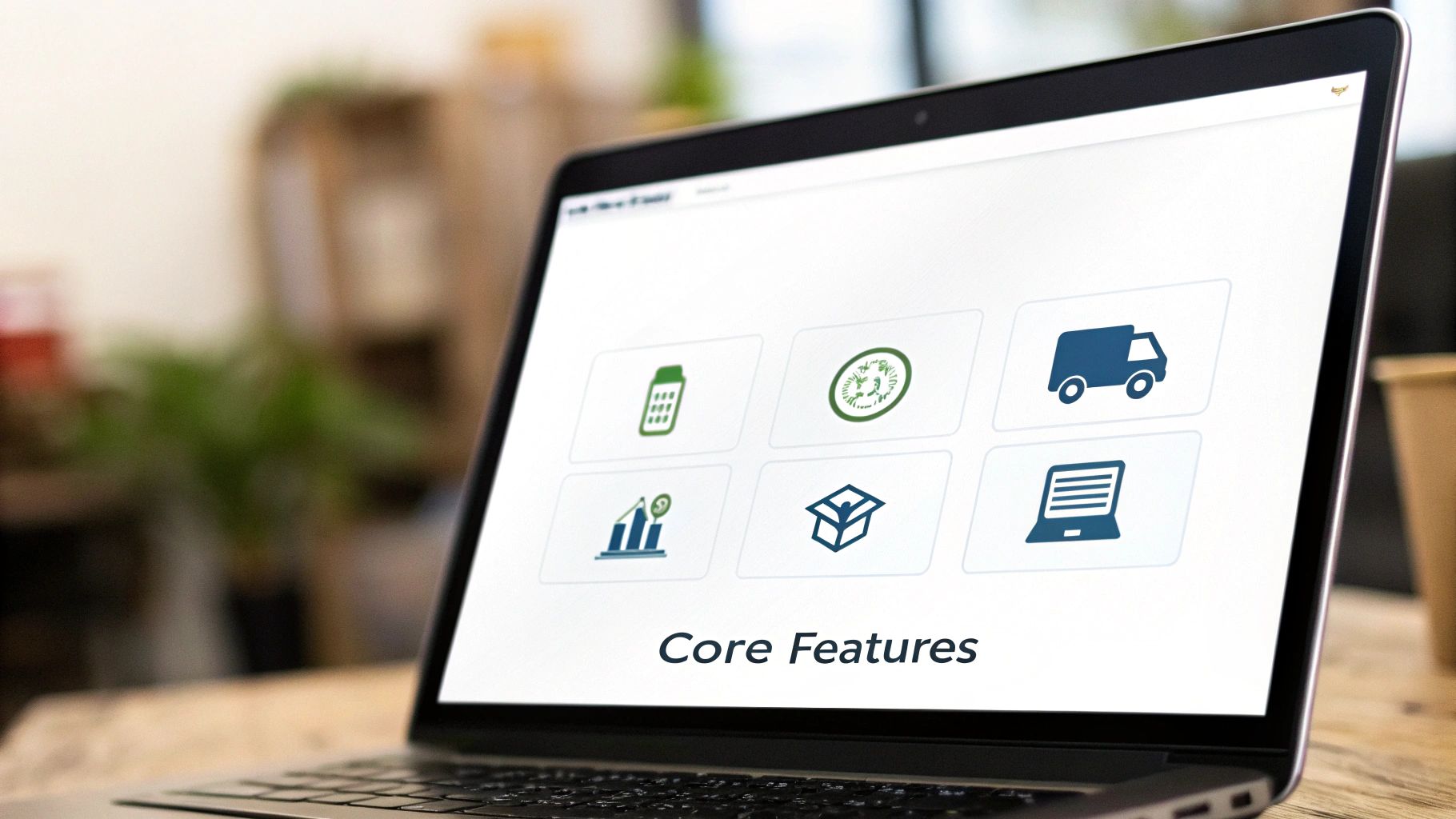
To really get what makes supply chain visibility software so effective, you have to look under the hood. The magic isn't in one single gadget but in how a handful of powerful features work together, turning a flood of raw data into smart, practical actions.
Think of it like the crew on a ship's bridge. You've got the navigator, the lookout, and the captain, all with different jobs but communicating constantly. They work in sync to steer through rough seas and get the cargo—your products—to its destination safely and on schedule. Let's break down the five key features that make this possible.
Real-Time Tracking and Location Intelligence
This is the bedrock of any visibility platform, but we've moved way beyond a simple pin on a map. A basic carrier update might tell you a package is "in transit," which isn't very helpful. Modern software gives you intensely detailed, real-time location data pulled from GPS, IoT sensors, and direct carrier connections.
What this means is you can see the actual truck moving down the highway, the container sitting on a specific ship, or the delivery van turning onto your customer's street. It’s the difference between knowing an order has shipped and knowing it's exactly three blocks from its final destination. You can see just how granular this gets with an ultimate parcel tracker that brings the entire journey to life.
Predictive Analytics and ETA Forecasting
Knowing where a shipment is right now is good. Knowing where it's going to be tomorrow is a game-changer. Predictive analytics uses AI and machine learning to chew through historical data, live traffic, weather reports, and port congestion to produce surprisingly accurate Estimated Times of Arrival (ETAs).
This feature is like having a logistics crystal ball. It doesn't just tell you about a delay after it's already happened; it can predict a potential problem 24-48 hours ahead of time. That gives you a priceless window to adjust, reroute, and—most importantly—let your customer know what's going on before they have to ask.
By moving from reactive firefighting to proactive planning, predictive analytics helps you manage customer expectations. A potential complaint can become an opportunity to show how great your customer service really is.
Automated Alerts and Exception Management
Nobody can manually watch hundreds or thousands of shipments at once. That's where automated alerts come in. These systems are your tireless watchdogs, monitoring every single shipment 24/7 and flagging the moment something goes off-plan.
You can set custom rules to get pinged for specific issues, like:
- Customs Hold-ups: Get an instant alert if a shipment gets stuck at the border.
- Failed Deliveries: Know immediately if a driver couldn't drop off a package so you can reschedule right away.
- Temperature Spikes: For cold-chain goods, an alert fires if a refrigerated container's temp falls outside the safe zone.
This approach is called "management by exception." Instead of drowning in data, you only focus on the shipments that actually need your attention.
Centralized Dashboards and Reporting
All the data in the world is useless if you can't make sense of it. A central dashboard pulls everything together from all your carriers and systems into one clean, easy-to-read screen. It uses interactive maps, charts, and key performance indicators (KPIs) to tell you the story of your supply chain.
Forget logging into a dozen different carrier portals. Your whole team gets one unified view. At a glance, the dashboard can answer crucial questions:
- What's our on-time delivery percentage this month?
- Which of our carriers is dropping the ball?
- Where are our most common bottlenecks?
These insights are pure gold, helping you make smarter, data-backed decisions that tighten up operations and cut costs.
Seamless Systems Integration
Finally, a visibility platform has to play nice with the other tools you already rely on. This is all about integration—making sure data flows automatically between the visibility software and your other key systems. We're talking about your Enterprise Resource Planning (ERP), your Warehouse Management System (WMS), and your e-commerce platforms like Shopify or WooCommerce.
This connection builds a single source of truth. When a customer orders from your site, the information flows to your WMS to be picked and packed, then straight into the visibility software for tracking. No one has to type anything in manually. This slashes errors, saves a ton of time, and ensures everyone from the warehouse floor to the customer support desk is looking at the same real-time information.
The Real-World Payoff: What Visibility Actually Does for Your Business
Let's move past the technical jargon. The true test of any supply chain visibility software isn't its list of features, but the real, measurable results it delivers. This is about more than just seeing dots on a map—it’s about changing the way you run your business, serve your customers, and handle the unexpected. The effects are felt everywhere, from the warehouse floor right up to your bottom line.
Think about a small but growing online store, let's call them "Urban Bloom," selling handcrafted home goods. In the early days, they juggled shipping with a messy mix of spreadsheets and carrier websites. But as they grew, so did the chaos. Their customer support team was drowning in "Where Is My Order?" (WISMO) calls, and the operations folks were completely blind to shipping delays until an angry customer email landed in their inbox. It was a reactive, inefficient mess that was burning cash and eroding customer trust.
Once Urban Bloom adopted visibility software, they could finally see everything in one place. That newfound clarity started paying off almost immediately.
Cutting Down on Operational Waste
One of the first things you'll notice is a serious drop in operational costs. Good visibility software doesn't just track parcels; it shines a spotlight on all the little inefficiencies that quietly drain your budget. By actually seeing what's happening with transit times and carrier performance, you can start plugging those financial leaks.
For instance, Urban Bloom’s data showed that one of their regional carriers was consistently late, causing packages to sit idle in sorting facilities. Armed with concrete evidence, they were able to renegotiate their contract and shift more business to a reliable partner. That single move saved them thousands in fees and prevented lost sales from unhappy customers. To dig deeper into how these systems boost efficiency, it's worth exploring the broader benefits of modern fleet management software.
This kind of insight helps you:
- Find Better Routes: Pinpoint the most efficient shipping lanes to cut down on fuel and get packages delivered faster.
- Dodge Demurrage Fees: Proactively manage container pickups and drop-offs at ports so you aren't hit with expensive penalties for sitting too long.
- Lower Your Safety Stock: When you can actually trust your delivery forecasts, you don't need to tie up as much cash in "just-in-case" inventory.
Seriously Upping Your Customer Game
In today's e-commerce world, the delivery experience is your brand. Visibility software lets you switch from a reactive to a proactive customer service model. Instead of waiting for a customer to call you about a delay, you can automatically shoot them a notification the second a problem pops up—often with a solution already in the works.
A proactive heads-up about a one-day delay, paired with a quick apology, turns a potentially bad experience into a moment of exceptional customer care. That builds far more trust than a support agent fumbling for answers after the fact.
This simple shift has a massive impact. It drastically cuts down on those repetitive WISMO tickets, freeing up your support team to solve real problems. For Urban Bloom, rolling out automated tracking updates slashed their support ticket volume by over 40% in just three months. Their team could finally focus on building relationships instead of just chasing tracking numbers.
Building a More Resilient Business
Let's face it: modern supply chains are fragile. They're vulnerable to everything from port closures and labor strikes to freak weather events. Visibility software is your early-warning system, helping you spot these risks before they spiral into a full-blown crisis. By keeping an eye on global events and how they affect shipping lanes, you can build a much more agile and resilient operation. We dive deeper into how this works for larger shipments in our guide to cross-country freight tracking.
This proactive approach is fast becoming the new standard. By 2024, a staggering 72% of global manufacturers had already adopted digital tracking and visibility tools. This shift has driven a 45% improvement in real-time logistics tracking accuracy across North America and Europe, changing the game for how businesses manage international shipments. You can find more details on this global logistics trend from Business Research Insights. Ultimately, the ability to anticipate disruptions—not just react to them—is what separates the businesses that thrive from those that just get by.
How to Choose the Right Visibility Software
Choosing the right supply chain visibility software can feel overwhelming, but it doesn’t have to be. With so many options out there, the trick is to zero in on what your business actually needs, not get dazzled by a long list of features you'll never use. What works for a massive global corporation is probably overkill for a growing e-commerce shop.
The real goal here is to find a solution that fixes your current shipping headaches and can keep up as you grow. Think of it less like buying a piece of software and more like hiring a critical team member—you need one that’s reliable, easy to work with, and ready for what’s next.
Let's break down the essentials into a straightforward framework. We'll cut through the noise and help you ask the right questions to find the perfect fit for your team and your budget.
Assess Your Core Business Needs First
Before you even book a single demo, take a look inward. What are the biggest logistical nightmares you're dealing with right now? Getting a crystal-clear picture of your problems is the most important step; it will guide every decision you make from here on out.
Are any of these challenges hitting a little too close to home?
- A flood of "Where Is My Order?" (WISMO) tickets: Is your support team drowning in repetitive tracking questions?
- Reactive, not proactive, communication: Do you only learn about a shipping delay after an angry customer calls?
- Carrier chaos: Is it a pain to compare carrier performance or hold them accountable for missed delivery promises?
- The manual tracking grind: Does your team waste hours jumping between different carrier websites just to find basic information?
Answering these questions helps you build a priority list. If WISMO calls are public enemy number one, then a platform with great customer-facing tracking pages and automated alerts should be at the top of your list.
Key Evaluation Criteria for Visibility Software
Once you know what you're trying to fix, you can start looking at vendors. To make sure you’re choosing a long-term partner, focus on these five critical areas.
1. Scalability and Future Growth The software you pick today has to work for the business you'll be tomorrow. Ask vendors point-blank how their platform handles a spike in shipment volume. Is the pricing model flexible, or will you get hit with a massive bill the second you start growing? A scalable solution means you won't be doing this all over again in a year.
2. Carrier Network Coverage Your visibility platform is only as good as the data it can access. Make sure the software integrates directly with every carrier you use now and any you might add later, from national giants to small regional couriers. A broad carrier network gives you a single source of truth, no matter how your shipping strategy changes.
3. Integration Capabilities A visibility tool that doesn't talk to your other systems just creates another data silo. To be truly effective, it needs to connect seamlessly with your tech stack—especially your e-commerce platform (like Shopify, WooCommerce, or Magento) and your inventory management system. This is what makes order and tracking data flow automatically, killing manual entry and the errors that come with it.
This is more important than ever, with cloud-based supply chain visibility software now holding a dominant 57% market share. That’s great news for smaller e-commerce businesses that need powerful, affordable tracking without a huge IT footprint. You can discover more about supply chain software market trends on GMI Insights.
4. Ease of Use and Team Adoption A platform with all the bells and whistles is useless if your team hates using it. Look for a clean, intuitive user interface (UI) and a dashboard that puts the most important information front and center. During a demo, picture your customer support team using it every day. Can they find what they need in just a couple of clicks? The faster your team adopts it, the faster you see a return on your investment.
Pro Tip: Bring your end-users into the demo process. The people who will be in the software all day are the best judges of whether it’s genuinely useful or just another complicated tool.
5. Transparent and Fair Pricing Software pricing can be a minefield, with models ranging from per-shipment fees to flat monthly subscriptions. Look for a vendor with a clear, straightforward pricing structure that makes sense for your business. Steer clear of platforms with sneaky hidden fees or long, restrictive contracts.
To help you stay organized during your search, here’s a checklist to guide your conversations with potential software providers.
| Software Selection Checklist For Small Businesses | | :--- | :--- | :--- | | Evaluation Criteria | Key Question to Ask | Importance (High/Medium/Low) | | Business Need Alignment | Does this software directly solve our top 2-3 logistics problems (e.g., WISMO calls, manual tracking)? | High | | Carrier Integrations | Does it connect with all of our current and planned shipping carriers? | High | | E-commerce Platform Integration | Can it integrate seamlessly with our platform (Shopify, WooCommerce, etc.)? | High | | Ease of Use | Can our support/ops team find a shipment's status in under 30 seconds? Is the dashboard intuitive? | High | | Scalability | How does the pricing and performance change if our shipment volume doubles next year? | Medium | | Customer-Facing Features | Does it offer a branded tracking page and customizable email/SMS notifications for our customers? | Medium | | Alerts & Exception Management | Can we set up proactive alerts for delays, stuck shipments, or delivery exceptions? | High | | Pricing Model | Is the pricing clear and predictable? Are there hidden fees for setup, support, or carrier connections? | High | | Support & Onboarding | What does the implementation process look like, and what level of customer support is included? | Medium |
This checklist isn't just about ticking boxes; it's about making sure the software you choose is a genuine asset, not just another expense.
This simple decision tree shows how investing in the right platform creates a ripple effect of positive outcomes across your business.
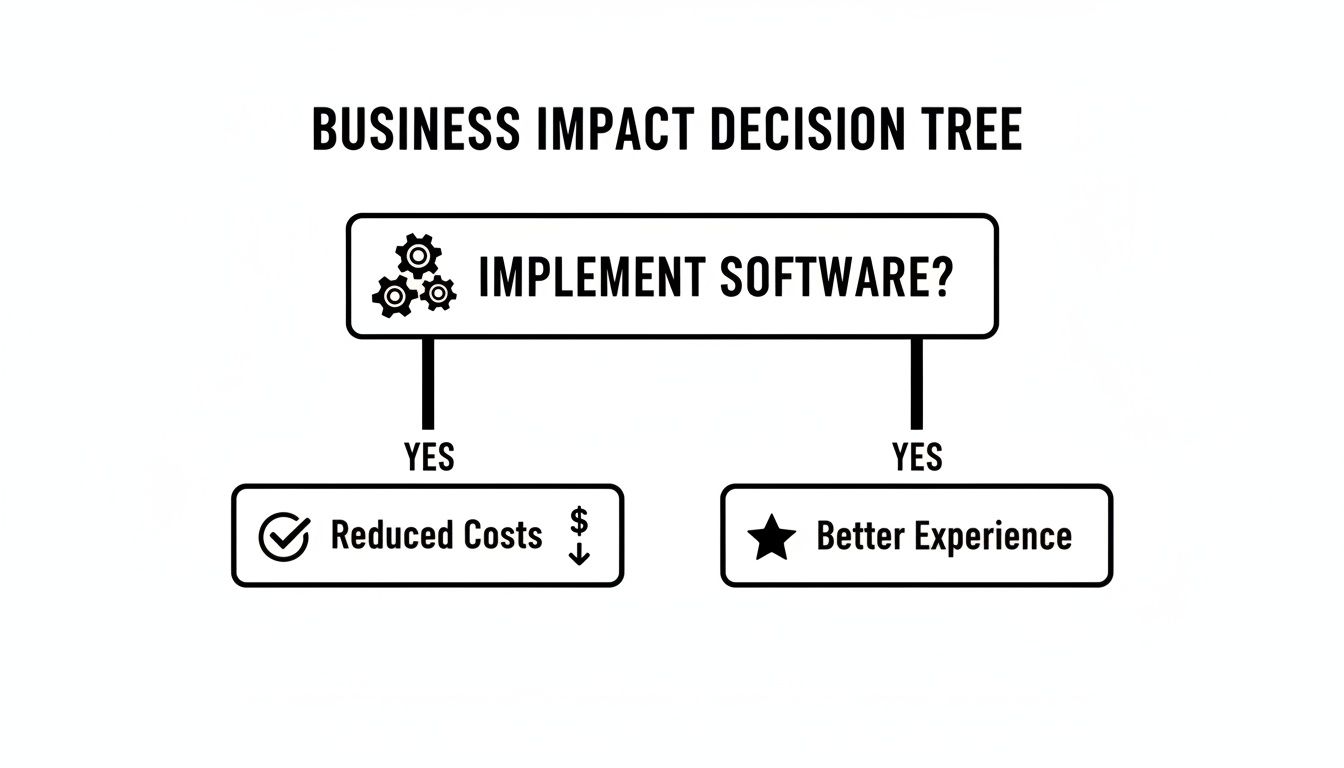
As you can see, the decision to adopt visibility software directly leads to two of the most important goals for any business: cutting operational costs and delivering a much better customer experience.
Implementing Your First Visibility Platform
Jumping into new technology can feel like a huge commitment, especially for a small team that doesn't have a dedicated IT department. The good news? Modern supply chain visibility software is built with exactly this in mind. Getting started is less about writing code and more about following a smart, straightforward plan.
Think of this as your non-technical roadmap. We'll walk through everything from deciding what you actually want to achieve to getting your team comfortable with the new tool. The goal here is a quick, successful launch that starts delivering value right away, changing how you handle logistics and talk to your customers for the better.
Phase 1: Define What Success Looks Like
Before you connect a single thing, you have to know what you’re aiming for. A vague goal like “improve visibility” won’t cut it. You need to get specific and focus on measurable outcomes that solve your biggest headaches.
This isn't just busywork. This step gives you a clear benchmark to measure your return on investment and keeps your team focused on using the software to fix real problems, not just play with new features.
Here are a few examples of strong, actionable goals:
- Cut down on "Where Is My Order?" (WISMO) support tickets by 30% in the first three months.
- Boost our On-Time Delivery (OTD) rate by 5% by spotting and swapping out underperforming carriers.
- Give our customer support team 10 hours back each week by eliminating manual shipment tracking.
Phase 2: Get Everything Connected and Configured
With your goals locked in, it’s time for the technical part—which is surprisingly simple these days. Most modern platforms have ditched custom development for easy, wizard-based connections.
This is where you bring all your scattered supply chain data into one place and make it work for you. A clean, reliable data connection is the bedrock of everything that follows.
Here’s a simple checklist for this phase:
- Integrate Your Sales Channels: First, hook up your e-commerce platforms like Shopify or WooCommerce and any marketplaces you use. This ensures order info flows in automatically.
- Connect Your Carriers: Next, link all your shipping carrier accounts using their API keys. This is what lets the platform pull tracking data directly from the source in real-time.
- Set Up Custom Alerts: Think about what you need to know instantly. Configure automated notifications for events like customs delays, packages at risk of being late, or failed delivery attempts.
- Customize Your Dashboard: Finally, arrange your main dashboard to put the metrics you defined in Phase 1 front and center. Your team should be able to see exactly how things are going in a single glance.
Remember, the quality of your insights depends entirely on the quality of your data. Take the time to ensure all integrations are working correctly and that information is flowing without errors. Poor data in equals poor visibility out.
Phase 3: Train Your Team and Go Live
A tool is only as good as the people using it. To make sure your team actually embraces the new software, you need a smart rollout and good training. Don't just flip a switch and throw everyone in the deep end.
Start with a small, core group of users—maybe your customer support lead or operations manager. Let them get comfortable and become the in-house experts. They'll become advocates for the platform, which makes the transition much smoother when you bring the rest of the team on board.
A successful launch comes down to these final steps:
- Run Focused Training Sessions: Don't just show them features. Show them how the software solves their real, day-to-day problems, like answering a customer's question in seconds instead of minutes.
- Do a Phased Rollout: Start small. Begin by tracking shipments for just one carrier or one product line to iron out any kinks before you go all-in.
- Ask for Feedback: Listen to what your team has to say. Their on-the-ground experience is invaluable for tweaking dashboards or alert settings to make the tool even better.
Putting Visibility Software Into Practice
It's one thing to talk about benefits in theory, but the real magic of supply chain visibility software happens when you see it solve real-world problems. Let's walk through a few everyday scenarios where these platforms become absolute game-changers for small businesses, turning abstract features into real money and happier customers.
These examples show how visibility software graduates from a simple tracking tool into a core part of your operations. It's about protecting your revenue, freeing up your team's time, and building the kind of customer loyalty that lasts.
For the International Dropshipper
Imagine you’re dropshipping products from a dozen different suppliers across Southeast Asia. You’re dealing with a tangled web of carriers, languages, and time zones. When a customer emails asking, "Where's my order?" your support team has to jump between multiple, clunky tracking sites, piecing together information that’s often stale. It's a huge time sink.
This is where a visibility platform completely changes the game. It pulls every single shipment, from every supplier, into one clean, unified dashboard.
- A Single Source of Truth: Instead of ten confusing browser tabs, you get one simple map showing where every package is in real time.
- Proactive Alerts: The system flags a shipment that’s stuck in customs in Singapore before your customer even has a chance to worry. You get to be the hero who solves a problem they didn't even know they had.
- Smarter Supplier Management: Over time, the data clearly shows you which suppliers are reliable and which ones are consistently late. This is invaluable information for optimizing who you work with.
That centralized view takes a chaotic international network and makes it feel completely under control.
ROI in Action: Let's say your support agent spends 10 minutes manually tracking a single international order. Visibility software cuts that down to one minute. You just saved nine minutes. At 50 of these inquiries a day, that's 7.5 hours saved—practically an entire workday your team can now spend on growing the business instead of chasing down packages.
For the Marketplace Seller Protecting Their Ratings
Now, picture yourself selling on a cutthroat marketplace like Amazon or Etsy. Your seller rating is your lifeline. It dictates everything from your search ranking to your customer's trust, and it's heavily tied to hitting your delivery estimates. One late shipment can trigger a negative review that tanks your reputation.
A visibility platform is your secret weapon for making and keeping accurate delivery promises.
- Smarter ETAs: The software doesn't just parrot the carrier's generic estimate. It analyzes historical performance and real-time transit data to give you a much sharper, more realistic delivery window to share with customers.
- Automated Customer Updates: You can set up branded, automated emails or texts that keep your customer in the loop at every step. This simple act of communication heads off anxiety and dramatically reduces the chance of a "my package is late!" complaint.
- Carrier Performance Scorecards: You can quickly see which carriers are actually delivering on time and which aren't. This lets you confidently partner with the most reliable options for your routes.
Sellers are catching on to this fast. The market for this kind of real-time visibility is exploding, projected to grow from USD 1.92 billion in 2024 to USD 15.93 billion by 2033. This massive growth is fueled by sellers just like you who need to pull carrier data together, spot delays early, and protect customer trust at all costs. You can learn more about how digital tools are reshaping supply chains on Vizion API.
By safeguarding your delivery promises, this software is directly protecting your most valuable asset: your reputation.
Frequently Asked Questions
Still have questions about how supply chain visibility software could work for your business? We get it. Here are some of the most common things we hear from fellow business owners and logistics managers, with straight-to-the-point answers.
"Isn't This Kind of Software Just for Giant Corporations?"
That used to be true, but not anymore. In the past, only massive companies could afford the custom-built systems needed for true visibility. Today, cloud-based (SaaS) platforms have completely changed the game, making this technology affordable and accessible for small and medium-sized businesses.
Most modern tools offer flexible, pay-as-you-go pricing. This means you can start with just what you need and scale up as your business grows, avoiding a huge upfront investment.
"How Is This Any Different from the Free Tracking My Carrier Gives Me?"
It’s a night-and-day difference. The free tracking from a carrier like UPS or FedEx is a one-way street—it only shows you what's happening within their network. Supply chain visibility software gives you the full picture.
Here’s how they really stack up:
- It’s a Single Source of Truth: Instead of juggling multiple tracking sites, it pulls data from all your carriers—FedEx, USPS, regional couriers, you name it—into one clean dashboard.
- It Adds a Layer of Intelligence: It does more than just report a package’s location. It gives you predictive ETAs, sends proactive alerts when a shipment is delayed, and analyzes carrier performance over time.
- It’s a True Operational View: You get a holistic view of your entire shipping operation, something no single carrier can ever provide on its own.
Here’s a good way to think about it: A carrier's tracking portal shows you one piece of the puzzle. Visibility software assembles the entire puzzle for you, so you can finally see how everything connects.
"What Does Implementation Look Like? Is It a Huge IT Project?"
Forget the horror stories of month-long IT projects. Modern, cloud-based visibility tools are built for speed and simplicity.
For most small businesses, getting set up is incredibly fast. Connecting your Shopify store or linking your carrier accounts can usually be done in just a few hours or a couple of days at most. You can start seeing the benefits and a real return on your investment almost immediately.