
Global Logistics Tracking: Mastering global logistics tracking for visibility
Global logistics tracking is all about creating one seamless story for a shipment as it moves across borders and switches between different carriers. Think of it as a master key that unlocks visibility into a package's entire journey, giving you a clear picture of its location and status from the moment it leaves to the second it arrives.
Why Global Tracking Is No Longer a Luxury

Tracking a package within your own country is usually straightforward—like watching a direct flight on a map. But once that package crosses a border, things get complicated.
International shipping is more like a journey with multiple connecting flights on different airlines. Each carrier has its own crew, its own system, and its own potential for delays. A single international parcel might pass through the hands of four or more separate logistics partners before it finally lands on the customer's doorstep.
This hand-off process creates blind spots, leaving both you and your customer in the dark. Global logistics tracking fills in those gaps, acting as a universal control tower for your shipments.
The Modern Supply Chain Demands Visibility
It wasn't long ago that a simple "shipped" notification was good enough. Those days are over. Today’s customers expect to see real-time updates every step of the way, making clear and consistent tracking a must-have for any business selling internationally.
This transparency isn't just about keeping customers happy; it’s about managing expectations, reducing "where is my order?" inquiries, and building genuine brand trust. For a wider view of how goods move around the world, this International Supply Chain Management Guide offers some great strategies for global operations.
Real-time visibility isn’t just about customer service; it’s a powerful operational tool that allows businesses to anticipate delays, manage inventory more effectively, and streamline their entire supply chain from end to end.
A Competitive Edge Through Data
In today's market, comprehensive visibility is a massive competitive advantage. It's not a secret, either—the big players are already using advanced tracking to fine-tune their operations.
In fact, 70% of shippers in North America are now actively sharing transportation data throughout their supply chain, and more than half are looping in their suppliers, too. This trend points to a simple truth: you can't optimize what you can't see. Knowing exactly where your products are is the first, most critical step to making them move smarter.
The Technology That Powers Your Package Across Borders
Behind every single tracking update, there's a fascinating world of technology working in perfect harmony. The best way to think about it is as a digital passport for your package. Each scan, signal, and data transfer adds a new stamp, creating a detailed chronicle of its journey around the globe. This intricate system is what turns a simple physical box into a rich stream of data, making global tracking a reality.
It all starts with a single scan. The moment a shipping label gets printed, a unique identity is created for that parcel. This digital identity is the secret to keeping an eye on it every step of the way.
The Tools That Capture the Data
At the heart of any tracking system are the technologies that pinpoint a package's location and status at key moments. Each tool has its own specific job, kind of like different instruments in an orchestra, all coming together to give you a complete picture of the shipment’s progress.
Barcodes: The humble barcode is the foundation of it all. Think of it as the package's unique fingerprint. Every time it gets scanned—at a warehouse, during sorting, or when loaded onto a truck—its location is updated in the carrier's system. It’s simple, reliable, and universally understood.
RFID (Radio-Frequency Identification): RFID tags are a huge leap forward from barcodes. They're more like an automated E-ZPass for your package, constantly broadcasting a low-power radio signal. Scanners can read these signals from a distance without needing a direct line of sight, which is a game-changer in busy hubs where an entire pallet of goods can be scanned in a single pass.
GPS (Global Positioning System): When you need to know exactly where your package is right now, GPS is the answer. It’s the live pin on a world map, tracking the real-time position of the truck, ship, or plane carrying your goods. This is absolutely critical for long-haul journeys and provides that "in transit" visibility everyone has come to expect.
These physical scans and pings create the raw data. But how does that information get from a warehouse in another country or a cargo ship in the middle of the ocean to your computer screen? That’s where the data transmission network kicks in.
How Data Travels Around the World
Once a scan or a location fix happens, that little piece of information needs to be sent, shared, and understood. This is where the digital backbone of global logistics connects all the dots, weaving separate systems into a network that makes universal tracking possible.
There are two main channels that keep the information flowing:
Carrier APIs (Application Programming Interfaces): You can think of APIs as digital handshakes between different logistics systems. An API lets a carrier like FedEx securely share its tracking data with a partner airline or a local delivery service in another country. This ensures the tracking history stays complete and unbroken, even when the package changes hands.
Postal Networks: When packages are handled by national postal services (like USPS in the U.S., Royal Mail in the U.K., or Deutsche Post in Germany), data is shared through long-standing international agreements. These networks make sure that a package scanned into one country's postal system is recognized and updated by the next one down the line.
The real magic of global logistics tracking isn't in any single technology, but in how data from all these sources is seamlessly brought together. It’s about translating dozens of small, separate events into one clear, easy-to-understand journey for the customer.
The next frontier is integrating even smarter systems. Automation and AI are already starting to change how logistics companies manage parcels. For example, AI can analyze tracking data to spot potential disruptions—like a major storm or port congestion—and automatically reroute shipments to avoid the delay, keeping things moving efficiently. You can learn more about how AI is shaping logistics and other market trends on iContainers.com.
Ultimately, all these technologies work together to tell a story—the story of your package's journey. By understanding the technologies that power cross-country freight tracking, you can better manage your supply chain and deliver a truly fantastic customer experience.
How Universal Trackers Create a Single View of Truth
If you've ever tracked an international order, you know the headache. A package starts with DHL in Germany, gets passed to an airline, clears customs, and then lands in the hands of USPS for the final delivery. You're left juggling multiple websites, trying to piece together where your package actually is.
This is exactly the problem universal trackers were built to solve. Think of them as a master translator for the global language of logistics. Instead of you having to bounce between different carrier sites, a universal platform takes one tracking number and does all the heavy lifting for you. It automatically figures out every carrier involved and pulls all their data into one clean, unified timeline.
This process turns a fragmented, confusing mess of updates into a single, coherent story. You get a clear, step-by-step view of your package’s entire journey—from the first warehouse scan to your doorstep—all in one place.
The Magic of Data Aggregation and Normalization
At its heart, a universal tracker works by using data aggregation. It automatically reaches out to the systems (or APIs) of every carrier involved—from global giants to local postal services—and gathers every scan, update, and event tied to your tracking number. This creates a complete, raw log of the shipment's history.
But just grabbing the data isn't enough. The real trick is that every carrier has its own lingo. One might report an event as "Processed at Sort Facility," while another says "Scanned at Hub," and a third might use "Arrival at Transit Point." To a customer, these different phrases just create confusion and uncertainty.
This is where data normalization comes into play. A smart tracking platform acts as an interpreter, translating these varied, carrier-specific terms into simple, standardized statuses that anyone can understand.
- "Processed at Sort Facility" becomes In Transit.
- "Arrival at Destination Country" becomes Customs Clearance.
- "Forwarded to Local Post" becomes Handed Off for Final Delivery.
By standardizing this language, the platform strips away all the jargon and guesswork. It creates a consistent, easy-to-follow experience, so you know exactly what’s happening at every stage of the global logistics tracking journey.
Visualizing the Journey for Clarity
This concept map illustrates how different tracking technologies, from short-range barcode scans to long-range GPS pings, feed data into the system.
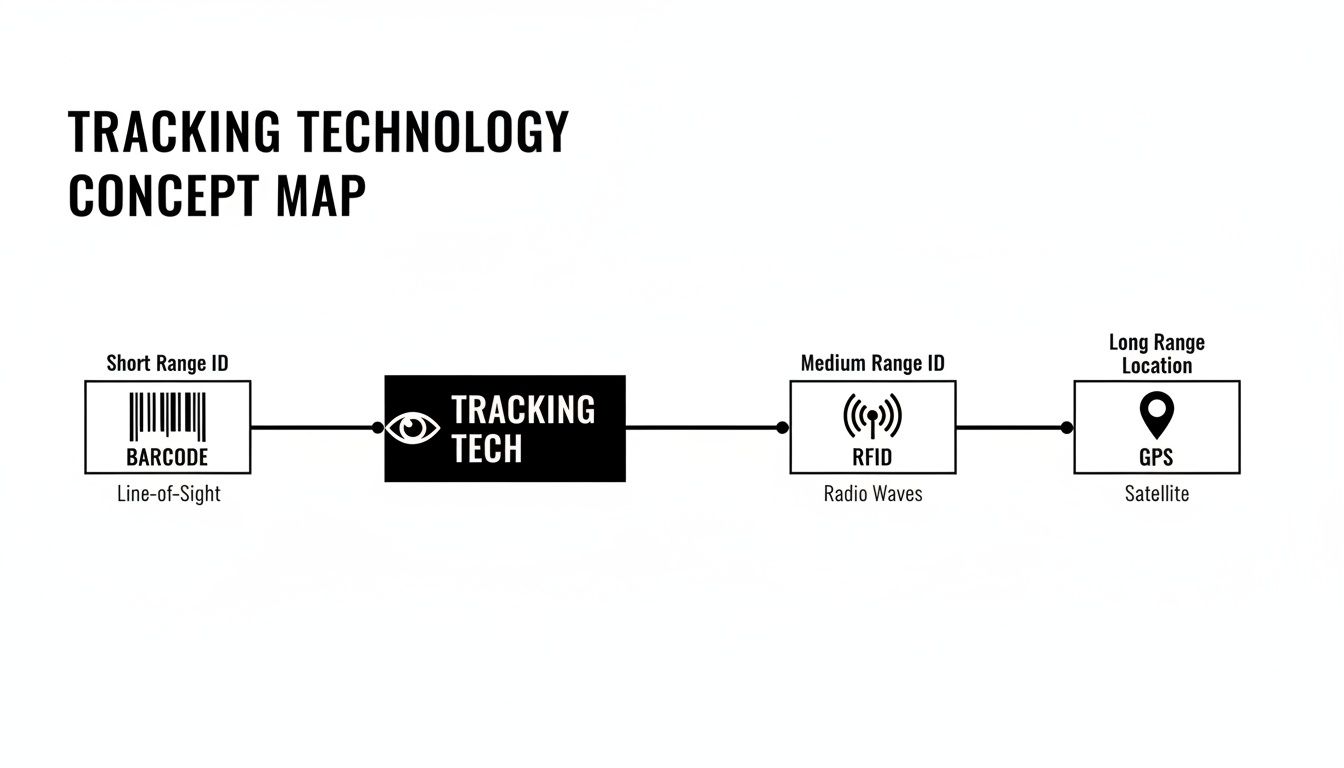
As you can see, each technology plays a specific role, capturing data points at different stages. This information is then all brought together to build that complete, end-to-end tracking history.
A universal tracker’s greatest strength is its ability to create a "single source of truth." By combining data from every logistics partner into one timeline, it eliminates confusion and provides a reliable, comprehensive view that neither the shipper nor the customer could assemble on their own.
The Benefits of a Unified View
This unified approach brings huge advantages for everyone, from online shoppers to large e-commerce businesses. For anyone managing shipments, a tool like a universal package tracker can simplify operations immensely.
The main benefits really boil down to three things:
- Reduced Customer Confusion: Customers no longer have to figure out which carrier's website to check. They get one link and one clear timeline, which massively improves their post-purchase experience.
- Fewer Support Inquiries: Businesses see a major drop in "Where Is My Order?" (WISMO) tickets because customers have the answers themselves. This frees up support teams to focus on more complex problems.
- Proactive Problem Solving: With a complete view of the journey, businesses can spot potential delays—like a package stuck in customs for too long—and take action before the customer even knows there’s an issue.
Ultimately, by translating the complex, multi-layered process of international shipping into a simple, linear story, universal tracking platforms deliver the clarity and control that modern commerce demands. They turn chaotic data into actionable intelligence.
Solving the Toughest Hurdles in International Shipping
Even with all the tech in the world, international shipping can sometimes feel like a total black box. A package leaves the warehouse, then… silence. The tracking status freezes for days. Customers get nervous, support tickets start flooding in, and a simple delivery turns into a headache for everyone.
These frustrating gaps aren't just bad luck; they’re baked into the very nature of sending a parcel across multiple borders, carriers, and customs agencies. But once you understand what causes these common pain points, you can start to fix them.
Let’s pull back the curtain on the most frequent challenges and see why they really happen.
The Carrier Handoff Blackout
One of the most maddening issues is the "tracking blackout." This is what happens when your package moves from one carrier to another—say, from an international courier like FedEx to a local country’s postal service. For a little while, the parcel seems to vanish into a digital blind spot.
Think of it like a relay race. For a split second, as the baton is passed from one runner to the next, it’s not really in anyone’s hand. It’s just in the air. That’s your package’s data during a handoff. The first carrier’s updates have stopped, but the second carrier hasn’t scanned it into their system yet.
This blackout can last a few hours or even a few days, creating a real nail-biter for the person waiting for the delivery.
Unpacking the Customs Black Box
Customs clearance is another place where packages seem to fall off the map. When a parcel enters a new country, it hits a wall of regulations, and the tracking often stalls on a vague status like "Held at Customs" with no timeline for release.
Why does this happen? It could be any number of things:
- Paperwork problems: A tiny error on a customs form can stop a shipment in its tracks.
- Big backlogs: During busy seasons, customs offices get swamped, and packages end up in a long queue.
- Random checks: Sometimes, a package is just pulled for a random physical inspection, which adds unexpected delays.
Inside this customs "black box," the package is completely out of the carrier's hands. They can't give you any real updates until the authorities officially clear it and hand it back.
The real problem with both carrier handoffs and customs delays is a breakdown in communication. Each organization has its own system, and the moments where a package transitions between them are where visibility disappears and customer anxiety skyrockets.
Navigating Time Zones and Last-Mile Confusion
Beyond those big blackouts, other little things can muddy the waters. Simple time zone differences can make tracking updates confusing. A package might be scanned as "Departed Facility" on Tuesday morning local time, but it still shows as Monday evening for the recipient. It can make the timeline look like it’s going backward.
Then there's the last mile in a foreign country, which brings its own chaos. A failed delivery attempt is ten times more stressful when you’re dealing with language barriers and unfamiliar address formats. A status like "Delivery Attempted" is frustrating for a customer who has no idea how to arrange a redelivery with a postal service they've never heard of. You can get more practical advice in our guide on how to track international packages.
Modern supply chains also face a growing list of outside pressures that directly impact deliveries. We're talking about everything from new cybersecurity threats and climate disruptions to complex trade rules and labor shortages. These factors just add more uncertainty, making reliable end-to-end tracking more essential than ever. A universal tracker helps cut through this noise by giving you one clear, consistent view of the entire journey.
It's clear that tracking a package across the globe is full of potential pitfalls. Here’s a quick breakdown of these common issues and how a centralized tracking platform can make a real difference.
Common Tracking Challenges and Their Solutions
| Challenge | Why It Happens | How a Universal Tracker Helps |
|---|---|---|
| Data Gaps at Handoffs | The original carrier stops tracking before the new carrier starts. The two systems don't sync in real-time. | Aggregates data from both carriers, creating a seamless timeline and filling in the "blackout" period faster. |
| Vague Customs Statuses | Customs is a government process, separate from the carrier. Updates are often generic and infrequent. | Provides standardized, easy-to-understand statuses and can sometimes pull more detailed event data if available. |
| Inconsistent Status Terms | Each carrier uses its own terminology (e.g., "Out for Delivery" vs. "On-Board for Delivery"). | Normalizes all carrier data into a single, consistent set of statuses, so "In Transit" means the same thing every time. |
| Time Zone Confusion | Events are logged in the local time of the scan, which can be confusing for the recipient in a different time zone. | Displays all tracking events in the user's local time zone, creating a logical, easy-to-follow timeline. |
| Last-Mile Communication | The final delivery carrier may be a local postal service with a separate tracking system and language. | Integrates with thousands of last-mile carriers, providing visibility all the way to the final delivery confirmation. |
Ultimately, a universal tracking system acts as a translator and a bridge, connecting all the disconnected pieces of a package’s journey into one coherent story for you and your customers.
Actionable Strategies for Businesses and Support Teams
Simply having access to global logistics tracking data is one thing. Turning that information into a real competitive edge is another thing entirely. For businesses and their support teams, this means ditching the reactive "wait and see" mindset and adopting a proactive strategy that sharpens operations and keeps customers happy.
This shift begins by focusing on what actually moves the needle. Instead of drowning in an ocean of data points, smart businesses identify and watch the key performance indicators (KPIs) that directly affect their bottom line and customer experience.
Key Performance Indicators That Matter
When you track the right metrics, you can spot the weak links in your shipping chain and accurately measure the results of any changes you implement. For companies aiming to dial in their global logistics, a solid grasp of core asset tracking best practices is the foundation for building any efficient strategy.
Here are a few essential KPIs you should be watching:
- Average Time in Transit: This is the total clock time from when a package leaves your hands to when it reaches the customer's door. Tracking this by country or carrier quickly reveals which shipping lanes are speedy and which are sluggish, helping you set delivery expectations you can actually meet.
- Customs Clearance Duration: How long are your packages sitting in customs for a particular country? If this number suddenly jumps, it’s a red flag that you might have a documentation problem or need to get up to speed on new regulations.
- Delivery Exception Rate: This KPI tracks the percentage of shipments that hit a snag, like a failed delivery attempt or damage. A high rate is a clear sign of last-mile carrier issues that demand your attention.
Watching these metrics is how you turn raw tracking data into real business intelligence. It empowers you to make better choices about which carriers to trust, how to price international shipping, and where to focus your energy for improvement.
Creating a World-Class Post-Purchase Experience
In today's market, the customer journey doesn't stop at the checkout button—it stretches all the way to the final delivery. Offering a proactive, transparent post-purchase experience is one of the most powerful ways to build lasting brand loyalty. The numbers don't lie: an overwhelming majority of customers—often over 90%—expect to be able to track their orders from start to finish.
This is where a centralized platform for global logistics tracking becomes a game-changer. It gives you the power to create a branded, self-service experience that keeps customers in the loop and eases their anxiety.
By providing a single, easy-to-use tracking page with your own branding, you keep customers on your website instead of sending them to third-party carrier sites. This reinforces your brand and creates new opportunities for engagement.
Think about putting these strategies into action:
- Branded Tracking Pages: Build a custom tracking page that lives on your own domain. It should deliver the same clear, standardized updates as a universal tracker but wrapped in your brand’s familiar look and feel.
- Proactive Email and SMS Notifications: Don't make customers come to you for updates. Set up automated alerts for key milestones like "Shipped," "Cleared Customs," and "Out for Delivery." This kind of proactive communication builds trust and shows you're on top of things.
Empowering Your Customer Support Team
For any customer support agent, the most common question is, "Where Is My Order?" (WISMO). Every single WISMO ticket costs time and money to resolve. A unified global tracking platform is your support team's best defense against this relentless wave of inquiries.
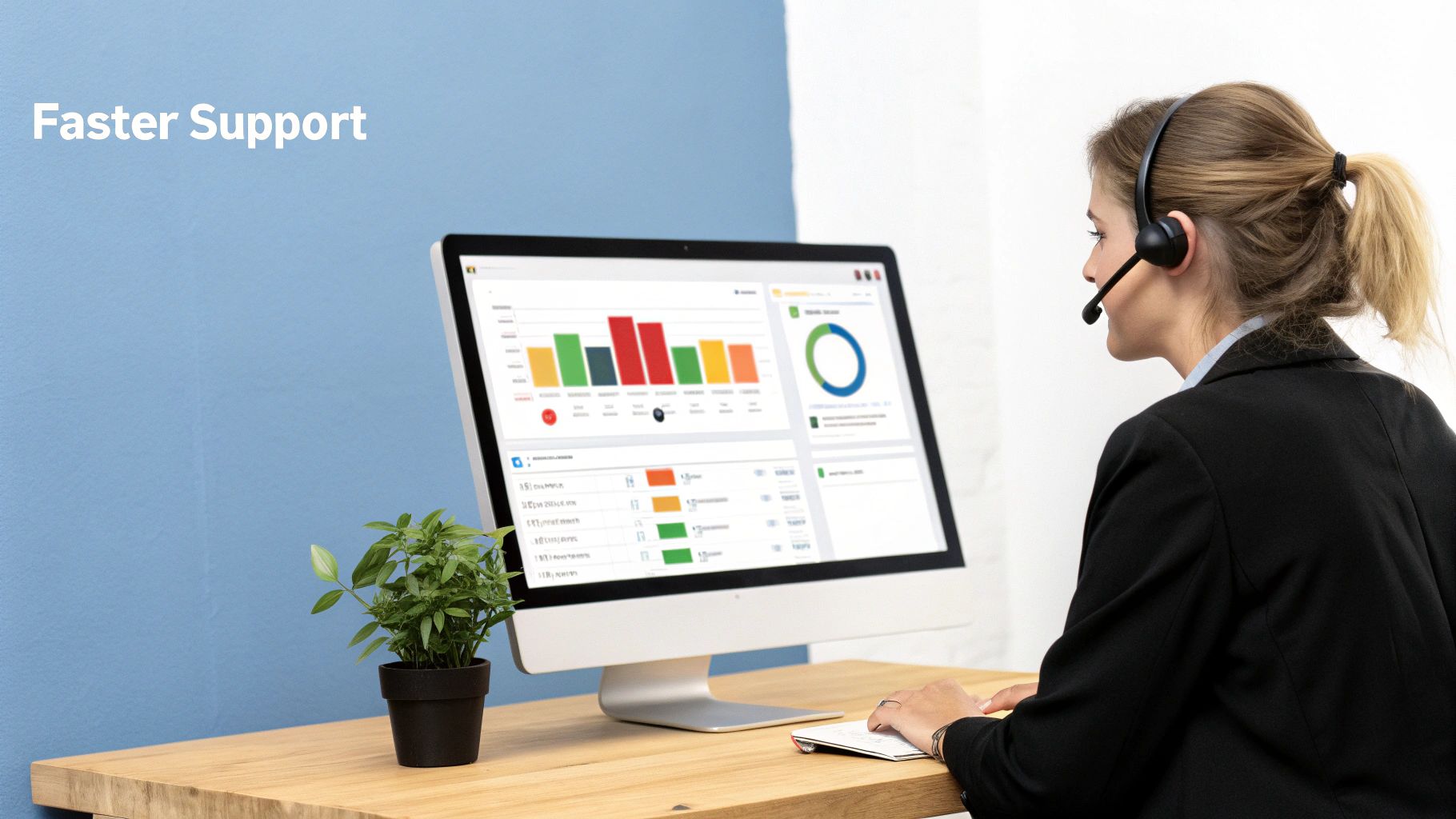
When an agent has a single dashboard showing the complete, end-to-end journey of every shipment, they can provide fast, confident answers. No more juggling multiple carrier websites or trying to decipher vague tracking statuses. This efficiency doesn't just slash resolution times; it also boosts customer confidence, because they get a clear, correct answer the first time they ask.
Your Practical Global Tracking Implementation Plan
Knowing you need global tracking is one thing; actually putting a system in place is another. It can feel like a huge undertaking, but breaking it down into a clear, step-by-step plan makes it entirely manageable. The real goal here isn't just to see where your packages are. It's to build a system that makes your customers happier and your support team's life easier.
This whole process kicks off with an honest look at how you're operating right now. Who are you shipping with? Where are the frustrating blind spots in your delivery chain? Answering these tough questions is the first step. From there, you can pick the right tools and build the automated workflows that save you time and stop customer headaches before they start.
Step 1: Lay the Groundwork
Before you can build something better, you need a solid blueprint of what you're working with. Think of this as a foundational audit—it's what ensures the solution you choose solves your actual problems, not just the ones you think you have.
Audit Your Current Carriers: Get a complete list of every single shipping partner you use for international orders. Note which regions they cover, how they typically perform, and most importantly, where you consistently lose visibility during the shipping journey.
Map the Customer Journey: Walk through the entire experience from your customer's perspective, from the moment they click "buy" to when the package lands on their doorstep. Identify every single point where they'd want a tracking update and pinpoint where your current process lets them down.
Define Your Goals: What does success look like for you? Is it cutting those "Where Is My Order?" tickets by 50%? Or maybe it's boosting your customer satisfaction score by being radically transparent about delivery times. You need to set clear, measurable targets.
Step 2: Choose and Configure Your Platform
With your goals locked in, it's time to choose the tech that will serve as the central hub for all your tracking data. This platform needs to be the single source of truth for both your internal team and your customers, making a complex process feel simple.
The platform you pick is critical. A universal tracker like Instant Parcels is built to pull data from thousands of carriers across the globe, consolidating everything into one clean interface. You'll want a solution that plugs right into your e-commerce store—whether it’s Shopify, WooCommerce, or Magento—to grab order info automatically.
Once you've chosen your platform, the next move is to get your automated notifications set up.
The best tracking systems are proactive. Don't make the customer come looking for an update—send it to them automatically when it matters most.
Configure email or SMS alerts for these key moments:
- Order Shipped: The first "it's on its way!" confirmation that gets things started.
- In Customs: A crucial update that helps manage expectations around a common delay point.
- Out for Delivery: The final heads-up that builds excitement and ensures someone is home to get the package.
Step 3: Empower Your Team and Launch
The final piece of the puzzle is all about your people. A brilliant system is only as effective as the team using it. The right training will empower your customer support agents to use the full capabilities of the platform to give customers fast, accurate answers.
Show your agents how to use the central dashboard to look up any order and instantly see its complete, end-to-end history. This simple skill equips them to resolve an inquiry in seconds, turning a potential customer complaint into a genuinely positive interaction.
Case Study in Action: An online store selling handcrafted goods was drowning in support tickets about international shipments. After bringing in a universal tracking platform and switching on proactive notifications, they slashed their WISMO inquiries by nearly half in just three months. Their support team was finally free to handle more complex issues, and their customer satisfaction ratings got a serious bump. It’s a perfect example of how a well-executed tracking plan delivers real, tangible results.
Your Top Questions About Global Tracking, Answered
If you’ve ever shipped something internationally, you know it can feel a bit like a black box. Questions always pop up. Here are straightforward answers to some of the most common things people ask about global logistics tracking.
What's the Difference Between a Carrier and a Universal Tracker?
Think of a carrier's own tracker—like what you'd find on the FedEx or DHL website—as a specialist. It gives you incredibly detailed information, but only for the part of the journey they handle. The moment that package gets handed off to a local postal service in another country, the trail goes cold.
A universal tracker like Instant Parcels is more like a general contractor for your package's journey. It pulls together data from all the different specialists (carriers, postal services, etc.) into a single, easy-to-follow timeline. This completely eliminates the tracking blackouts that happen during handoffs.
Why Does My Tracking Status Seem Stuck on "In Transit"?
Seeing "In Transit" for days on end is probably the most common source of shipping anxiety. More often than not, it's completely normal, especially for international shipments. It usually means your package is on a long-haul journey, like sitting on a container ship crossing the Pacific or waiting in a cargo hold for the next flight.
Since there are no physical barcode scans happening mid-ocean or mid-air, the status won't update. It doesn't mean something is wrong; it just means your package is between major checkpoints. You'll see a new update as soon as it gets scanned at the next port or sorting hub.
How Can I Track a Package if I've Lost the Tracking Number?
This is a tough one, and the honest answer is you really can't. A tracking number acts like a unique passport for your shipment. Without it, logistics systems have no way to find your specific box among the millions they process every single day.
If you don't have the tracking number, your best bet is to go back to the source. Contact the sender or the online shop where you bought the item. They will have that number on record and can give it to you.
Can Global Tracking Tell Me Exactly When My Package Will Arrive?
While global tracking provides a pretty good estimated delivery date, it's crucial to remember that it is just an estimate. International shipping is full of moving parts and variables that can throw a wrench in the schedule.
Common reasons for unexpected delays include:
- Customs holdups: A package can get flagged for inspection, or the customs office might just be buried in paperwork.
- Weather problems: A big storm can easily ground flights or keep ships from leaving port.
- Logistical jams: High shipping volumes, especially around holidays, can create backlogs at sorting facilities.
Modern tracking systems are getting smarter about their predictions, but they can't see the future. The real power of tracking is in monitoring progress and getting alerts when things change, not in pinpointing an exact delivery minute.