
Universal Tracking Number Lookup: Track Any Package from All Carriers
Ever found yourself with a dozen browser tabs open, trying to track packages from USPS, FedEx, and DHL all at once? It’s a common frustration. A universal tracking number lookup is the simple, elegant solution to that chaos.
Think of it as a master key for all your shipments. Instead of jumping from one carrier’s website to another, you use a single search bar to find out where any of your packages are, at any time.
Why You Need a Single View for All Packages
Let's be real—juggling tracking numbers can feel like a part-time job. You’re constantly switching between sites, trying to decipher different status updates and delivery estimates. This disjointed process isn't just annoying; it creates real stress and wastes time, especially when you're waiting on multiple orders.

The Problem with Traditional Tracking
The heart of the issue is that every shipping company lives in its own world. A tracking number from Amazon Logistics is useless on the FedEx website, and a DHL number won't get you anywhere on the USPS portal. This forces you to play a frustrating guessing game, trying to remember which carrier is handling which delivery.
This constant back-and-forth impacts everyone in the e-commerce chain:
- Shoppers are left feeling anxious, never quite sure where their various orders are.
- Sellers get bogged down answering endless "Where is my order?" questions instead of focusing on growing their business.
- Support teams waste hours on repetitive tasks, manually hunting for tracking information across different carrier systems.
A universal tracking number lookup cuts through all that noise. It’s a single platform that brings every package—no matter the carrier—into one clean, simple view.
A tool like Instant Parcels completely changes the game. You just paste any tracking number into the search field and get immediate, easy-to-read updates. The technology instantly identifies the carrier, fetches the latest data, and presents it to you in a standardized format. It turns a frustrating chore into a simple, one-click task, bringing much-needed clarity and control back to the shipping experience.
How Universal Package Tracking Actually Works
So, how does a single search bar manage to make sense of tracking numbers from hundreds of different carriers? It's not quite magic, but it's close. Think of it like a master key that can unlock the tracking systems of virtually every shipping company on the planet. A universal tracking number lookup takes what could be a huge headache and boils it down to a simple, three-step process.
And in today's world, that's more important than ever. With a staggering 407 billion packages expected to ship this year alone—up from 380 billion last year—we're talking about more than a billion packages in transit every single day. This explosion in e-commerce creates a massive need for a simple, unified way to keep tabs on everything.
Step 1: Carrier Detection
The moment you paste a tracking number into a tool like Instant Parcels, it goes to work like a detective. The system instantly analyzes the number’s unique structure—its length, the mix of letters and numbers, and any special prefixes or patterns.
This initial identification happens in a flash because every carrier has its own signature format.
- USPS numbers are often just long strings of digits, like 94001...
- UPS tracking codes nearly always begin with "1Z".
- FedEx will use different formats depending on whether it's a Ground or Express shipment.
The system checks the format against a massive internal database of hundreds of global carriers and finds a match in milliseconds. If you're curious about these different formats, you can learn more about what is a tracking number in our deep-dive guide.
Step 2: Data Aggregation and Translation
Once the carrier is nailed down, the universal tracker plugs directly into that company's system using an Application Programming Interface (API). An API is basically a secure digital handshake that lets our system request the latest tracking information for your package. It pulls in all the raw data—every scan, location update, and status change—straight from the source.
But this raw data is often messy and full of confusing industry jargon. That brings us to the most important step: translation.
A universal lookup tool takes all that jumbled information and standardizes it. It translates cryptic carrier-speak like "Tendered to delivery agent" or "Clearance event" into plain English updates you can actually understand, like "Passed to local post office for delivery" or "Customs processing."
This last step is what makes it so powerful. Instead of trying to decipher multiple tracking sites, you get a single, clean, and reliable story of your package's journey, from the warehouse shelf to your front door.
Who Wins with Universal Tracking?
A universal tracking number lookup isn’t just a small convenience; it’s a genuine upgrade for anyone who ships or receives packages. It fundamentally changes the experience for everyone involved, from the customer waiting by the door to the business juggling hundreds of orders. This kind of tool cuts through the noise and turns what was once a confusing mess into a clear, simple process.
This shift couldn't come at a better time. The global parcel delivery market is already enormous, valued at USD 520.59 billion, and it's expected to rocket to USD 727.65 billion. E-commerce is the engine behind this growth, making up a massive 54.3% of that market. As more packages from more carriers fly around the globe, the need for a single, easy-to-use tracking system becomes essential. You can dive deeper into the numbers by reading the full analysis of the parcel delivery market boom.
For Online Shoppers: Peace of Mind
If you’ve ever bought something online, you know the drill. Is it FedEx? USPS? DHL? Instead of juggling bookmarks and trying to remember who’s shipping what, a universal tracker gives you one place to see everything.
- No More Guesswork: Forget trying to figure out which carrier is handling your package. Just pop the number in one search bar, and it does the heavy lifting for you.
- Less Waiting Anxiety: Seeing all your inbound packages on a single screen gives you a reassuring overview. It’s a simple way to quiet that little voice asking, "Where's my stuff?"
- A Real Time-Saver: You can check on every single order in seconds. No more bouncing between different carrier websites just to get an update.
For E-commerce Sellers: A Business Multiplier
For anyone running an online store—especially dropshippers or high-volume sellers—the "Where Is My Order?" (WISMO) question is a constant headache. It’s a huge time sink. A universal lookup tool is one of the best ways to fight back.
When you give your customers a simple, reliable tracking link from a service like Instant Parcels, you’re empowering them to get answers on their own. This self-service approach dramatically cuts down on support tickets. Suddenly, your team is free to focus on what actually grows the business—sales, marketing, and product development—instead of answering the same tracking questions over and over.
The real win for sellers is getting their time back. Every minute you don't spend manually tracking down a package is a minute you can reinvest in activities that actually make money.
For Customer Support Teams: Ultimate Efficiency
Customer support agents know the pain of manual tracking better than anyone. Digging through multiple carrier websites to solve one customer's issue is slow, frustrating, and a recipe for burnout. This is where a universal tool completely changes the game.
With a unified dashboard, an agent can paste in any tracking number and get an instant, easy-to-read status update. This means they can give faster, more accurate answers, solve problems on the first try, and handle more inquiries throughout the day. The end result is a much smoother support operation and, most importantly, much happier customers.
The table below shows just how different the workflow becomes.
Manual Tracking vs. Universal Lookup: A Comparison
The difference between the old, manual approach and using a universal lookup tool is night and day. One is a frustrating time-waster, while the other is built for speed and clarity.
| Task | The Old Way (Manual Tracking) | The New Way (Universal Lookup) |
|---|---|---|
| Finding Status | Search through emails to find the carrier, then go to the carrier's website. | Paste any tracking number into one search bar. |
| Handling Inquiries | Manually look up each customer's order on the correct carrier website. | Instantly pull up standardized tracking history for any order. |
| Efficiency | High time consumption per ticket, leading to agent burnout and long waits. | Drastically reduced resolution time, boosting agent productivity. |
Ultimately, a universal lookup tool helps everyone work smarter, not harder. It’s a simple change that delivers a massive improvement in efficiency and customer satisfaction.
Your Practical Guide to Tracking Any Package
Okay, theory is great, but let's get practical. This is where a universal tracking number lookup really shines—turning what used to be a frustrating hunt across different websites into one simple action.
First things first, you need your tracking number. This part is usually easy. Just check your email for a shipping confirmation from the retailer. The tracking number will be the long string of letters and numbers they sent you.
Got the number? The rest is a piece of cake.
How to Use the Universal Tracker
A tool like Instant Parcels is built to be dead simple. You don't have to play detective trying to figure out if it's a FedEx or a USPS number. The system does all the heavy lifting for you.
Here’s how it works in three quick steps:
- Copy Your Number: Just highlight the full tracking number from your email or the store's order page and copy it.
- Paste and Search: Head over to the universal tracker and paste that number right into the search bar.
- Get Instant Results: Hit the "Track" button. The system instantly figures out the carrier and pulls up the complete tracking history.
That's it. In a few seconds, you’ll have a clean, easy-to-read summary of your package’s journey. You'll see its current status—like "In Transit" or "Out for Delivery"—along with a detailed log of every scan and location update. It also shows you the latest estimated delivery date the carrier has provided.
Going Beyond a Single Search
A really good universal tracker offers more than just a one-off search. It gives you tools to manage everything, which is a lifesaver for online sellers or anyone juggling a bunch of different orders. Checking out the best package tracking app can open your eyes to just how much easier logistics can get.
The real goal of a universal tracker isn't just to find a package. It's to create a single, reliable source of information that you can trust and easily share. This simple change saves a surprising amount of time and cuts down on a lot of stress for everyone.
For instance, most platforms let you save or "watch" your most important shipments. They're added to a personal dashboard, so you can check in on them anytime without having to dig up the tracking number again.
Another killer feature? One-click sharing. Instead of sending a customer or a family member a confusing link to a carrier's clunky website, you can send them a direct link to the clean, universal tracking page. This guarantees everyone is looking at the same clear information, solving a huge communication headache for businesses.
Decoding Confusing Shipping Statuses
Let's be honest, one of the most frustrating parts of tracking a package is trying to figure out what the carrier's updates actually mean. What one company calls "In Transit," another might list as "Shipment on the Way." A universal tracking number lookup helps cut through this noise by standardizing the statuses, but it’s still incredibly useful to know the lingo. Think of this as your personal translator for the world of shipping.
The whole idea is to take a complicated process and make it simple for you: just find the number, paste it in, and get your updates.
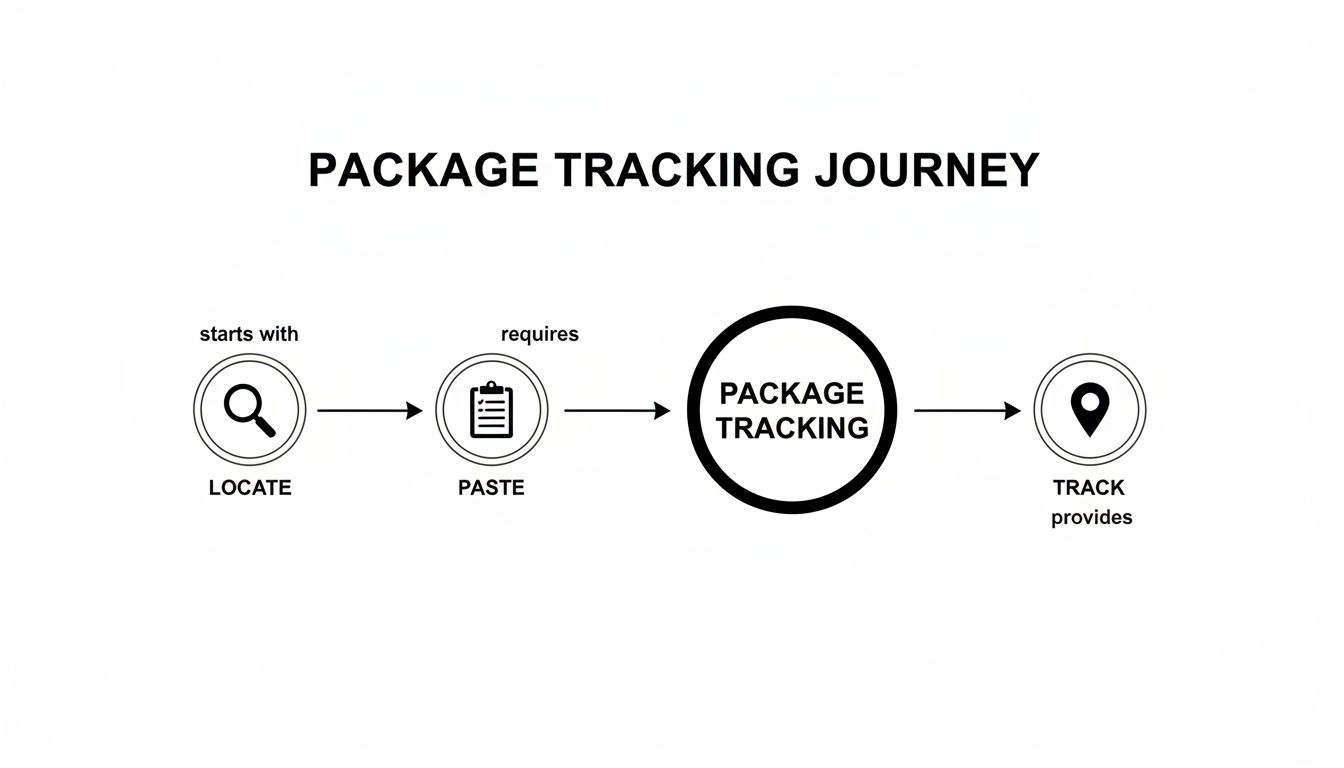
This process boils everything down to a few simple steps, making sure anyone can see where their package is without needing to be a logistics expert.
Common Statuses and What They Really Mean
Let’s break down some of the most common—and commonly misunderstood—updates you'll run into. Knowing what these mean will give you a much clearer picture of your package's journey, no matter who's handling it.
1. In Transit
This is the big one. It's the most frequent status you'll see, and it can feel frustratingly vague. "In Transit" just means your package is on the move somewhere within the carrier's network. It could be on a truck, a plane, or sitting in a sorting facility between cities.
- The real story: The package has left its starting point but hasn't made it to the local facility that will handle the final delivery.
- How carriers say it: FedEx usually sticks with a simple "In transit," while you might see USPS use "In Transit to Next Facility." For a deeper dive, check out our guide on what does "In Transit" mean.
2. Out for Delivery
This is the update everyone waits for! It means your package has been loaded onto the final delivery truck and should be arriving at your doorstep sometime today.
- The real story: Your package is physically on the local delivery truck making its way through your neighborhood.
- How carriers say it: Thankfully, this one is pretty consistent. UPS, FedEx, and USPS all tend to use the phrase "Out for Delivery."
3. Tendered to Postal Service / Final Delivery Agent
You’ll see this status pop up a lot with hybrid services like FedEx SmartPost or UPS SurePost. In these cases, the main carrier handles the long-haul journey, then hands the package off to your local post office (USPS) for the final stretch to your home.
- The real story: A private carrier like FedEx has done its part. Now, your local postal worker is in charge of bringing it to you.
- How carriers say it: Look for terms like "Tendered to USPS," "Handed Over to Final Mile Carrier," or sometimes "Inducted into Pitney Bowes Network."
Keep in mind that once a package is passed to the postal service, the original tracking number should still work on the USPS site. It might just take a few hours for their system to show the new updates.
Navigating International Shipping Terms
When a package has to cross a border, the tracking updates can get a whole lot more confusing. Here are two critical ones you'll definitely want to know.
4. Clearance Event / Customs Processing
This status means your package has arrived in the destination country and is being looked over by customs officials. It’s a completely normal part of the process where they check the package's contents, verify the paperwork, and assess any duties.
- The real story: Your package is being held at the border for a standard inspection. Delays here are pretty common, especially if paperwork is missing or if there are taxes or duties to be paid.
- How carriers say it: DHL often uses "Clearance event," but you might also see "Held at Customs" or "Processing at Border Facility" from other international couriers.
Solving Common Package Tracking Problems
Even with a great universal tracking tool, things can still get a little weird sometimes. Most tracking issues are small bumps in the road that sort themselves out, but knowing what’s going on can save you a lot of unnecessary worry.
Let's walk through a few of the most common tracking headaches and what to do about them.
Tracking Number Not Found
This is easily the most frequent hiccup, and thankfully, it’s almost always a simple fix. Before you start to worry that your order has vanished into thin air, check these things first.
Timing Is Everything: After a shipping label is created, it can take a full 24-48 hours for that new tracking number to get logged into the carrier's system. If you just got the shipping confirmation email, the best thing to do is just give it a day.
A Simple Typo: It happens to everyone. Go back and double-check the number you copied. It’s incredibly easy to miss a digit or mistake a "0" for an "O." Try copying and pasting it one more time, carefully.
Wrong Carrier Selected: A universal tracker like Instant Parcels figures out the carrier for you, but if you're checking manually on a carrier's website, this is a common mistake. You can't plug a UPS number into the USPS site and expect it to work.
Status Is Stuck In Transit
Staring at the same "In Transit" update for days on end can be unnerving, but it’s rarely a reason to sound the alarm.
Usually, this just means your package is on a long trip between major sorting facilities—think a cross-country truck or cargo flight. It simply isn't getting scanned at every little stop along the way. Delays can also pop up from bad weather, a massive surge in packages (especially around the holidays), or routine customs checks for international orders.
If the status hasn't budged in over 5-7 business days, then it might be a good time to reach out to the seller to see if they have any more details.
The key is patience. A lack of new scans doesn’t mean your package is lost; it often just means it's moving between points where scans occur.
Delivered But Not Received
Okay, this one is definitely the most stressful alert to get. But don't panic just yet.
First, do a thorough check around your property. Delivery drivers can get creative and sometimes leave packages in a "safe" spot like behind a planter or under a porch chair. It's also worth asking family members or neighbors if they might have grabbed it for you.
Occasionally, a carrier will scan a package as "Delivered" a few hours before it physically arrives at your door to stay on schedule. If it’s still not there by the end of the day, that's your cue to contact the seller or the carrier to start an official search.
Beyond general tracking, resolving specific issues often requires additional support. For AI-driven assistance with common package tracking problems or interpreting confusing statuses, consider exploring AI support solutions from supportgpt.
Got Questions About Universal Tracking? We've Got Answers.
Even after you've got the basics down, a few questions always pop up when you start using a universal tracking tool. Let's tackle some of the most common ones we hear.
How Does the Tool Magically Know Which Carrier I'm Using?
It's not magic, but it is clever. Every carrier designs its tracking numbers with a unique format—a specific length, a certain combination of letters and numbers, or a special prefix. Think of it like a postal code for packages.
A universal tracker instantly scans the number you enter and compares its pattern against a massive, constantly updated database of hundreds of global carriers. This pattern recognition allows it to pinpoint the correct carrier in a split second, saving you the guesswork.
Is My Tracking Information Safe on These Sites?
Yes, your privacy is a top priority for any trustworthy tracking platform. These tools use secure HTTPS connections to pull tracking information directly from the official carrier websites.
The key thing to remember is that they only fetch and display the public tracking data. They don't store any of your personal information, so your name, address, and order details remain completely separate and confidential.
A universal tracker is simply a window into the carrier's public data—it doesn't collect or store any private information about you or your order.
Can I Really Use This for International Packages?
Absolutely! In fact, this is where a universal tracking number lookup truly shines. If you've ever ordered something from overseas, you know how confusing it can be when a package switches from a carrier like Cainiao or Yanwen to your local postal service.
Universal trackers are built for this. They connect the dots between different international and local couriers, giving you a single, clear view of your shipment's entire journey from a warehouse on the other side of the world right to your doorstep.