
A Guide to Universal Package Tracking Services
If you've ever found yourself juggling a dozen browser tabs just to keep an eye on different shipments, you know the frustration. One tab for FedEx, another for DHL, while you frantically search your inbox for that lost USPS tracking link. Each carrier's website has its own quirks and status updates, making the simple question "Where's my package?" surprisingly hard to answer.
This scattered approach is a huge time-waster for shoppers and a logistical nightmare for e-commerce businesses.
A universal package tracking service is the antidote to this chaos. Think of it less like a single key and more like a master key for all things shipping. It’s a single platform that brings together tracking information from hundreds of different couriers into one clean, simple dashboard.
Essentially, it works like a financial aggregator app (think Mint or Personal Capital) but for your packages. Instead of logging into multiple bank accounts to see your whole financial picture, you see it all in one place. These tracking platforms do the same thing by tapping into the APIs of carriers worldwide, pulling all that disparate data into one unified interface.
The benefits become clear almost immediately:
- One Dashboard to Rule Them All: See the real-time status of every shipment, no matter who's delivering it, on a single screen.
- Stop Wasting Time: No more bouncing between different carrier websites just to check on your orders.
- Clear and Simple Updates: Share tracking information with customers or family members without sending them a bunch of confusing links.
The growing need for this kind of clarity is reshaping the logistics industry. The 'Tracking as a Service' market is expected to balloon from USD 9.96 billion in 2025 to an astounding USD 41.55 billion by 2034. This isn't just slow growth; it's a massive shift away from clunky, single-carrier websites toward smarter, all-in-one solutions, as detailed in this in-depth market analysis on Precedenceresearch.com.
At its heart, a universal tracking service acts as a translator. It takes the complex, often jargon-filled language of global logistics and turns it into simple, human-readable updates. It weaves a clear story out of what would otherwise be a random jumble of tracking numbers.
By giving you a single search bar for every package, platforms like Instant Parcels provide an elegant solution to a very common problem. In this guide, we'll dig into how this technology actually works, who stands to benefit the most, and what you should look for when picking a service. You can get a head start and use a universal tracking number lookup to see just how much easier it can be.
How Universal Trackers Tame the Chaos of Global Shipping
Think of a universal package tracking service as a master translator for the world of shipping. It takes the jumbled mess of updates from countless different carriers and weaves them into a single, easy-to-follow story. This bit of magic happens through a clever three-step process that kicks in the moment you pop in a tracking number.
It all starts with automatic carrier detection. Every shipping company has its own unique format for tracking numbers—some are all numbers, others are a jumble of letters and digits. A universal tracker has been taught to recognize these patterns on sight, sort of like how a barcode scanner knows exactly what product it's looking at.
For instance, a 12-digit number is a dead giveaway for a standard FedEx Ground shipment, while a code beginning with "1Z" almost always points to UPS. This smart identification is the first crucial step, making sure your search gets pointed in the right direction from the get-go.
Pulling in Data from Every Corner of the Globe
Once the system knows which carrier has your package, it starts the data aggregation phase. Imagine a news app like Feedly or Apple News that pulls articles from hundreds of different sources into one clean feed. A universal tracker does the exact same thing, but for shipping data.
It connects directly to a carrier's Application Programming Interface (API), which is just a secure doorway for sharing information. The tracker uses this connection to pull all the latest details:
- Current Location: The last city, state, or sorting facility it passed through.
- Shipment Status: Is it on the move, out for delivery, or has it arrived?
- Delivery Estimates: The carrier's best guess for when it will show up.
This process takes the headache out of bouncing between multiple carrier websites and gives you one single place to get your answers. The diagram below shows how this technology turns a messy problem into a simple solution.
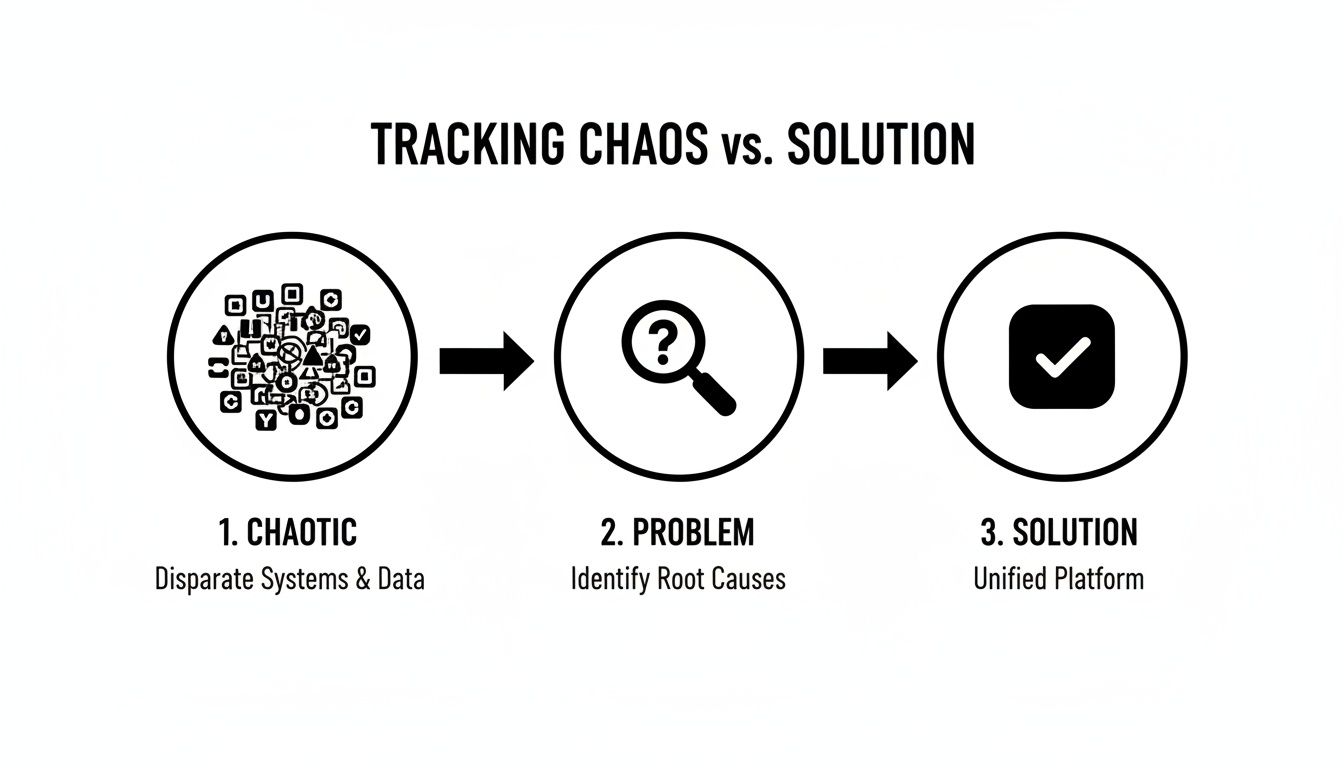
This really gets to the heart of what a universal service does: it takes all that tangled, confusing information from different systems and presents it through one clear, straightforward interface.
Turning confusing logistics-speak into plain English
The final step, and honestly the most helpful for most of us, is status standardization. Carriers love using technical jargon like "Departed Sort Facility" or "Inducted into Network." A good universal tracking service acts as your interpreter, translating these phrases into simple, everyday language.
Instead of you needing to decode what a "sort facility" even is, you get a clear, simple update. "Departed Sort Facility" might become "Your package is on its way," which tells you exactly what you need to know without any confusion.
This translation is a game-changer for international shipping, where your package gets passed between several different companies. If you're curious about the details, our guide on how to track international packages breaks it down further. By simplifying the language, these services make the entire shipping journey transparent and easy to follow from start to finish.
Key Benefits for Shoppers and Ecommerce Sellers
A universal package tracking service completely changes the post-purchase experience, turning what used to be an anxious waiting game into a clear and simple process. The payoff is huge for everyone. For customers, it's a breath of fresh air. For sellers, it's a game-changer for their operations.
What's In It for Shoppers?
For shoppers, the biggest win is pure convenience. Gone are the days of juggling a dozen browser tabs for different carrier websites or digging through old emails to find the right tracking number. Everything lives in one place. This single source of truth provides incredible peace of mind, especially when you've got orders coming from multiple stores that use a mix of couriers like FedEx, USPS, and DHL.
This isn't just a nice-to-have anymore; it's becoming a necessity. With the global parcel delivery market hitting USD 340 billion in 2022 and on track to reach USD 700 billion by 2030, the old way of doing things is breaking down. During the holiday rush, when order volumes can spike by 40%, trying to track packages manually is a recipe for frustration.
"Switching to a universal tracker saved me at least two hours a week. I went from manually checking a dozen carrier sites to just glancing at a single dashboard. It's a small change that had a huge impact on my workflow and freed me up to focus on growing my business."
Advantages for Ecommerce Sellers
For an ecommerce business, the benefits go way beyond simple convenience—they hit the bottom line. The operational boost is massive, especially when it comes to lightening the load on your customer support team.
The most immediate impact? A huge drop in "Where Is My Order?" (WISMO) calls and emails. When you give customers a single, user-friendly tracking page with clear, standardized updates, you’re answering their biggest question before they even have to ask. It's all about proactively updating customers on their order status, which builds trust right away.
Plus, this level of transparency after the sale makes for a far better customer experience. A smooth, predictable tracking process is a powerful way to build brand loyalty and keep people coming back. It’s a core part of a great post-purchase strategy, and you can learn more in our guide on how to improve the ecommerce customer experience.
Let's look at a quick side-by-side comparison to see just how different the two approaches are.
Traditional Tracking vs Universal Tracking Service
The old-school method of bouncing between carrier sites feels clunky and outdated compared to the streamlined experience of a universal service.
| Feature | Traditional Method (Multiple Websites) | Universal Tracking Service (Like Instant Parcels) |
|---|---|---|
| Visibility | Fragmented across different carrier sites, requiring multiple tabs and logins. | Centralized dashboard showing all shipments from all carriers in one view. |
| Customer Updates | Manual process of sharing different links; often leads to confusion. | Automated notifications and a single, shareable link for customers. |
| Efficiency | Time-consuming for both sellers managing shipments and shoppers checking statuses. | Drastically reduces time spent on tracking logistics for everyone involved. |
| Status Clarity | Inconsistent carrier jargon like "Inducted" or "Sort Facility Arrival." | Standardized, easy-to-understand statuses like "In Transit" or "Out for Delivery." |
As you can see, the shift to a universal platform isn't just an upgrade; it's a fundamental change in how both sellers and shoppers manage the delivery process.
Essential Features of a Great Tracking Service
Not all universal tracking platforms are created equal. When you're picking a service, you’re really choosing a central command center for all your shipping data. It's crucial to know what separates a good service from a great one.
Think of this as your buyer's guide—a checklist of must-haves to make sure you're getting a tool that actually simplifies your life, not one that just adds another layer of complexity.
With the explosion of global e-commerce, making the right choice is more important than ever. The courier, express, and parcel (CEP) market is expected to balloon from USD 724.98 billion in 2026 to a staggering USD 928.43 billion by 2031. This incredible volume just underscores why a reliable universal tracking service is no longer a nice-to-have—it's a necessity for managing the sheer flood of deliveries.
Core Functionality Checklist
Before you sign up for any service, make sure it nails these fundamentals. These are the bedrock features of a truly useful and dependable tracking experience, whether you're a casual shopper or a serious e-commerce seller.
A top-tier service must deliver on these points:
- Broad Carrier Support: What good is a "universal" tracker if it can't find your package? The platform has to work with hundreds of carriers, from global giants like FedEx and DHL to smaller, regional couriers and postal services.
- Real-Time Update Frequency: Your tracking data is only as good as it is fresh. The service needs to pull updates directly from carrier systems in real-time (or very close to it) so you always have the latest status.
- Intuitive User Interface: A cluttered or confusing dashboard completely defeats the purpose. The ideal platform is clean and simple, letting you find what you need in seconds with a single search bar for all your tracking numbers.
Advanced Capabilities for Power Users
Once you've covered the basics, a few advanced features can completely change your workflow and elevate the customer experience you provide. These capabilities turn a simple lookup tool into a powerful logistics hub, helping you get ahead of problems before they happen.
Look for these value-added features:
- Unified Multi-Package Dashboard: For anyone juggling multiple orders, the ability to add, save, and name all your shipments on one screen is an absolute game-changer.
- Customizable Notifications: Proactive updates are everything. A great service will let you set up custom alerts for specific status changes, like "Out for Delivery" or "Delivery Attempted," so you’re never caught off guard.
- Easy-to-Share Tracking Links: Sharing a package's progress with a customer or a family member should be effortless. The platform should generate one clean, simple link that shows them everything they need to know.
One powerful way to keep customers in the loop is through direct messaging. Exploring different Whatsapp automation features can give you a good idea of how a tracking service could push these crucial notifications right to a customer’s phone.
Key Takeaway: The best universal package tracking service does more than just show you data—it presents that data clearly and proactively. It should bring all your information together effortlessly, send timely alerts, and offer a user-friendly experience that saves you time and cuts down on stress. It's these core principles that platforms like Instant Parcels are built on.
Putting It All Together with Instant Parcels
It’s one thing to talk about universal package tracking in theory, but seeing it in action is where the lightbulb really goes on. Let’s walk through how a real-world solution like Instant Parcels takes these concepts and solves the shipping headaches that plague both sellers and their customers.
Picture this: you're an e-commerce seller who just sent out five different orders. Two are with FedEx, two are with USPS, and one international package is in the hands of DHL. The old way of doing things means you're now juggling three different carrier websites and five separate tracking numbers. It's a recipe for confusion and wasted time.
With Instant Parcels, you just copy and paste all five of those numbers into a single field. That's it.
A Single Hub for All Your Shipments
The system’s automatic carrier detection immediately figures out who has each package. You don’t have to tell it which one is FedEx, USPS, or DHL—it just knows by recognizing the unique format of each tracking number. This simple step alone gets rid of the guesswork and the typos that can send you down a rabbit hole.
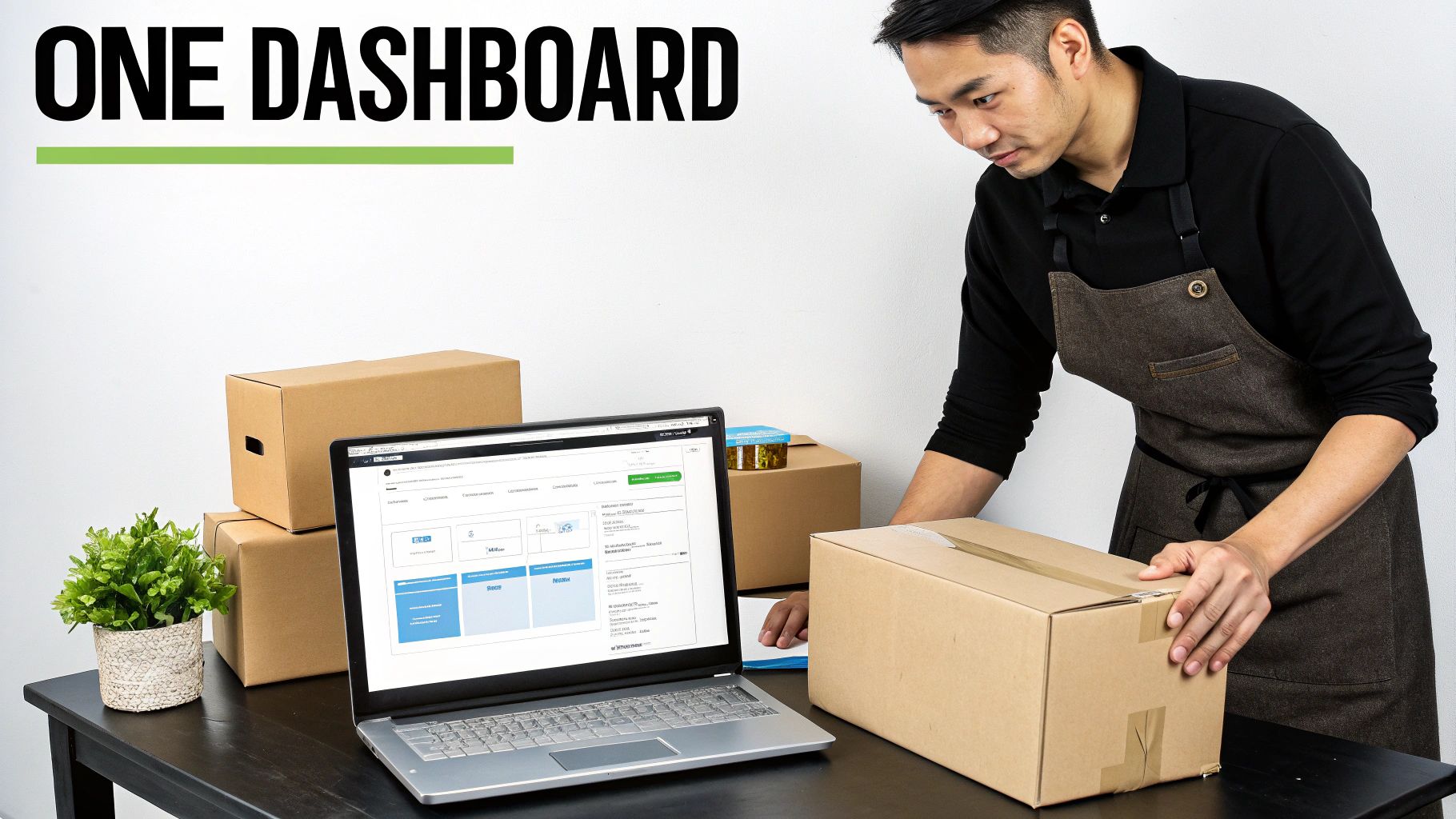
Instantly, all five of your shipments pop up on one clean, organized dashboard. Gone are the days of trying to decipher confusing carrier-specific jargon like "Inducted into Network." Instead, you see clear, standardized statuses like "In Transit" or "Out for Delivery" for every single order, giving you a complete overview of your logistics in a single glance.
The core promise of a universal package tracking service is to transform chaos into clarity. It consolidates scattered data points into a single, actionable dashboard, saving valuable time and reducing customer support inquiries.
This unified dashboard is the command center for your shipping operations, putting all the crucial information right where you need it.
Sharing Updates with Ease
Now, what happens when a customer emails asking, "Where's my order?" You no longer have to dig up the right tracking number and send them a clunky link to the carrier’s site.
Instead, you can generate a simple, shareable tracking link from Instant Parcels. This link gives your customer the same clear, standardized information you see, taking the confusion out of the equation for them, too.
This entire flow—from auto-detection to a unified dashboard and easy sharing—is what a great universal package tracking service does. It turns a frustrating, multi-step chore into a streamlined and efficient process, freeing you up to focus on growing your business.
Still Have Questions About Universal Tracking?
It's completely normal to have a few questions when you're looking at a new way of doing things. Moving away from juggling a dozen carrier websites to a single platform is a big shift, so let's clear up some of the common uncertainties. Think of this as your guide to feeling confident that a universal tracker is a secure, reliable, and genuinely useful tool for your shipping needs.
We'll walk through the big questions: accuracy, international shipping headaches, account needs, and, of course, data privacy.
How Accurate Are These Universal Tracking Services, Really?
This is usually the first question on everyone's mind, and for good reason. The good news is that top-tier services are incredibly accurate. They aren't just guessing where your package is; they're plugged directly into the source.
A platform like Instant Parcels connects straight to the official carrier APIs. That means the tracking update you see on the universal platform is the very same data the carrier is showing on its own site. The real magic isn't in creating new data, but in how a universal package tracking service organizes and presents it. It syncs in real-time, giving you the latest status without you having to hit refresh on three different browser tabs. You get the same accuracy as the carrier, but with a whole lot less hassle.
How Do They Handle Complicated International Shipments?
This is where a universal tracker truly proves its worth. International shipping can be a real mess. A package might start its journey with China Post, get handed off to USPS when it lands in the US, and then maybe even get passed to a smaller, local courier for the final delivery.
Trying to follow that chain of custody on your own is a nightmare. You're often left scrambling for new tracking numbers and trying to navigate websites in different languages.
A universal tracking service elegantly solves this problem by stitching the entire journey together into one cohesive story. It follows the package from the very first scan to the final signature, presenting a single, uninterrupted timeline. This end-to-end visibility turns a confusing, fragmented process into something clear and manageable, making global shipping feel almost as simple as sending a package across town.
It gets rid of the blind spots that happen during carrier handoffs, which is a massive relief for anyone buying or selling across borders.
Do I Need to Create an Account to Use a Universal Tracker?
For a quick, one-time check? Not usually. Most services let you pop a tracking number into a search bar and get an immediate update, no strings attached. It's perfect for when you just need to find out where that one specific package is right now.
But if you track packages regularly, creating a free account unlocks a bunch of features that make life so much easier.
- Your Personal Dashboard: An account saves all your active tracking numbers in one place. No more hunting through emails to find that number from two weeks ago.
- Give Them a Name: Instead of a long string of numbers, you can name your shipments things like "Dad's Birthday Present" or "Client Order #1254." It makes identifying what's what a breeze.
- Automatic Alerts: Why keep checking? Set up notifications to get a ping when your package is out for delivery or if there's an unexpected delay.
So, while an account isn't required for a quick lookup, it’s a game-changer for staying organized, whether you're an avid online shopper or a business owner.
Is My Personal Information Safe?
Yes, absolutely. Legitimate universal tracking platforms are built from the ground up with privacy in mind. The entire system is designed to work without ever needing your sensitive personal details.
The only piece of information the service needs is the tracking number. That number is completely anonymous; it doesn't contain your name, address, or credit card info. It's just an identifier for the package itself.
Platforms like Instant Parcels are lightweight tools focused solely on logistics data. They don't need to connect to your online store, access your email, or see your order history. The whole process is secure by design, so you can track your shipments with total peace of mind, knowing your personal data is never even part of the conversation.