
What Is Delivery Confirmation and How Does It Work?
Picture this: you've just shipped an important package. That sigh of relief you breathe when you see it's been delivered? That's what delivery confirmation is all about. It's the carrier's official nod, a digital stamp of approval, confirming your package has finished its journey and is safely at its destination.
It’s not just another blip on the tracking screen—it’s the final, definitive word that the job is done.
What Is Delivery Confirmation Explained
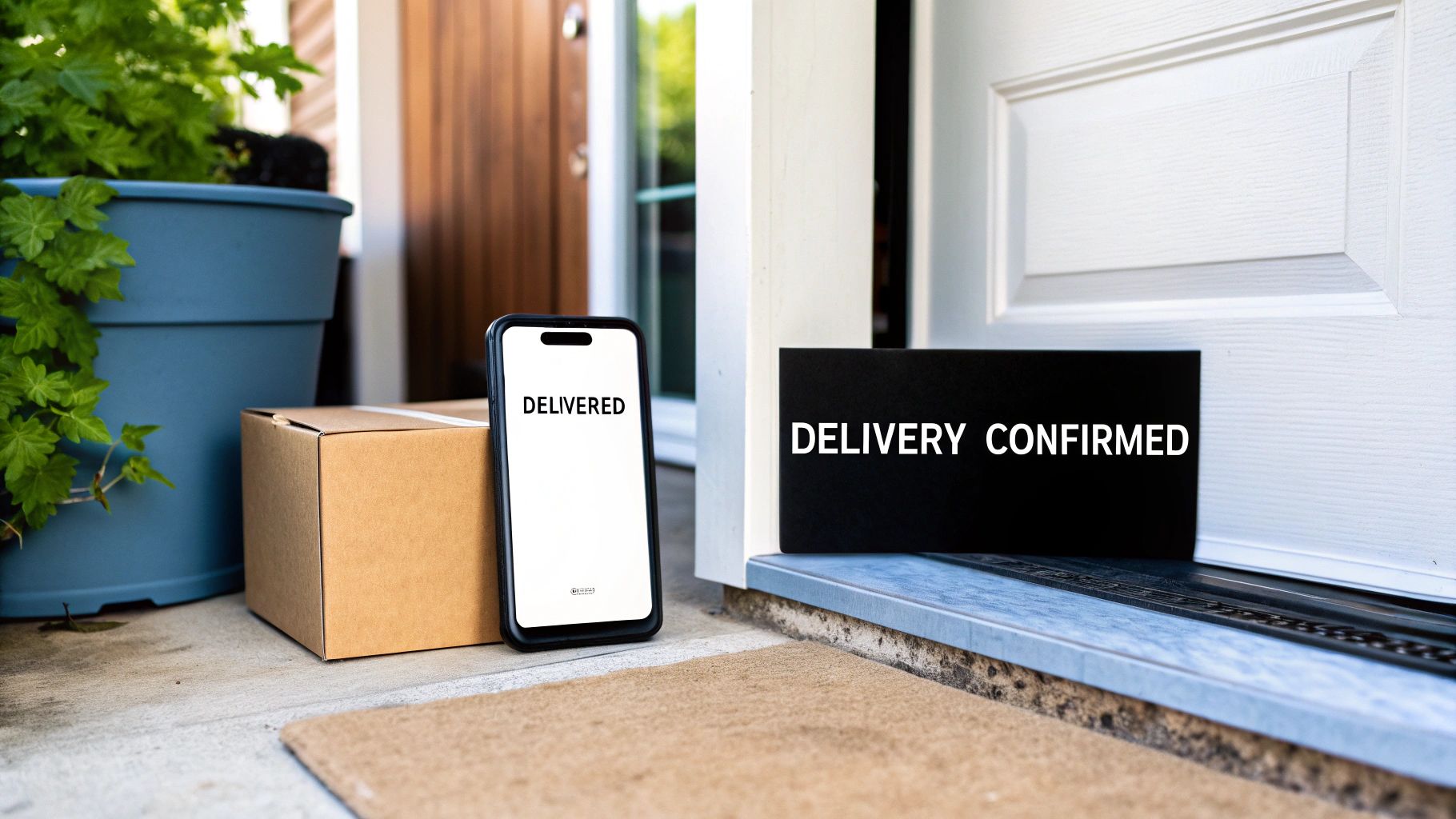
Think of delivery confirmation like the receipt you get from a store. A standard receipt proves you paid, while a delivery confirmation proves the carrier handed off the package. It's the official close to the shipping loop.
But it’s more than a simple "delivered" status. A true confirmation is backed by a specific set of data points, creating a formal record of the event.
Key Details in a Delivery Confirmation
At its heart, this service is all about providing clear, verifiable proof of that final step. The exact details might look a little different depending on whether you're using USPS, FedEx, or UPS, but a solid delivery confirmation will almost always include:
- Final Delivery Date: The specific day the package arrived.
- Final Delivery Time: A timestamp, often down to the minute, marking the moment it was dropped off.
- Delivery Location: Details about where it was left, like "Front Door," "Mailbox," or "With Receptionist."
These three simple facts take the abstract idea of a "delivered" package and turn it into a concrete, documented moment. For both the person sending the package and the one waiting for it, that information is gold.
For an e-commerce seller, delivery confirmation is your key piece of evidence. It's the proof you need to show you fulfilled your promise to the customer, protecting you from disputes and building trust.
Why This Final Step Matters
So, why does this matter so much? It’s not just about satisfying curiosity. This final confirmation is a cornerstone of trust in the world of online shopping and shipping.
For the customer eagerly tracking their order, it replaces anxiety with certainty. For the business that shipped the item, it's a vital defense against "item not received" claims, which can be costly and frustrating.
This is where platforms like Instant Parcels really shine. They pull all of these confirmations together from dozens of different carriers into one place. Instead of bouncing between tracking sites, you get a single, unified dashboard showing everything is where it should be. It streamlines a messy process, making it incredibly simple to verify that every single package has made it home.
How Delivery Confirmation Technology Works
Ever wonder how that "Delivered" notification pops up on your phone the second a package hits your porch? It’s not magic. It’s the final step in a surprisingly complex sequence of events that turns a physical drop-off into a digital thumbs-up. This whole process relies on a mix of rugged hardware, smart software, and constant communication that all come together in the final moments of your delivery.
It all begins with the handheld scanner in the delivery driver's hand. This isn't just a simple barcode reader; it's a powerful mobile computer. When the driver gets to your address, they perform the "final scan" on the package's label. This scan instantly reads the unique barcode tied to your shipment, which is directly linked to what a tracking number is and its journey through the system.
The Final Scan and Data Transmission
As soon as that barcode is scanned, the device does more than just register the time. These scanners are packed with technology. The built-in GPS immediately geotags the precise physical location of the scan, creating a digital pin on a map. This is a huge help in verifying the package was scanned at the right house and not two streets over.
The scanner then bundles up all this data—the tracking ID, the exact time, and the GPS coordinates—into a tiny data packet. This packet is zapped over a cellular network to the carrier's main servers almost instantly. If you're interested in the nuts and bolts of how this data integrity is maintained, the industry is moving toward more robust methods like server-side tracking for reliable data delivery to make sure nothing gets lost in translation.
Carrier Systems and Universal Translation
Here’s where it gets tricky for anyone trying to keep an eye on multiple packages. Every carrier, whether it's USPS, FedEx, or UPS, has its own internal system and its own way of saying "the package is there."
- USPS might give you a simple, "Delivered, In/At Mailbox."
- FedEx could get a bit more specific with "Delivered, Left at Front Door."
- UPS sometimes adds a human touch with notes like "Met Customer Woman."
The underlying technology is pretty much the same across the board, but the final language they use can be wildly different. This can be a real headache for both shoppers and online sellers who are trying to manage shipments from various companies at once.
A key challenge for e-commerce is the lack of a standardized language for delivery events. A 'drop-off' for one carrier might be a 'release' for another, making unified tracking difficult without a translation layer.
This is exactly the problem platforms like Instant Parcels were built to solve. We act as a universal translator. Our system takes in all those different status updates from hundreds of carriers and normalizes them into one consistent, easy-to-read format. So instead of trying to figure out what "Driver Release" means, you just see a clear and simple "Delivered"—no matter who dropped it off. It’s how we turn a tangled web of carrier data into a single, straightforward confirmation for you.
Decoding Delivery Confirmation vs. Proof of Delivery
When you're shipping a package, not all "confirmations" are created equal. A basic delivery confirmation gives you peace of mind, sure, but it's really just the starting point. To make the right call for your shipments, you need to understand how it stacks up against its more secure siblings: Proof of Delivery and Signature Confirmation.
Think of it like a staircase of security. Delivery confirmation is the first step—it's the fundamental electronic handshake that says a package has reached its destination. This digital record, complete with a time and date stamp, is often all you need for low-value items to keep customers in the loop.
The technology behind this is pretty straightforward, but it’s the backbone of modern logistics.
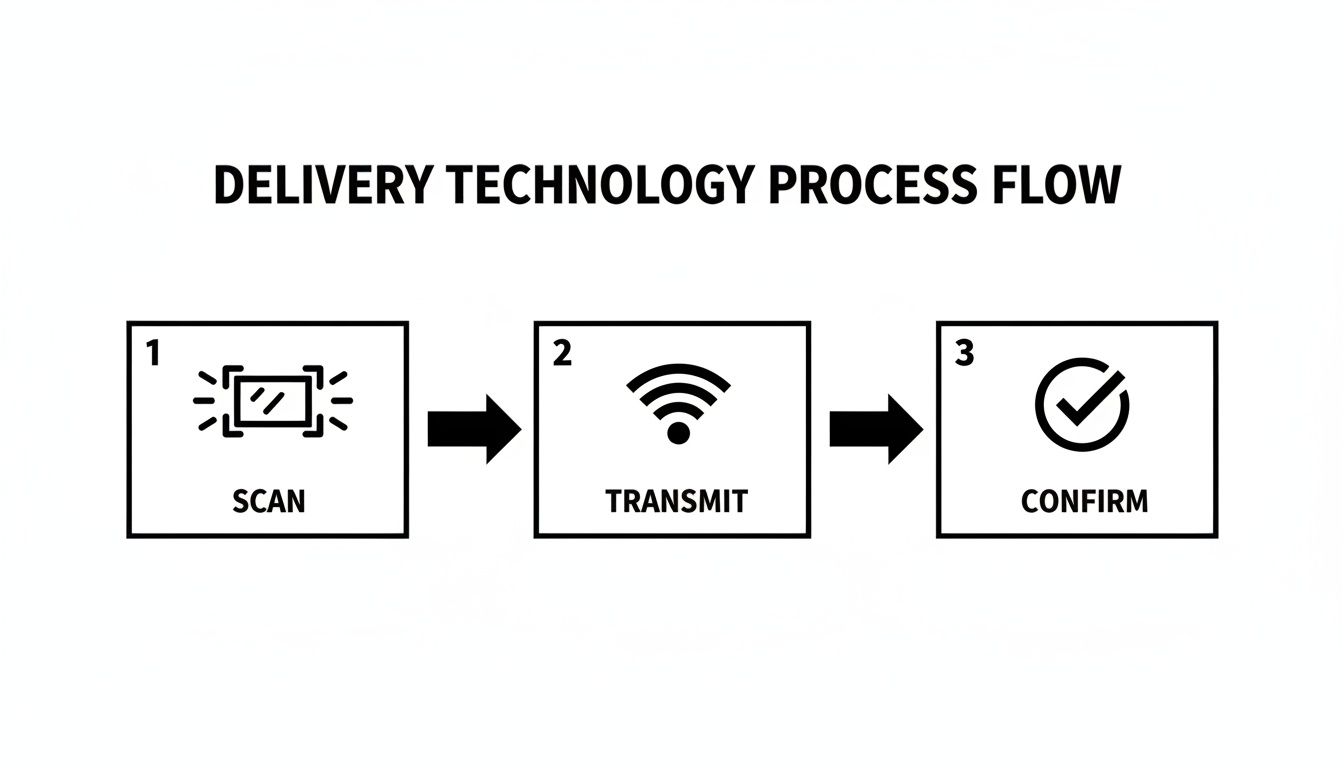
It’s a simple but powerful process: the driver scans the barcode, the data is sent to the carrier's system, and the status is updated to "Delivered."
What Is Proof of Delivery?
Take another step up, and you get to Proof of Delivery (POD). This service bundles everything from a standard delivery confirmation but adds a crucial piece of visual evidence.
Typically, POD includes a photograph of the package right where the driver left it—sitting on the front porch, tucked behind a pillar, or safely inside a mailroom. This picture makes it much tougher for someone to claim a package never showed up. It’s a snapshot in time that proves the delivery was completed.
The Gold Standard: Signature Confirmation
At the very top of the staircase is Signature Confirmation. This is the most secure option by far because it requires a real person to physically sign for the package.
This service shifts the confirmation from a passive digital event to an active, in-person handoff. That signature provides undeniable proof that the package was given directly to someone at the intended address. If you're shipping high-value electronics, legal documents, or anything you can't afford to lose, this is your go-to for minimizing risk.
Signature Confirmation is your best friend in a chargeback dispute. When a customer insists they never got their order, a signed confirmation is often the only piece of evidence you need to prove you held up your end of the bargain.
Choosing Your Level of Delivery Security
So, how do you decide which service is the right fit? It all comes down to what you're shipping and how much risk you're willing to take. This quick breakdown should help clear things up.
| Service Type | What It Confirms | Evidence Provided | Typical Use Case |
|---|---|---|---|
| Delivery Confirmation | The package arrived at the destination address. | Digital record with date, time, and drop-off location (e.g., "Front Door"). | Standard, low-value e-commerce orders and personal shipments. |
| Proof of Delivery (POD) | The package was physically present at the delivery location. | Digital record plus a photo of the package at the location. | Mid-value items or shipments going to areas with a higher risk of theft. |
| Signature Confirmation | The package was received and accepted by a specific person. | A physical or digital signature from the person who accepted the package. | High-value goods, legal documents, pharmaceuticals, or luxury items. |
At the end of the day, picking the right level of confirmation is a balancing act between cost, convenience, and security. For most everyday shipments, a standard delivery confirmation will do the job just fine. But for anything valuable or irreplaceable, spending a little extra on Proof of Delivery or Signature Confirmation can save you from a world of financial and logistical headaches.
Why Delivery Confirmation Is a Pillar of Modern E-Commerce
In the world of online shopping, delivery confirmation is so much more than a simple status update. Think of it as the invisible thread of trust that holds the entire system together. For everyone involved in a transaction, this final digital handshake provides a crucial layer of security and peace of mind.
It’s the proof that a seller kept their promise and a buyer actually got their stuff. For shoppers, that confirmation turns the anxious waiting game into confident anticipation. For sellers, it's a vital shield against fraudulent "item not received" claims and the expensive chargebacks that can follow.
The Foundation of Customer Trust
Customer support teams live and breathe by this final scan. A clear confirmation is the best tool they have for quickly resolving the constant stream of "where is my order?" questions, which frees them up to handle more complex issues.
When customers see their order has been safely delivered, their whole experience improves, making them far more likely to shop with you again. It helps make the entire fulfillment process, from click to doorstep, feel smooth and transparent. This is often accomplished through systems for automated order processing.
This has become a cornerstone of trust, especially with global parcel volumes projected to hit a staggering 407 billion by 2025. That’s nearly 5,900 packages delivered every single second, showing just how indispensable services like Instant Parcels are for keeping track of it all. In fact, research shows that 73% of global shoppers will walk away if they don't trust the delivery provider, proving how critical confirmation is.
Why It's Essential for Business Operations
Beyond just keeping customers happy, delivery confirmation is a key part of running a healthy business. It gives you the hard evidence needed to settle disputes and protect your bottom line. Without it, sellers are exposed and have very little to stand on when a transaction goes sideways.
Here’s why it’s a non-negotiable for any modern seller:
- Dispute Resolution: It's your primary piece of evidence when fighting "Item Not Received" (INR) claims.
- Chargeback Defense: A solid confirmation record is often all it takes for payment processors to rule in your favor during a chargeback dispute.
- Operational Clarity: It marks a clear end to the fulfillment cycle, which helps with everything from inventory management to sales reconciliation.
In short, delivery confirmation officially closes the loop on a transaction's journey. It brings security to the seller, assurance to the buyer, and clarity to support teams.
For businesses shipping across borders, understanding these confirmation signals is even more important. Our guide on how to track international packages breaks down how to maintain visibility from start to finish. In a world of remote transactions, this simple confirmation is absolutely essential for building trust on a global scale.
Troubleshooting Common Delivery Confirmation Issues
It’s a uniquely modern frustration: seeing a "Delivered" status on your screen while staring at an empty porch. When your delivery confirmation says one thing and reality says another, it’s easy to feel helpless. But don't panic—there’s often a simple explanation and a clear path forward.
This "delivered but not received" mystery is one of the most common hiccups in the shipping world. Let's walk through a practical, step-by-step plan to figure out what happened and get your package where it belongs.
First Steps When a Package Goes Missing
Before you jump to calling customer service, take a few minutes to do some detective work around your property. A quick search can often solve the problem right away.
Start with these simple checks:
- Look Everywhere: Check all potential drop-off spots. Think back door, behind planters, inside a screened-in porch, or with your building's receptionist or mailroom.
- Ask Around: Politely check with your neighbors to see if they received your package by mistake. It’s a common mix-up, especially in apartment buildings or dense neighborhoods.
- Wait It Out: Sometimes, a driver marks a package as "Delivered" a few minutes—or even an hour—before they actually drop it off to stay on schedule. Give it until the end of the day before you raise an alarm.
The Problem of Premature Scans
One of the most frequent culprits behind this confusion is a premature scan. This happens when a delivery driver scans all the packages for their route as "Delivered" at the start of their shift or long before reaching your address. While it’s usually against company policy, it’s a shortcut taken to save time.
If you suspect a premature scan, your best bet is patience. More often than not, the package will show up later in the day as the driver completes their route. If it doesn’t, it’s time to take the next step.
Your Best Evidence: A consolidated tracking history is crucial. When you file a claim, being able to show a clear, time-stamped log of every scan—including a potentially premature "delivered" notification—strengthens your case significantly.
Contacting the Carrier and Seller
If the package is still nowhere to be found by the next morning, it’s time to get in touch with the carrier. Have your tracking number ready and calmly explain the situation. They can access internal data, like the GPS coordinates from the driver's scanner at the time of delivery, to confirm if it was even at your address.
Should the carrier be unable to locate the package, your next call is to the seller. They initiated the shipment and have a business relationship with the carrier, which gives them more leverage to resolve the issue or file a claim. Sometimes these situations can lead to a formal investigation, much like what happens with a shipment exception.
With global parcel revenues projected to hit $502.57 billion in 2025, getting these confirmations right is more critical than ever. In fact, a bad delivery experience can be a deal-breaker, as 78% of European shoppers are hesitant to buy again from the same seller after one. For small businesses, accurate confirmations are proven to lower chargeback rates by 15-20%—a massive benefit in a competitive market. You can dive deeper into how delivery stats shape e-commerce in this detailed analysis.
Delivery Confirmation FAQs
Let's tackle some of the most common questions that pop up for both shoppers and sellers. We'll cut through the confusion with clear, practical answers to help you handle real-world shipping situations.
Is Delivery Confirmation the Same as Tracking?
Not exactly, but they're closely related. Think of tracking as the full story of your package's journey—it’s the play-by-play, showing every scan from the warehouse to your local depot.
Delivery confirmation is the final chapter of that story. It's the one, single event that officially confirms the package has been dropped off. While a service with delivery confirmation will always have tracking, not all tracking services end with that distinct, final "delivered" scan. This is why a tool like Instant Parcels separates the final "Delivered" status from all the other "In Transit" updates—it highlights that final, crucial step.
What If My Package Shows Delivered, But I Can't Find It?
First off, take a breath. This happens more often than you'd think, and there's usually a simple explanation.
Before you start worrying, do a quick search around your property. Check the back porch, behind any planters, or with your apartment manager. It's also a good idea to ask your neighbors if they might have grabbed it for you. Sometimes, a carrier will mark a package as "delivered" a few minutes before they actually drop it off, so it might just be a matter of waiting until the end of their route.
If it's still MIA by the end of the day, find the exact delivery time in your tracking history and contact the carrier with that detail. If you're still stuck, your next step is to get in touch with the seller.
When you call a carrier about a missing package, giving them the exact "delivered" timestamp is key. It helps them check the driver's GPS coordinates at that very moment to see where the scan actually happened.
Can a Delivery Confirmation Ever Be Wrong?
It's rare, but yes, mistakes can happen. A driver might accidentally scan the wrong package, or they might trigger the confirmation scan at the wrong house—a classic "premature scan." Modern scanners use GPS to cut down on these kinds of errors, but they're still operated by humans.
If you have a strong feeling the confirmation is wrong, don't hesitate to contact the carrier. They can pull up the driver’s GPS logs for the time of the scan and verify whether the location lines up with your address. This digital trail is usually the quickest way to find out if an error was made on their end.
How Does Delivery Confirmation Help Sellers Win Disputes?
For sellers, that delivery confirmation is your best defense against "Item Not Received" claims and chargebacks. When a customer says their order never showed up, you can provide the carrier's official confirmation as proof that you held up your end of the bargain.
This digital receipt—complete with the date, time, and location—is often all the evidence payment processors or credit card companies need to side with you. This simple piece of data is crucial for protecting your e-commerce business from fraudulent claims, saving both your revenue and your reputation. It’s a small detail that makes a big difference.