
What Is Proof of Delivery and Why It Matters for Your Shipments
Proof of delivery, or POD, is exactly what it sounds like: a verifiable record showing a shipment made it to its final destination. Think of it as the final handshake in the delivery process—a piece of evidence, either digital or physical, that closes the loop and confirms the job is done.
So, What Exactly Is Proof of Delivery?
Have you ever gotten a "delivered" notification on your phone, rushed to the door, and found... nothing? That sinking feeling is precisely why proof of delivery is so important in modern shipping. It’s far more than a simple status update; it's the definitive answer to the question, "Where's my package?"
At its core, POD is documented verification that the carrier handed off the parcel. This proof can take a few different forms—a signature scrawled on a digital screen, a quick photo of the package sitting on a porch, or even a GPS location ping with a timestamp. No matter the method, the goal is the same: to create a clear, indisputable record that the delivery happened as planned.
The Bedrock of Trust in E-commerce
In the world of online shopping, where you rarely meet the seller face-to-face, proof of delivery builds a crucial bridge of trust. For a shopper, it’s the hard evidence you need if a package goes missing or gets stolen. For the seller, it's their primary defense against false claims and expensive "item not received" disputes, protecting both their revenue and their reputation.
The need for this kind of verification has exploded right alongside e-commerce itself. The global parcel market is growing at a staggering rate, with projections hitting 217 billion packages delivered in 2025. To put that in perspective, that’s almost 5,900 parcels landing on doorsteps every single second. You can dig deeper into these numbers with ClickPost's package delivery statistics. With that kind of volume, a solid POD system isn't just nice to have—it's absolutely essential.
Think of it this way: Without POD, every delivery dispute is just a frustrating "he said, she said" argument. With it, both the customer and the seller have a factual starting point to figure out what went wrong and make it right.
When it comes to confirming a delivery, not all methods are created equal. Think of it like evidence in a courtroom—a vague testimony isn't nearly as convincing as a timestamped video. The same principle applies to Proof of Delivery (POD). The way a delivery is verified determines just how solid that proof really is.
Over the years, POD has evolved from simple pen-and-paper signatures to sophisticated digital records that offer layers of verification. Getting to know these different types is crucial because each one offers a unique mix of convenience, security, and detail. Let's break down the most common methods you'll see in the wild.
The Classic: Signature POD
The old-school, tried-and-true method is the Signature Proof of Delivery. It's the classic "sign on the dotted line" that we're all familiar with. For decades, this was the standard for confirming a package was received, whether with a pen or, more recently, a stylus on a driver's handheld scanner.
This approach is great for confirming that someone at the address physically accepted the item, which is especially important for high-value goods. The catch? Signatures can be scribbled and illegible, and there's no way to know if the signer was the intended recipient, a family member, or the receptionist downstairs. With contactless deliveries now being so common, its use for everyday shipments has definitely taken a backseat.
The Visual Alibi: Photo POD
They say a picture is worth a thousand words, and when it comes to delivery disputes, it's absolutely true. Photo Proof of Delivery is exactly what it sounds like: the driver snaps a quick picture showing exactly where they left the package. This simple photo serves as an indisputable alibi for the courier.
A photo POD instantly answers the most important questions: Was the parcel left by the front door? Tucked behind a planter? Or was it accidentally dropped at the neighbour's house? This level of clarity is a game-changer for quickly resolving those frustrating "item not received" claims.
This visual confirmation is a key piece of the puzzle, clarifying what happened at the final step of the delivery journey.
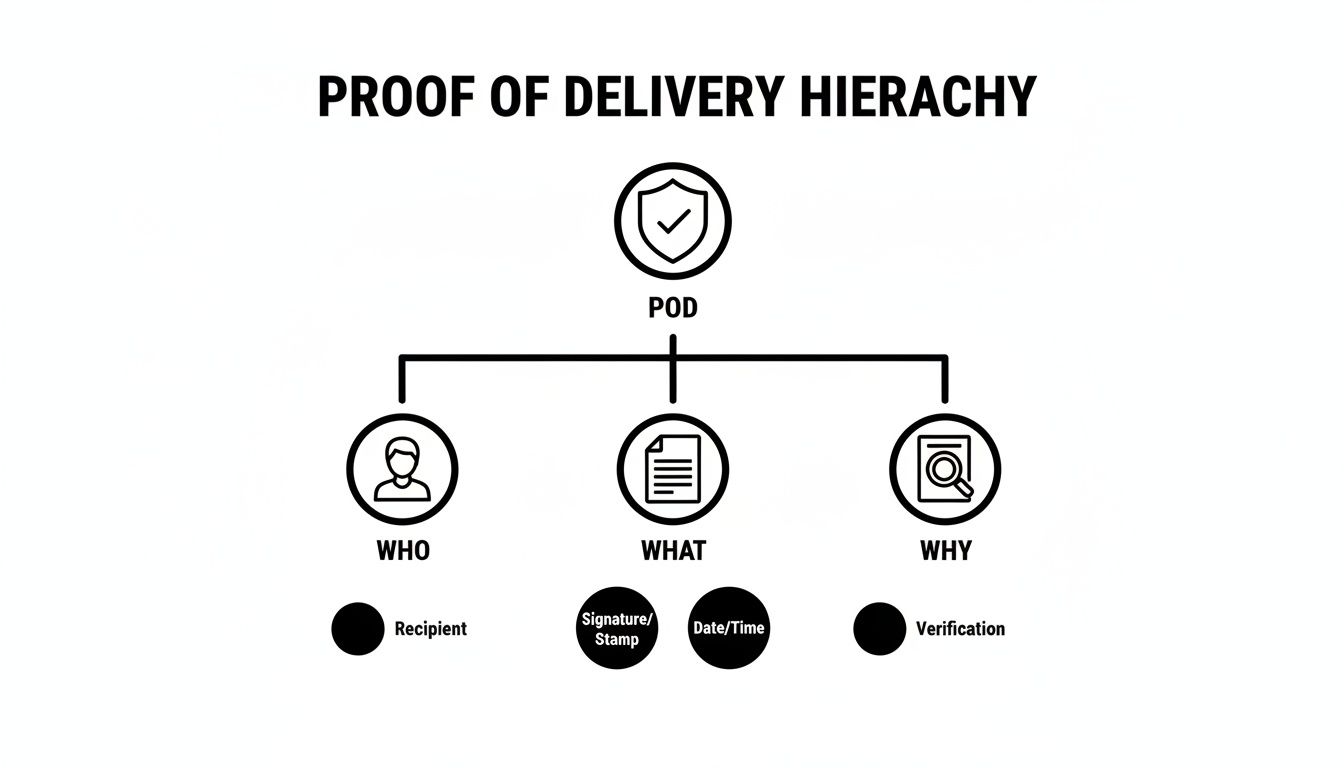
As you can see, a strong POD system ties together who was involved, what was documented, and why it all matters for accountability.
Comparing Proof of Delivery Methods
To make sense of the options, it helps to see them side-by-side. Each POD type has its own strengths and weaknesses, making it better suited for different situations.
| POD Type | How It Works | Primary Benefit | Common Limitation |
|---|---|---|---|
| Signature POD | A recipient provides a physical or digital signature upon delivery. | Confirms direct hand-off to a person at the location. | Signature can be illegible; doesn't verify the signer's identity. |
| Photo POD | The courier takes a picture of the package at the delivery location. | Provides clear, visual evidence of the package's placement. | Doesn't confirm who, if anyone, physically received the item. |
| GPS/Time-stamp | The courier's device automatically logs the time and GPS coordinates. | Offers precise, objective data on when and where the delivery occurred. | Doesn't show the package's condition or specific placement. |
| Electronic POD (ePOD) | A digital record combining multiple data points (e.g., GPS, photo, signature). | Creates a comprehensive, multi-layered, and hard-to-dispute record. | Can be more complex to implement and manage for carriers. |
This table highlights the trade-offs, showing why a modern ePOD system that combines several of these elements is now considered the most reliable approach for both shoppers and sellers.
The Modern Standard: Electronic Proof of Delivery (ePOD)
Today, most major carriers rely on Electronic Proof of Delivery (ePOD). This isn't just one type of proof; it’s a digital dossier that bundles multiple data points into a single, rock-solid confirmation.
A typical ePOD record will often include a powerful combination of evidence:
- GPS Coordinates: Pinpointing the exact latitude and longitude where the delivery scan happened.
- Timestamp: Recording the precise time and date the delivery was completed.
- Digital Signature or Photo: Incorporating one of the methods we've already discussed.
- Recipient Name: Noting the name of the person who accepted the package, when applicable.
By weaving all this information together, an ePOD creates a record that’s incredibly reliable and very difficult to argue with. It's the digital equivalent of having a signed, timestamped, and geo-located affidavit for every single parcel.
If you're curious to learn more, our guide on how delivery confirmation works in practice dives deeper into these nuances. Understanding why some proof is stronger than others will give you a huge advantage when it's time to investigate a missing package.
Why POD Is a Lifesaver for Online Shoppers
For anyone who shops online, proof of delivery is more than just a tracking update—it’s your peace of mind. That final notification is what turns the anxious question of "Where's my stuff?" into a clear, solvable situation. It’s what gives you the confidence to click "buy" without worrying about what happens next.

Think of POD as your personal consumer protection shield. Nothing is more frustrating than getting a "delivered" notification, only to find an empty porch. This is where proof of delivery cuts through the confusion, giving you a solid starting point to figure out what happened. It’s the one piece of evidence that can completely turn a bad situation around.
Turning Problems into Solutions
Let’s say you get an alert that your package was delivered, but it’s nowhere in sight. Without POD, you’re stuck. But with it, a quick look might reveal a photo showing your box left on the public sidewalk instead of tucked away on your secure porch.
Suddenly, you’re not just filing a vague complaint. You're showing the seller definitive proof that the delivery was mishandled. That single photo becomes your best tool for getting a quick refund or a replacement sent out.
With clear what is proof of delivery evidence, a missing package claim shifts from a potential dispute to a straightforward resolution process. It equips you with the facts needed to hold carriers and retailers accountable.
This isn't just a nice-to-have feature anymore; it's a basic expectation. Shoppers demand this kind of visibility. In fact, around 91% of consumers now actively track their orders from shipment to doorstep. This shows just how critical proof of delivery is in building customer trust. If you're interested in the data behind these trends, you can explore the latest last-mile delivery statistics.
Building Trust with Every Delivery
Ultimately, a good POD system is what builds the trust that makes e-commerce thrive. When you know there's a verifiable record for every delivery, you can shop with confidence, even from a new brand you’ve never tried before. It reassures you that if something goes sideways, there's a system in place to fix it.
This sense of security is what keeps customers coming back. When shoppers feel protected after they've already paid, they're far more likely to become loyal, repeat buyers. Proof of delivery provides that crucial safety net, making the final step of your purchase just as reliable as the first click.
How POD Protects Your E-commerce Business
For anyone running an e-commerce store, proof of delivery is much more than a simple checkbox on a shipping manifest. Think of it as your first line of defense—the concrete evidence that safeguards your revenue, your reputation, and frankly, your sanity with every single package that leaves your warehouse.
POD is your business's insurance policy against some of the most frustrating and expensive delivery disputes. When a customer claims they never received their item, the situation can quickly spiral into a chargeback, which means a direct hit to your bottom line. Without solid proof, it's often your word against theirs.
But when you can pull up a timestamped photo or a geolocated signature in seconds, the entire conversation changes. You can instantly verify that the carrier did their job correctly, turning a potentially damaging claim into a simple, resolvable inquiry.
Defending Against Chargebacks and Fraud
Let's be honest: fraudulent "item not received" claims are a real and costly problem in online retail. A solid proof of delivery system is your best weapon for shutting them down.
Imagine a customer disputes a charge. If you can immediately provide the credit card company with the carrier's official POD—a photo showing the package on the right doorstep at a specific time—you're presenting irrefutable evidence. This documentation dramatically improves your odds of winning the dispute, saving you the product cost and those pesky administrative fees.
Making verifiable proof a standard part of every delivery does more than just help you win disputes; it actively discourages opportunistic fraud. It sends a quiet but firm message that every delivery is tracked, documented, and accounted for.
Empowering Your Customer Support Team
Beyond protecting your finances, good POD data gives your customer support team the tools they need to resolve issues with speed and confidence. No more getting stuck in frustrating "he said, she said" loops. Your agents can access the POD and give customers immediate, factual answers.
This efficiency doesn't just reduce the workload on your team; it completely changes the customer experience for the better. If you're looking for ways to streamline your operations, exploring different e-commerce solutions can help you build more robust processes from checkout to delivery. Faster resolutions mean happier customers, even when things go wrong.
You can also build a ton of trust by sharing POD information proactively. Including a direct link to the photo or signature confirmation right in your delivery notification email offers total transparency. It’s a small touch that shows you’re committed to a secure, reliable delivery process. You can learn more about how to improve the e-commerce customer experience in our detailed guide.
This level of openness reinforces your brand's credibility and helps turn first-time buyers into loyal customers who trust that their orders are in good hands.
How to Find and Use Your Proof of Delivery
So, you know proof of delivery exists—but where do you actually find it? And more importantly, what do you do with it once you have it?
The good news is that your POD isn't usually buried in some hard-to-find logistics database. For most shipments, it's attached directly to your package's tracking history. Every time a parcel gets scanned, its journey is updated. The final scan, the one that says "Delivered," is typically where you'll find the proof. It might be a photo, a signature, or a GPS pin.
The problem? Juggling multiple carrier websites can be a real pain, especially if you're managing several incoming or outgoing packages at once. Who has time to hop between different tracking portals?
A Simpler Way to Locate Your POD
Instead of opening a dozen browser tabs, using a single tool like Instant Parcels consolidates everything into one simple, clear view. It takes the guesswork out of figuring out which carrier has your parcel and where to click to see the final delivery details.
It really is as straightforward as it sounds.
Here’s how you can find your POD using a centralized platform:
- Enter Your Tracking Number: Just pop your tracking number into the search field. The system instantly recognizes the carrier and pulls up the complete tracking history. If you're not sure where to start, our guide on how to find your tracking number can help.
- Find the Final "Delivered" Scan: Scroll down to the very last update in the timeline. It will be clearly marked with a status like "Delivered."
- Click to View the Proof: Right alongside that final status, you'll see the POD. It might be a link that says "View Proof of Delivery," a small photo you can click to enlarge, or the name of the person who signed for it.
A clean, all-in-one interface makes this process a breeze.
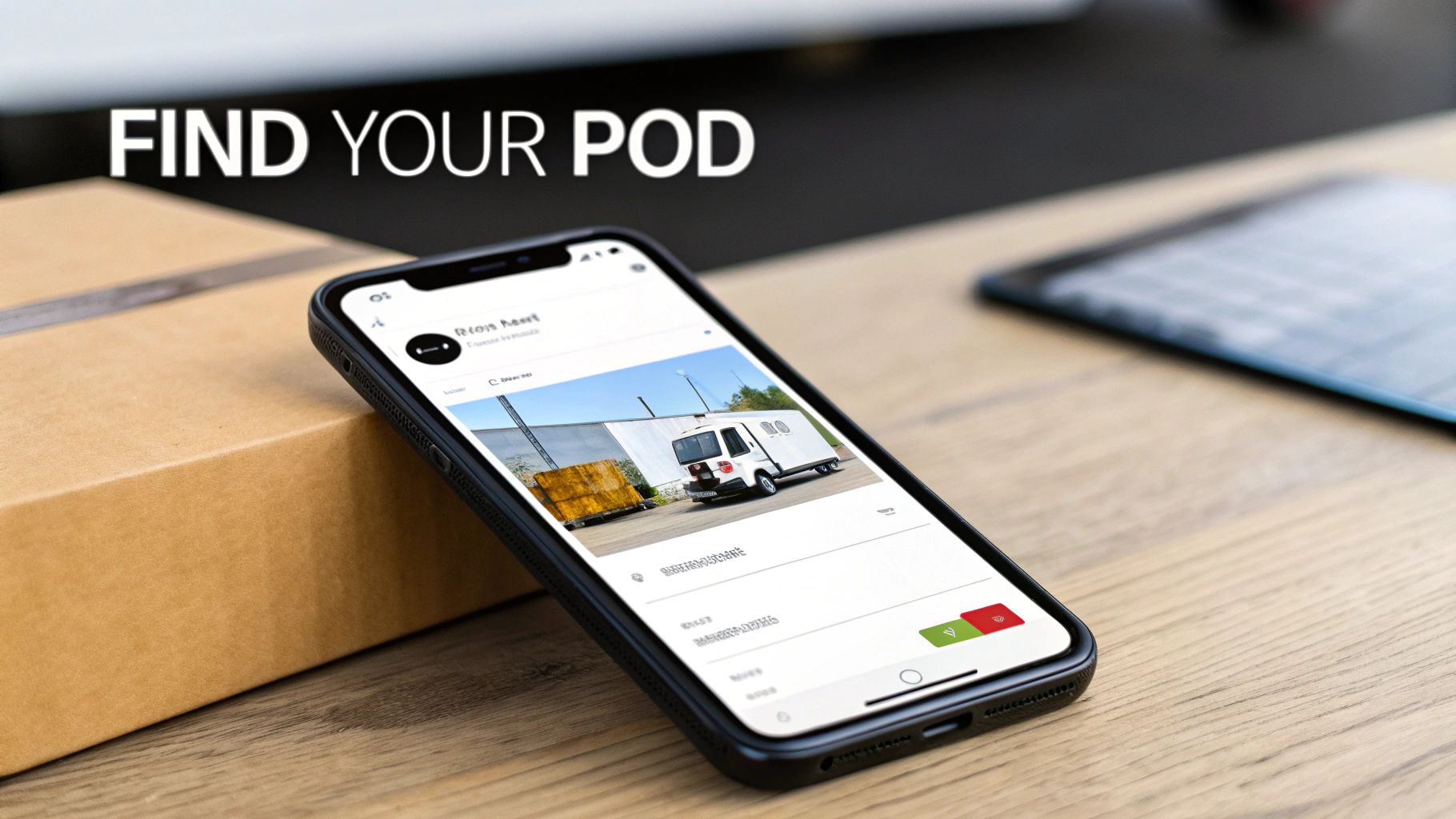
Ultimately, having one reliable spot to find your delivery evidence saves a ton of time and eliminates any confusion.
Interpreting Your POD: Once you've found it, take a second to look closely. Does the photo actually show your front door? Is that signature from someone in your household? Do the GPS coordinates match your address? This little piece of data is your best friend if you ever need to dispute a missing package claim.
Navigating Delivery Disputes Like a Pro
Even with the best tracking systems in the world, things can go sideways. We've all been there: you get a "delivered" notification, but the package is nowhere in sight. It’s a frustrating moment, but having solid proof of delivery is what turns a head-scratching mystery into a solvable problem for everyone involved.
Knowing how to use that POD is the real secret. It empowers both you and the seller to get to the bottom of things quickly and fairly. Instead of a messy back-and-forth, you have a clear, professional way to handle the hiccup, which can actually build trust even when something goes wrong.
A Clear Plan for Shoppers
So, your package is MIA but the tracking says it's delivered. What do you do? Your first move should always be to check the POD.
- Look at the evidence: Scrutinize that photo, signature, or GPS pin. Is that actually your front door in the picture? Is the signature anyone you know? Sometimes the answer is obvious right away.
- Contact the seller immediately: With this information in hand, reach out to the seller. Give them your order number and explain precisely why the POD doesn't add up. A photo showing your package sitting on a stranger's porch is pretty hard to argue with.
Taking this direct approach gives the seller the concrete evidence they need to kick off an investigation with the carrier and fight on your behalf.
Best Practices for E-commerce Sellers
For anyone running an online store, POD is your number one tool for handling "where's my order?" inquiries without losing your mind—or your customer.
When a customer says their package never arrived, your first step isn't to issue a refund. It's to pull up the proof of delivery. This lets you see the carrier's side of the story before deciding whether to ship a replacement or start a claim.
Your role here is to be your customer's advocate. Use the POD to file an official claim with the shipping carrier to get reimbursed. For bigger issues, especially with high-value freight, it's good to be aware of the rules that govern liability, like the Carmack Amendment.
By tackling these situations with transparency and a clear process, you not only protect your bottom line but also show your customers you've got their back.
Answering Your Top POD Questions
Even when you know what proof of delivery is, real-world situations can get a little messy. Whether you’re an eager shopper checking your porch or a business owner juggling shipments, you’re bound to run into some tricky scenarios. Let's tackle some of the most common questions that come up.
What If POD Exists But My Package Is Gone?
It’s a frustrating moment: you get a delivery notification, but your doorstep is empty. What now?
First, don't panic. Dig into the proof of delivery details in your tracking history. If there's a photo, does it actually show your front door, or is it your neighbor's place? If there’s a signature, is the name or scribble familiar?
Next, do a quick check with anyone else at home or your immediate neighbors—someone might have grabbed it for you. If the package is still nowhere to be found, contact the seller right away. Give them your order number and explain exactly why the POD doesn't add up. That evidence is your first step in getting them to open a lost package investigation with the carrier.
Key Takeaway: Think of the POD not as the final word, but as the starting point for an investigation. Use the details to build your case when you reach out for help.
Are Electronic Signatures Valid Proof?
Absolutely. In the eyes of the law and nearly every business, an electronic signature captured on a courier’s handheld scanner is legitimate proof of delivery. In many ways, it's actually more reliable than an old-fashioned pen-and-paper signature.
Why? Because that digital signature doesn't exist in a vacuum. An ePOD record almost always bundles the signature with other vital data points, like:
- GPS coordinates pinning the exact location of the delivery.
- A precise timestamp showing the exact moment the delivery was completed.
This multi-layered approach creates a robust and verifiable record, proving the driver was physically at the correct address when that signature was captured.
How Long Should a Seller Keep POD Records?
For any e-commerce seller, holding onto proof of delivery is non-negotiable. The industry best practice is to keep all POD records for at least 120 days. This isn't an arbitrary number—it aligns with the standard window a customer has to dispute a charge with their credit card company.
That said, many savvy businesses play it safe and archive these records for six months or even a full year. Having that extra cushion protects against delayed claims and comes in handy for internal audits. Using a shipping platform that automatically stores this information for you is the easiest way to ensure you're always prepared to validate a delivery.