
A Guide to How to Track International Packages Like a Pro
When you're waiting on a package from overseas, the key is using the tracking number the seller gave you. You'll often need to check it on the websites for both the origin and destination country's postal service, or directly with the private courier. Because packages get handed off between different companies, a universal tracking platform can be a lifesaver, pulling all those updates into one simple timeline.
Your Guide to Navigating Global Package Tracking
Ever felt that mix of excitement and mild panic after ordering something from another country? You're not alone. That waiting game, where tracking updates can be vague or seem to stop for days, is a common experience. This guide is here to pull back the curtain on the complex world of global logistics and make you a pro at tracking your stuff.
We’re going to walk through everything, from figuring out what your tracking number actually means to understanding what's happening when your package gets stuck in customs. To really get a handle on it, it helps to understand the basics of the international shipping process that dictates how items move across borders in the first place.
The Massive Scale of Global Shipping
It's hard to wrap your head around just how many packages are constantly flying around the globe. In 2025, an estimated 407 billion packages will be shipped worldwide—that's a jump from 380 billion in 2024.
Do the math, and that's nearly 5,900 parcels crossing borders every single second. When you're trying to find one specific box in that massive flow, it puts the whole challenge into perspective. You can dive deeper into these package delivery statistics to see the full picture.
This guide is your roadmap. We'll show you how to follow any package, no matter its origin. You'll understand why a shipment gets passed between different couriers and what those confusing status updates actually mean.
Instead of trying to piece together information from multiple carrier websites, you'll learn how to get a single, unified view of your package's journey from start to finish. By the end, you'll have the confidence and know-how to track any shipment like an expert.
Decoding Your International Tracking Number
Think of your tracking number as the secret password to your package's travel diary. It's that all-important string of letters and numbers that lands in your shipping confirmation email, and it’s your single best tool for following an international shipment.
But here’s the thing: not all tracking numbers are created equal. The format itself is the first big clue, telling you a story about who's handling your package and where it started its journey.
Universal Postal Union vs. Private Couriers
Most international packages, especially the ones you order from big online marketplaces, use a standardized format from the Universal Postal Union (UPU). This is a huge advantage because it means the code is recognized by national postal services all over the world.
A classic UPU tracking number looks something like this: RA123456789CN.
Let’s break that down:
RA: The first two letters tell you the package type. 'R' usually means it’s a registered small packet weighing less than 2kg.
123456789: These nine digits are the unique serial number for your specific parcel.
CN: The last two letters are the country code of origin. You guessed it—'CN' is for China.
Getting a handle on this structure is a real game-changer. If you're waiting on something from Asia, digging into the specifics of how to track packages from China can clear up a lot of confusion, especially around that tricky handover phase.
On the other hand, you have the big private couriers—think FedEx, DHL, UPS, or Aramex. They play by their own rules and use their own unique tracking number formats. These are often just a long string of numbers. For instance, a FedEx International Priority package might have a 12-digit number like 794653128456. These proprietary numbers will almost always work only on that courier's website, at least until they pass it off to a local partner for the final delivery.
Pro Tip: The format is your first clue. A code like 'XX123456789YY' tells you it’s moving through the global postal system. A long, purely numerical code? That almost always points to a private courier like DHL or FedEx.
Anticipating the Carrier Handover
Once you recognize the tracking number format, you can start to predict the package's path. If your tracking number from China Post ends in 'CN', you know that once it clears customs in your country, it’s going to be handed over to your local postal service.
That means it'll go to USPS in the United States, Royal Mail in the UK, or Canada Post in Canada.
This handover is a classic spot where tracking seems to hit a wall. But now you know the secret: take that same UPU number and pop it into your local post's tracking website. You'll often find more detailed, up-to-the-minute information that the origin country's site just doesn't have yet. Nailing this first step sets you up for a much less stressful tracking experience.
The Journey of Your Package from Start to Finish
Following an international package is like watching a story unfold, with each tracking scan marking a new chapter in its journey across the globe. The whole process starts long before your parcel is actually in motion, often with statuses that can be a bit confusing at first.
When you get that initial tracking number, you'll probably see something like "Shipment Information Received" or "Pre-Shipment." Don't get too excited just yet—this doesn't mean your item is moving. It just signals that the seller has created a shipping label and registered the shipment with the carrier. The real adventure begins when the status updates to "Accepted at Origin Facility" or "Picked Up," which is your confirmation that the courier officially has the package.
This diagram gives you a quick visual of how those first few steps play out, from the moment you get your shipping confirmation to the courier taking over.
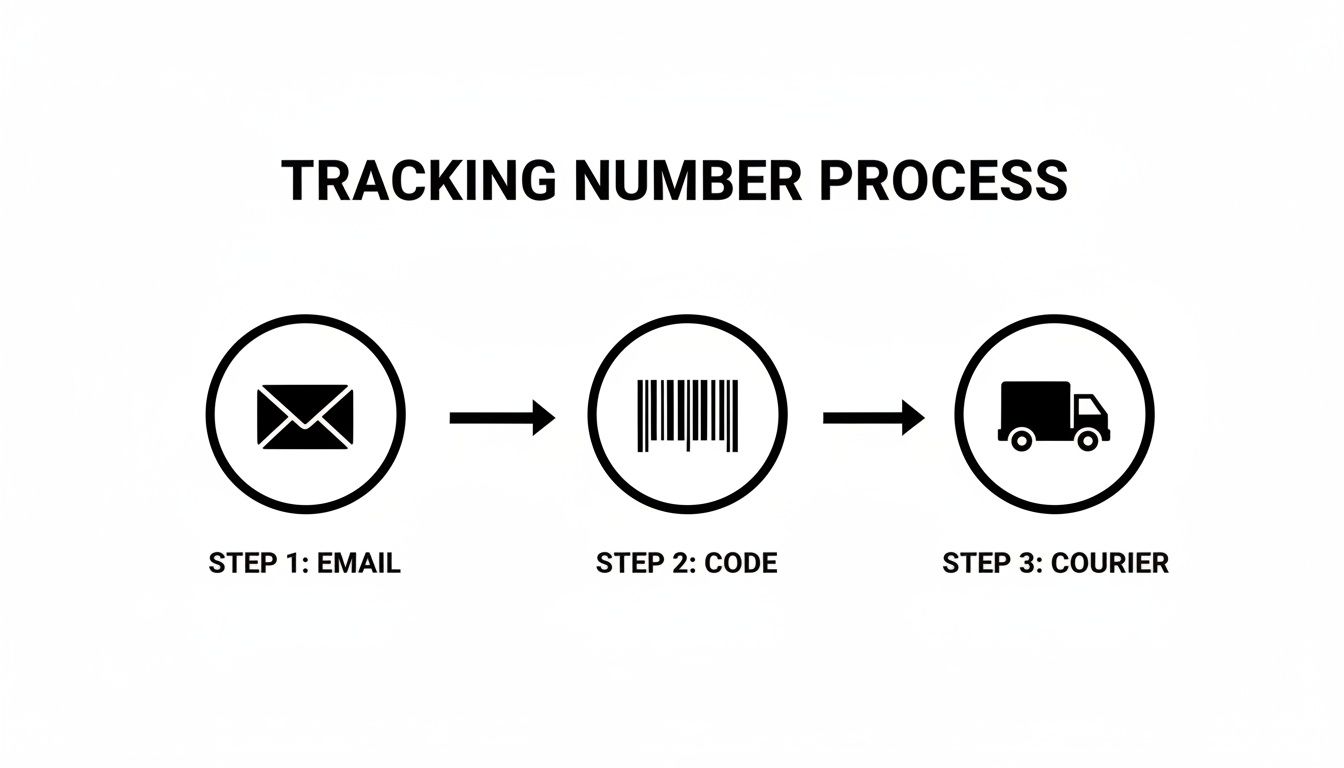
From there, your package enters the transit phase. You’ll see a flurry of updates like "Departed Origin Facility" as it moves through the logistics network. This is the famous "In Transit" stage, which can involve a whole series of stops at sorting centers, airports, and regional hubs. To get a better handle on this common status, our guide on what "in transit" really means breaks down exactly what's happening behind the scenes.
Navigating the Customs Clearance Maze
Here comes the part of the journey that often feels like the slowest: customs clearance. When your tracking updates to "Arrived at International Hub" or "Presented to Customs," it means your package has landed in the destination country. But it's not free to continue its journey just yet.
Customs agencies are the gatekeepers. They are responsible for a few key things:
Inspecting Goods: They’re on the lookout for any prohibited or restricted items.
Verifying Value: They check that the value declared on the customs form is accurate.
Assessing Duties and Taxes: Based on the item's value and type, they calculate any import fees that might be due.
A package can breeze through customs in a few hours or, in some cases, sit there for several weeks. Delays are usually caused by incomplete paperwork from the sender, a massive volume of incoming packages, or just random inspections. If duties are owed, the package will be held hostage until they're paid.
Demystifying Standardized Tracking Updates
While every carrier has its own way of wording things, most tracking statuses fall into a few standard categories. Understanding these common terms can take a lot of the guesswork out of following your shipment.
Here's a quick reference table to help you decode what's actually happening at each stage.
Common International Tracking Statuses Explained
Tracking Status | What It Really Means | Example Carriers |
|---|---|---|
Pre-Shipment / Label Created | The sender has created a shipping label, but the carrier hasn't picked up the package yet. It's not moving. | USPS, FedEx, UPS |
Accepted / In Possession | The carrier has officially received the package, and its physical journey has begun. | DHL, Royal Mail |
In Transit / Departed Facility | The package is on the move between sorting centers, hubs, or countries. It’s making progress. | All major carriers |
Held at Customs | The package is being inspected by the destination country's customs agency. This is a normal step. | All international shipments |
Out for Delivery | The package is on the local delivery truck and should arrive at your address that day. | Canada Post, Australia Post |
Delivered | The package has successfully reached its final destination. Mission complete! | All major carriers |
Seeing a status like "Held at Customs" might look alarming, but it's a completely normal part of the process for virtually all international orders. It just means your package is waiting its turn for inspection.
The Final Mile: A Real-World Example
Let's walk through a practical scenario. Imagine you've ordered a rare book from a small shop in London, UK, and you live in Toronto, Canada.
Origin: The shop sends it via Royal Mail. The tracking will show its movement through the UK network until it hits a major airport like Heathrow. The last update from Royal Mail might be something like "Item Leaving the UK."
Customs: Once it lands in Canada, the package is handed over to the Canada Border Services Agency (CBSA) for inspection. During this time, your tracking might go silent for a few days. Don't panic; this is normal.
Handover: After it's cleared, the CBSA releases the package to Canada Post, which is Royal Mail's partner carrier in the country. That original Royal Mail tracking number should now start working on the Canada Post website.
Final Delivery: Canada Post takes over for the final leg, bringing the book right to your doorstep in Toronto. The last tracking status you'll see is the one you've been waiting for: "Delivered."
By understanding these distinct phases—origin transit, customs, and final delivery—you can turn the often-confusing process of international shipping into a much more predictable and less stressful experience.
Tackling Common International Tracking Problems
Even if you’ve been ordering things from overseas for years, confusing tracking issues can pop up. When the updates stop or you see a weird error message, it's easy to think your package is lost forever. Let's walk through the most common snags and how to actually solve them.
First up is the classic "Tracking Number Not Found" error. My advice? Don't panic. There’s almost always a 24-48 hour lag between when the seller prints a shipping label and when the package gets its first physical scan at a facility. The number exists, but it's not active in the system yet. Just give it a day or two before you contact the seller.
This is a really common hiccup in the world of cross-border shipping, which is growing like crazy. A recent report on 2025 shipping statistics found that 82% of online merchants are looking to expand globally, so these little tracking challenges aren't going away anytime soon.
What to Do When Your Package Is Stuck in Customs
One of the biggest slowdowns you'll encounter is customs. If your tracking status has been sitting on "Held at Customs" for more than a few days, it's time to do a little digging. It doesn't mean something is seriously wrong; it usually boils down to one of three things:
Random Inspection: Customs officials can pull any package for a routine check. It’s just bad luck, but it can add a few extra days.
Missing Paperwork: The sender may have filled out the customs forms incorrectly or left something out.
Duties Owed: Your package might be waiting for you to pay import taxes or fees before it can be released.
Check the tracking page again, very carefully. Sometimes there’s a link or a note with instructions on what to do next. If you see nothing, the next step is to call the carrier that handles final delivery in your country (like USPS, Royal Mail, or FedEx). They're the ones who deal directly with customs and can tell you exactly what the hold-up is.
Pro Tip: Before you call, have your tracking number and the value of your item handy. Giving the agent this info upfront helps them find the file quickly and pinpoint the problem. A quick call can often get your package moving again in a day or two.
Decoding Sudden Tracking Stops
So, what happens when the updates just... stop? One minute your package is zipping through another country, and the next, there's radio silence for a week. It’s incredibly frustrating, but there's usually a simple explanation.
More often than not, this silence means there’s been a carrier handover. The package has been passed from the original courier to your local postal service, but the new tracking data hasn't synced up across their systems yet.
Here’s what you can do:
Figure out the destination carrier. If it shipped with China Post and is headed to the US, the final delivery will almost certainly be handled by USPS.
Try the original tracking number on the new site. Just copy the number from the first carrier and paste it into the search bar on your local post office's website. You’ll often find a whole new set of more detailed scans there.
Look for any "exceptions." If you see a status update like a "shipment exception," it means there was an unexpected issue. Knowing what a shipment exception means can help you figure out if you need to take action.
By checking both the origin and destination carrier websites, you're not just passively waiting. You're actively finding the information you need, which is the best way to keep tabs on your international packages.
Using Unified Platforms for Smarter Tracking
Let’s be honest, juggling half a dozen carrier websites to track one package is a massive headache. After you’ve already dealt with customs and figured out carrier handoffs, the last thing you want is more complexity. This is where universal tracking platforms come in—they are the secret to smarter, less stressful international shipping.
Instead of manually checking DHL, then China Post, and finally your local mail service, a unified tracker does all the heavy lifting. You just pop in your tracking number once, and the platform’s tech gets to work. It automatically identifies the courier (or couriers), pulls in all the latest data, and maps out the entire journey in one clean, easy-to-read timeline.
One Search Bar to Rule Them All
The magic of these platforms is consolidation. They pull data from hundreds of couriers around the world, creating a single, reliable story of your shipment's journey. This is a game-changer when your package gets passed from one company to another, which is often where tracking information gets lost in translation.
Think about the real-world advantages here:
Automatic Carrier Detection: Stop guessing if your tracking number is for FedEx or some obscure regional carrier. The system just knows.
Standardized Status Updates: Vague updates like "processed through sort facility" get translated into something you can actually understand, like "Your package has left a sorting center and is on its way."
Real-Time Notifications: You can get email or push alerts for the important stuff, so you know the second your package clears customs or is out for delivery.
When you're dealing with multiple international orders, a centralized tool like PledgeBox's dedicated Tracker page can save you an incredible amount of time and frustration.
A unified tracking platform eliminates the need to translate carrier-specific jargon or wonder which website has the most current information. It presents the full story in one place, from the seller's warehouse to your front door.
The Power of Real-Time Data
Instant visibility isn't just a nice feature anymore; it’s what powers modern logistics. This demand is a huge factor in what’s expected to be a $502.57 billion global parcel market by 2025, where nearly 5,900 packages are shipped every second.
The technology for live package tracking alone is projected to more than double from $4.92 billion to $10.95 billion by 2032. That shows you just how essential this capability has become for both businesses and consumers.
At the end of the day, a universal tracking service transforms a fragmented, often confusing process into a simple, straightforward experience. You get clarity, control, and peace of mind, knowing all the information you need is just one click away.
Got Questions About International Tracking? We've Got Answers.
When you're tracking a package from across the globe, a few common questions and snags tend to pop up. It can feel like a bit of a maze, but trust me, most of these issues have a pretty simple fix. Here are the answers to the problems I see most often.
Why Is My International Package Stuck in Customs?
This is, without a doubt, the most common roadblock for international shipments. If your tracking has been frozen at a customs facility for a week, it’s usually more than just a simple backlog. It often points to a specific problem.
The hold-up could be anything from the seller forgetting a piece of paperwork, to unpaid import duties, or even just a random, thorough inspection.
Check your tracking page for clues. Statuses like "Awaiting Payment" or "Documentation Required" are your cue to take action. If the tracking is silent, your best bet is to call the final delivery carrier (like USPS, DHL, or your local post). They're the ones who handle the customs brokerage and can dig into the exact reason for the delay. You might just need to pay a small fee online or send over a proof of purchase to get things moving again.
My Tracking Number Isn't Working. Is the Package Lost?
Hold on, don't panic just yet. It's completely normal for a new tracking number to take 24-72 hours to show up in the system. The seller creates the label and gets a number, but it doesn't actually go "live" until it gets its first physical scan at a sorting facility.
If it's been more than three days, the first thing to do is double-check that you’ve copied the number perfectly, with no extra spaces. Next, pop it into a universal tracking site like Instant Parcels. Sometimes, these sites can auto-detect a different carrier you weren't even aware was involved. If it still comes up as "Not Found" after a few business days, then it’s time to reach out to the seller to confirm they sent you the right number.
Key Takeaway: A "Not Found" error rarely means your package is lost, especially in the first 72 hours. A little patience goes a long way, but using a universal tracker can often clear things up faster.
Tracking Says "Delivered," But My Package Is Nowhere to Be Found. What Now?
Okay, this one is stressful, but there's a clear game plan. Before you do anything else, take a deep breath and a thorough look around your property. I’ve seen drivers leave packages in all sorts of "safe" spots—behind a planter, under a porch chair, or at a side door to keep it hidden.
Next up, check with your immediate neighbors. It's surprisingly common for a package to be dropped off at the wrong door by mistake. If you live in an apartment, don't forget the mailroom or front office.
Still no luck? Here’s what to do immediately:
Call the final delivery carrier. Whether it's FedEx, UPS, or the local post, they can often check the driver's scanner GPS data to pinpoint the exact delivery location.
Tell the seller what happened. Ultimately, they are responsible for getting the item to you. They will need to open an investigation with the carrier and will likely need to send you a replacement or issue a refund.
Can I Track a Package With Just an Order Number?
Unfortunately, no. An order number is just an internal reference number for the seller's own system. To track a shipment's journey, you absolutely need the tracking number, which is a unique code generated by the shipping company itself.
The first place to look for that tracking number is in the "shipping confirmation" email the seller sent you. If you can't find it, log into your account on their website and check your order history—it should be listed right next to the order details. If you've tried both and come up empty, your only option is to contact the seller's customer service and ask them for it directly.