
How Long Does Shipping Take? A Guide to Delivery Timelines
"How long will my package take to arrive?" It's the million-dollar question, and the answer almost always starts with, "It depends."
The single biggest factor is the shipping service you choose. A standard ground package making its way across the country will naturally take longer than an overnight envelope. As a rule of thumb, domestic ground shipping typically takes 2-5 business days, while premium express services can get it there the very next day.
When you venture into international shipping, the timeline stretches out considerably. Expect anywhere from 7 to 21 days, or sometimes even longer, as your package navigates customs and crosses oceans.
Decoding Delivery Windows
That "estimated delivery date" you see at checkout can feel a bit like a wild guess. But there's a lot of logic behind it. The calculation isn't just about the physical distance your package has to travel; it's a complex equation that includes the shipping service level, the carrier's specific network, and even what day of the week it was sent.
Think of it like planning a road trip. Ground shipping is the scenic route—it’s reliable and budget-friendly, but it takes time. Express shipping is the equivalent of hopping on a direct flight—it costs more, but your package arrives in a fraction of the time.
To help set your expectations, here’s a breakdown of what you can generally expect:
- Domestic Standard/Ground: This is your everyday, economical option. Most packages will arrive within 2 to 5 business days.
- Domestic Express: When you need it there now. Services like overnight or two-day air are built for speed, guaranteeing delivery in just 1 to 2 business days.
- International Shipping: This is where things get tricky. Timelines can range from 7 days to over 3 weeks, depending heavily on customs clearance, distance, and the efficiency of local delivery partners in the destination country.
For a deeper dive into how different carriers perform, our guide on the best parcel tracking website offers a side-by-side comparison.
Estimated Shipping Times by Carrier and Service
To give you a clearer, at-a-glance idea, we've put together a table with typical delivery windows for some of the most popular carriers and their services.
| Carrier | Service Level | Typical Domestic Time | Typical International Time |
|---|---|---|---|
| USPS | Ground Advantage | 2-5 Business Days | 7-21 Business Days |
| UPS | Ground | 1-5 Business Days | 5-12 Business Days |
| FedEx | Home Delivery | 1-5 Business Days | 6-14 Business Days |
| DHL | Express Worldwide | 1-3 Business Days | 2-6 Business Days |
Remember, these are just estimates! Always treat these timeframes as a solid starting point, but be prepared for potential variations based on the factors we'll explore next.
What Determines How Fast Your Package Travels?
Ever wondered why that last-minute gift arrived overnight, but the book you ordered seems to be taking the scenic route? It all comes down to the journey your package takes. Think of it like a road trip: the mode of transportation, the route, and the number of pit stops all have a massive impact on the arrival time.
The single biggest factor is the shipping method you choose. This is essentially the difference between taking the cross-country highway or hopping on a direct flight.
- Ground Shipping: This is your standard, budget-friendly option. Packages travel the old-fashioned way, by truck and sometimes train, stopping at various sorting centers along the way. It’s a reliable but methodical process, usually taking anywhere from 2 to 5 business days for a domestic trip.
- Air Shipping (Express): When speed is everything, packages take to the skies. This method bypasses most of the ground network, flying directly between major hubs. It's how carriers can get a package from one coast to the other in just 1 or 2 business days.
This flow chart gives a great visual breakdown of how these different shipping methods create completely different timelines.
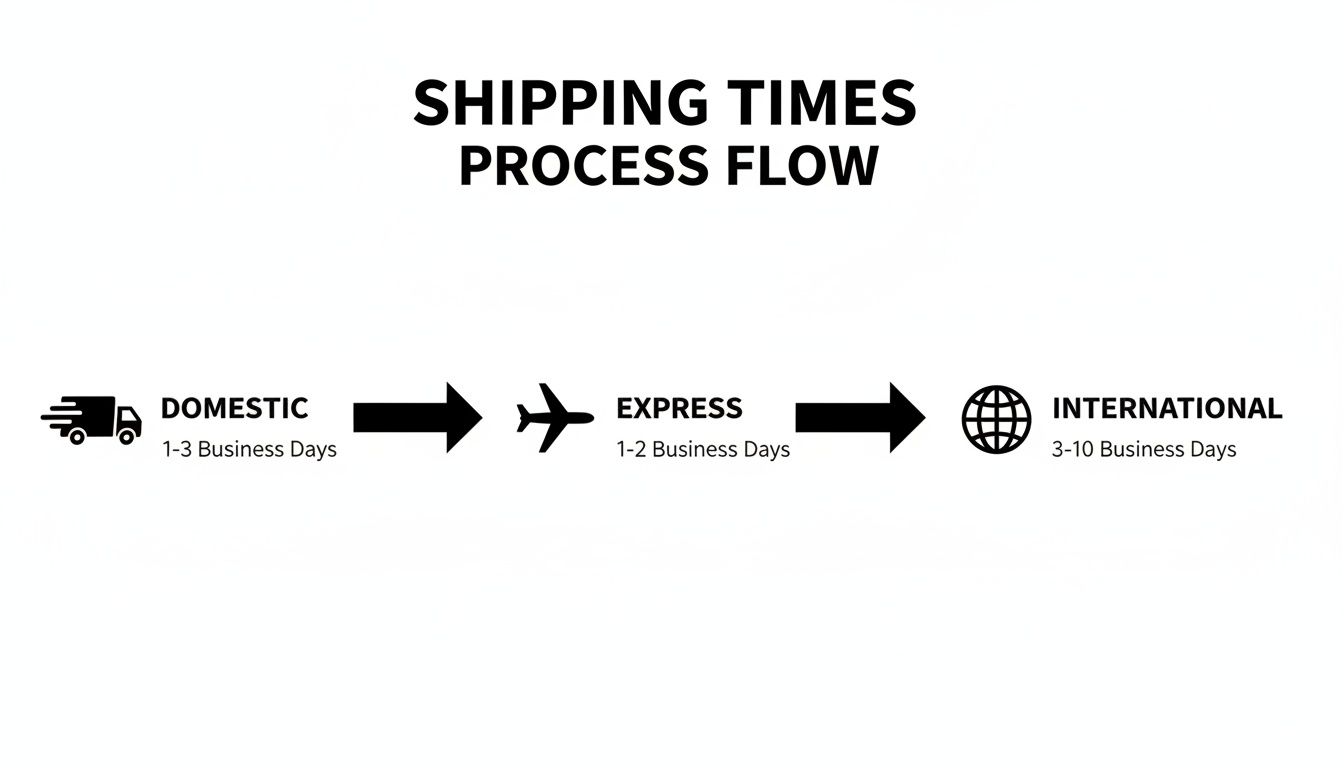
As you can see, the logistics for domestic, express, and international shipments are built on entirely different foundations, which is what really dictates their speed.
It's More Than Just Distance and Speed
While the shipping method is the star of the show, a few other key players can seriously affect the timeline. Following good shipping and fulfillment best practices is a great start, but there are other variables at play.
For instance, you have to think in terms of business days, not calendar days. Most shipping carriers operate Monday through Friday. So, if you send a package on a Friday with a three-day delivery window, don't expect it on Monday—it will likely arrive the following Wednesday. Weekends and public holidays are essentially "pause" buttons on your package's journey.
The carrier's logistics network is a complex beast. How efficient they are, where their sorting centers are located, and the sophistication of their route-planning software all determine how fast a package moves. A carrier with a dense, well-managed network simply has fewer opportunities for delays.
Finally, you can’t forget about the wild cards. Global events can throw a massive wrench in the works. We’ve seen firsthand how major disruptions can cause shipping reliability to plummet, with transit times becoming wildly unpredictable. Asia-US shipping lanes that were once clockwork suddenly stretched out for weeks.
These dynamics are constantly shifting, which highlights just how volatile global shipping can be. It’s also why having a tool like Instant Parcels is so valuable—it cuts through the chaos by giving you clear, standardized status updates you can actually understand. To see how differently various carriers operate, check out our guide on the differences between UPS and USPS.
Decoding Delays: Why Your Package Gets Stuck
We’ve all been there. You’re glued to the tracking page, hitting refresh again and again, only to see that your package hasn’t moved an inch for days. It’s incredibly frustrating, but the truth is, shipping delays are rarely caused by a single mistake.
It’s more like a massive, unexpected traffic jam on a highway than one wrong turn. A whole chain of events, often far beyond anyone’s control, can bring things to a halt. When you ask, "how long does shipping take?" these potential bottlenecks are a big part of the answer.
Common Causes for Shipping Delays
Sometimes, the reason your package is stuck is pretty straightforward, even if it's a pain. These common issues can add anywhere from a few hours to several days to your transit time.
- Severe Weather: You can't argue with Mother Nature. Major storms, floods, or wildfires can completely shut down transportation routes, grounding flights and stopping delivery trucks in their tracks. A single blizzard at a major hub can create a ripple effect that delays packages across the entire country.
- High Package Volume: Think about the holidays or big sale days like Black Friday. The sheer number of packages flooding the system can overwhelm even the most efficient sorting facilities. Every network has its limit.
- Incorrect Address Information: A simple typo in a street name or a wrong digit in the postcode can send a package on a wild goose chase. The carrier's system might catch it and try to make a correction, but that almost always requires a person to step in, pausing the delivery until everything is sorted out.
The Hidden Hurdles in Logistics
Beyond the obvious culprits, there are more complex, behind-the-scenes challenges that can stop a package dead in its tracks. These are the kinds of problems you won't see on a standard tracking page but can seriously impact your delivery window.
A huge one is port congestion. It can add days, or even weeks, to a shipment's journey. At the world's busiest ports, it’s not uncommon for ships to wait in line for days just for a spot to dock. This creates a massive backlog that cascades down the entire supply chain.
Then there’s customs. For any international shipment, this is a major hurdle. Your package isn't just sitting in a queue; it's undergoing a formal inspection. If paperwork is missing, incomplete, or the contents raise a red flag, it can be held for a long time. This is often where tracking seems to freeze because the parcel is temporarily out of the carrier’s hands and in the custody of government officials.
A delay is rarely a single event. It is often a series of small, interconnected problems—a truck breaking down, a sorting machine malfunction, or a container being misplaced—that combine to push back your delivery date.
These holdups are often categorized under a specific tracking status. To get a better handle on what’s happening when your package gets flagged, you can learn more about what a shipment exception means in our detailed guide.
Understanding these potential roadblocks makes it clear why delivery dates are always estimates. When your shipment takes an unexpected detour, having a powerful tracking tool like Instant Parcels is key to staying informed and knowing what's really going on.
Getting a Handle on Your Shipment's Journey
So, your package is finally on its way. Now comes the hard part: the waiting. If you've ever found yourself endlessly refreshing carrier websites, trying to decode cryptic status updates, you know how frustrating it can be. The question of "how long does shipping really take?" gets a lot more stressful when you have no idea where your package actually is.
This is where you can take back control. Forget juggling a dozen browser tabs or trying to remember which tracking number goes with which carrier. A unified tracking platform pulls everything together into one clean, simple dashboard. Think of it as a universal remote for all your shipments.
The beauty of a tool like Instant Parcels is how straightforward it is. You don't need to know if your package is in the hands of FedEx, USPS, or some small regional courier. All you need is the one thing you already have: the tracking number.
From Vague Updates to a Clear Picture
The entire process is built to cut out the guesswork. You just copy and paste any tracking number into the search bar, and the system does the heavy lifting. It automatically figures out the carrier and fetches all the important details, laying them out in a way that actually makes sense.
You can finally say goodbye to vague statuses like "In Transit" that leave you wondering. Instead, you get a clear, visual timeline of your package's entire trip. That transparency turns a frustrating waiting game into an empowering one, giving you the real-time information you need.
For instance, the Instant Parcels dashboard gives you a complete overview of your shipment's journey at a glance.
This visual map doesn't just tell you the current status; it shows you the entire path your package has traveled, making it incredibly easy to follow its progress.
Features That Genuinely Ease the Anxiety
A great tracking platform does more than just tell you which carrier has your package. It offers tools designed to give you genuine peace of mind, answering your questions before you even have to ask them.
- Visual Route Mapping: Why settle for a list of city names? See your package's journey unfold on an actual map, making it intuitive to understand where it's been and where it's going next.
- Real-Time Status Alerts: Get a heads-up the second there's an update. You'll know immediately when your package is out for delivery or if it's hit an unexpected snag.
- Plain English Updates: Different carriers often use confusing internal jargon. A platform like Instant Parcels translates these statuses into simple, consistent terms so you’re never left scratching your head.
- One Dashboard for Everything: If you're expecting several packages, you can see them all in one place. This is a game-changer for online sellers juggling multiple orders.
The whole point of a unified tracking system is to turn shipping from a source of stress into something transparent and predictable. It’s about having all the information you need, right when you need it, without any of the usual runaround.
At the end of the day, confident tracking isn't about pretending delays never happen—they do. It’s about knowing exactly what’s going on when they do. By using a single, powerful tool, you can stop hopping between different carrier sites and get a clear, accurate picture of your shipment's journey from start to finish. It puts you back in the driver's seat, replacing uncertainty with clarity and making the whole shipping experience a lot less painful.
Navigating International Shipping Complexities
Sending a package across borders is a whole different ball game. When you're dealing with an international order, the question "how long does shipping take?" has a much more complicated answer. It's not just about the distance; it's about navigating a maze of regulations, handoffs, and inspections that simply don't exist for domestic deliveries.
Think of your package as a traveler. It needs a passport and a visa to get where it's going. It can't just cross the border—it has to be officially processed through customs clearance, where government agents inspect the shipment, verify its contents, and figure out any taxes or duties owed.
This single step is almost always the biggest wild card in the delivery timeline. Your package isn't just sitting in line; it's undergoing a formal review that can take a few hours, several days, or even weeks if the paperwork isn't perfect.
The Customs Black Hole
We've all been there. You're tracking an international package, and suddenly it seems to fall off the face of the earth right after arriving in the destination country. The tracking status gets stuck on "Held at Customs" for days, sometimes with no updates at all. It's incredibly frustrating.
This happens because the package has temporarily left the hands of your shipping carrier and entered a government facility. During this limbo, the carrier has no control and often gets very little information, creating a communication blackout that's stressful for everyone involved.
International shipping is a team sport played by different national postal services and private carriers. A universal tracking tool like Instant Parcels acts as your team captain, ensuring you have a seamless view of the game even when the ball is passed from one player to another.
Global Events and Unforeseen Delays
On top of customs, major global events can throw a massive wrench into the works. Remember the Red Sea disruptions? People ordering products from Asia suddenly saw their packages rerouted around Africa's Cape of Good Hope. A typical two-week transit became an eight-week ordeal.
This kind of volatility is exactly why having a reliable, multi-carrier tracking tool isn't just a nice-to-have; it's essential for anyone involved in cross-border e-commerce. A great platform pulls in real-time updates from every single carrier handling the package along its journey. This gives you a clear, consolidated view of its route and any revised delivery dates, which is critical for managing customer expectations when the unexpected happens.
Common Questions About Shipping Times
Even with a good grasp of how shipping works, you're bound to run into a few head-scratchers when tracking your own package. Let's walk through some of the most common questions and what the answers actually mean for you.
Why Has My Tracking Been Stuck On “In Transit” For Days?
This one is probably the top cause of shipping anxiety, but it’s usually nothing to worry about. When your tracking says “In Transit,” it just means your package is on the move between two major points in the carrier's network.
Think of it this way: your package is on a long-haul truck driving across the country. It won't get scanned again until it reaches the next major sorting facility, which could be hundreds of miles and a couple of days away. It’s still moving, even if the tracking status isn’t updating every hour.
Does “Out For Delivery” Guarantee My Package Will Arrive Today?
Pretty much, yes! Seeing “Out for Delivery” is the best update you can get. It means your package has been scanned, loaded onto the local delivery truck, and is on its way to your doorstep that very day.
Could something go wrong? In theory, yes—a truck breakdown or a sudden road closure could cause a delay, but this is incredibly rare. Just keep in mind that delivery windows can stretch late into the evening, sometimes up to 9 PM, so don't panic if it's not there by 5 o'clock.
An estimated delivery date is a highly educated guess based on average transit times, not a guarantee unless you've paid for a time-definite service. Factors like weather or high package volumes can shift the date, so it's best to treat it as a reliable target rather than a firm deadline.
How Accurate Are Estimated Delivery Dates?
For the most part, carriers are pretty good at estimating delivery dates. They use complex systems that look at the shipping service you chose, the route, and historical data to make a solid prediction. For standard domestic shipments, they hit the mark a vast majority of the time.
But these estimates are just that—estimates. They can't account for real-world chaos. Here are a few things that can easily throw a wrench in the works:
- Weather Events: A blizzard shutting down a major airport hub will create a domino effect.
- Peak Seasons: During the holidays or big sales events, the sheer volume of packages can slow everything down.
- Operational Snags: Even a simple conveyor belt malfunction at a sorting center can cause a temporary backlog.
What Should I Do If My Package Is Late?
So your package is officially past its estimated delivery date, and the tracking has gone silent for a few days. It's time to be proactive.
Start by contacting the carrier directly with your tracking number. Their customer service team often has access to more detailed internal notes than what you see on the public tracking page. If they can’t give you a clear answer, your next best step is to contact the company you bought from. As the shipper and the carrier’s direct customer, they have much more leverage to launch an official investigation or file a claim on your behalf.