
The Ultimate Guide to a Universal Package Tracker
Ever found yourself juggling a dozen open tabs, one for FedEx, one for USPS, another for DHL, just to figure out where your stuff is? A universal package tracker is the simple, elegant solution to that chaos. It's a single hub that pulls all your shipment information from hundreds of different carriers into one clean, easy-to-read dashboard.
What Is a Universal Package Tracker and Why Use One?
Let’s paint a familiar picture. You've just finished a little online shopping spree and have three packages on the way from three different stores. One is coming via USPS, another is with FedEx, and the third is an international shipment handled by DHL. The old way of tracking involves digging through emails, copying three different tracking numbers, and plugging each one into a separate carrier website. It's clunky, time-consuming, and honestly, a bit of a headache.
A universal package tracker gets rid of all that.
Think of it like a financial aggregator for your deliveries. You know how apps like Mint or Personal Capital connect to all your bank accounts, credit cards, and investments to give you one clear view of your finances? A universal tracker does the exact same thing for your packages. It’s the master key that unlocks tracking data from a massive network of global carriers, then organizes it all in one place for you.
The Power of a Single Dashboard
At its heart, a universal tracker is all about making that post-purchase waiting game a lot less stressful. You just pop any tracking number into one search bar, and the system instantly figures out the carrier and pulls up the latest updates. In an e-commerce world, this kind of simplicity isn't just a nice-to-have; it's essential.
The sheer volume of packages moving around the globe is staggering. The global parcel delivery market is expected to grow from USD 520.59 billion in 2025 to USD 727.65 billion by 2032. To put that into perspective, experts estimate that around 5,900 parcels will be shipped every second worldwide in 2025. With that many packages in transit, having a simple, reliable way to track them is more important than ever for both shoppers and sellers.
A universal tracker transforms the chaotic experience of monitoring multiple shipments into a calm, controlled process. It provides clarity and peace of mind, answering the question "Where is my order?" before you even have to ask.
To really see the difference, let's compare the old way with the new.
Traditional Tracking vs a Universal Package Tracker
This table breaks down how a unified tool changes the game.
| Feature | Traditional Method (Multiple Carrier Websites) | Universal Package Tracker (e.g., Instant Parcels) |
|---|---|---|
| Tracking Process | Manually visit each carrier's site. Copy and paste each number. | Enter any tracking number into one search bar. |
| Carrier Identification | You have to know which carrier is handling the shipment. | Automatically detects the carrier from the tracking number. |
| Real-Time Updates | Requires refreshing multiple tabs to check for new scans. | A single dashboard shows the latest status for all packages. |
| Overall View | No single view; each package is isolated on its own site. | A unified list shows all your shipments in one place. |
| Time & Effort | High. Involves searching emails and navigating different websites. | Low. A few clicks and you're done. |
The contrast is clear. One method is fragmented and manual, while the other is integrated and effortless.
Why This Matters for You
The benefits go way beyond just saving a few clicks. For individual shoppers, a good universal tracker can seriously cut down on "delivery anxiety"—that feeling of uncertainty when you don't know where your package is. It becomes your single source of truth. For businesses, it’s a game-changer for customer service and keeping operations running smoothly.
Here’s what a centralized tracking system really gives you:
- Effortless Monitoring: Keep an eye on every shipment, no matter the carrier, from one intuitive interface.
- Time Savings: Stop hopping between carrier websites. That time adds up, and frankly, it's frustrating.
- Enhanced Visibility: Get a bird's-eye view of all your packages, both coming in and going out.
- Proactive Updates: Get notified automatically as your package moves, from "in transit" to "out for delivery."
Tools like Instant Parcels are built specifically for this. By gathering data from countless couriers around the world, it offers a truly seamless tracking experience for everyone. If you're tired of the tracking juggle, our guide on choosing the best package tracking app can help you find the right fit. This move toward unified tracking is making the global supply chain more transparent and accessible for all of us.
How Universal Trackers Decode Global Shipping Data
Ever wondered how a universal package tracker can take a random string of numbers and letters and instantly pinpoint your package? It’s not magic, but it’s a brilliant bit of technology built on two core pillars working together. Let's lift the hood and see how these systems make sense of the tangled web of global shipping.
First up, the system has to figure out who has your package. This is done through tracking number pattern recognition. Every carrier, from USPS to DHL, uses a unique format for their tracking numbers. These aren't just random digits; they follow specific rules about length, character types, and starting numbers that act like a digital fingerprint.
Think of it like an expert recognizing a car model just by the shape of its headlights. A universal tracker does the same thing. For instance, it knows that a 22-digit number usually belongs to USPS, while a 12-digit number is a classic FedEx format. This identification is the critical first step—it tells the tracker which door to knock on to get the details.
Connecting Directly to the Source
Once the tracker knows the carrier, the real work begins: carrier API integration. An API (Application Programming Interface) is just a fancy term for a secure, direct pipeline between the tracker and the carrier's own internal database. It’s like having a dedicated hotline straight to FedEx's or UPS's system, allowing the tracker to ask for and receive real-time updates on your specific shipment.
This direct link is what makes the information so reliable. The status you see isn't an educated guess; it's the exact same data you’d get on the carrier’s official website, just pulled instantly and displayed in one convenient place.
This is a simplified look at how a universal tracker acts as a central hub, pulling data from various carriers into a single, cohesive view.
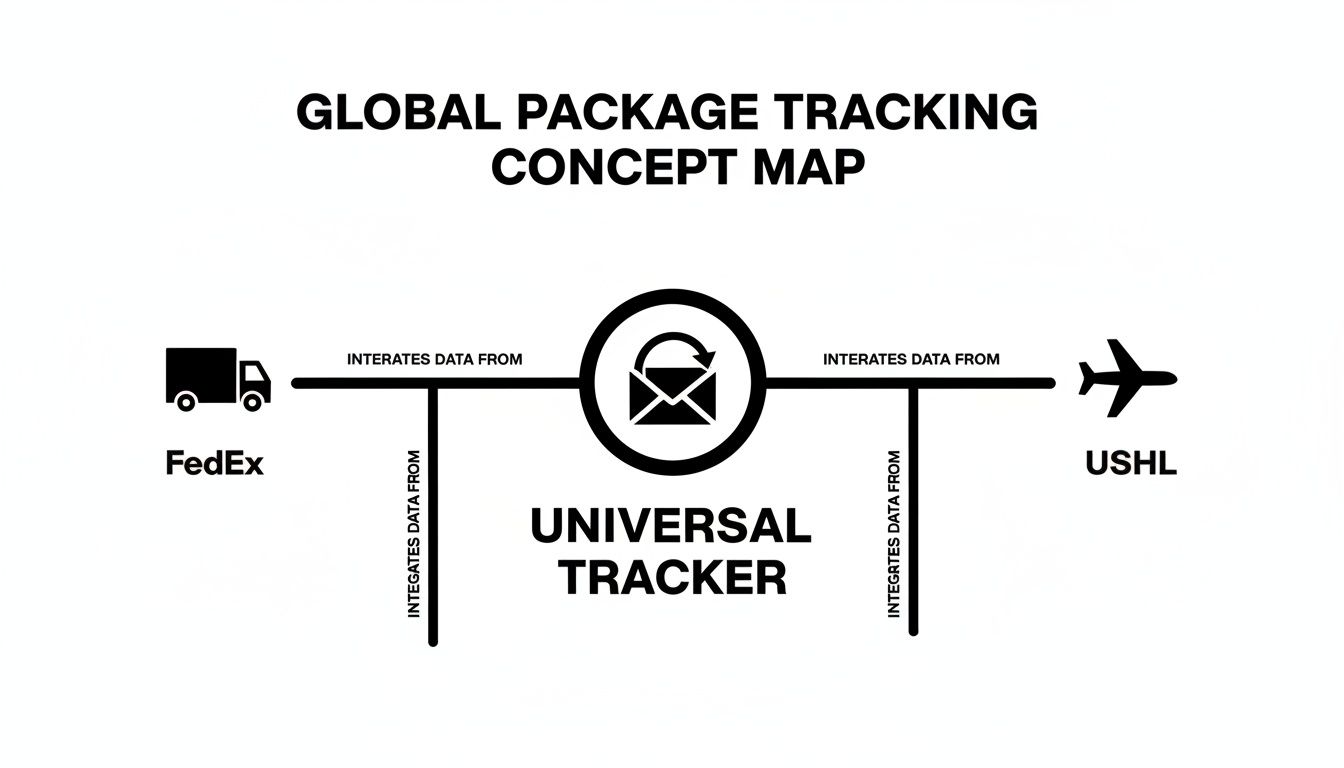
As the diagram shows, the tool's strength comes from its ability to merge all these separate data streams into one easy-to-follow story for the user.
Translating the Language of Logistics
Beyond just grabbing the data, a great universal tracker also acts as an interpreter. Each carrier uses its own internal jargon for shipping statuses, which can be incredibly confusing. "Manifested," "Pre-shipment," and "Label Created" might sound different, but they all mean the exact same thing: the package is officially in the system.
A good tracker standardizes this information, translating confusing carrier-speak into plain English.
Carrier Term: "Tendered to Delivery Service Provider"
- What it really means: Your package has been passed to the local post office for the final delivery.
Carrier Term: "Arrival Scan"
- What it really means: It just got to the next sorting facility on its route.
Carrier Term: "Exception"
- What it really means: There's a problem—maybe bad weather or a wrong address—that’s causing a delay.
By standardizing these updates, a universal tracker cuts through the noise. It gives you a clear, consistent narrative of your package's journey, so you don't need a degree in logistics to figure out what's going on.
This two-step process—pattern recognition followed by API data retrieval and translation—is exactly how platforms like Instant Parcels deliver such a smooth and dependable experience. It ensures that whether your package is coming from across town or across the globe, you get accurate, understandable information from start to finish.
What's In It For Me? Benefits for Shoppers, Sellers, and Support Teams
So, why does a universal package tracker even matter? It’s more than just a convenient gadget; for anyone buying or selling online, it's a game-changer. The benefits aren't just theoretical—they solve real, everyday problems for everyone involved, from the customer waiting by the door to the business owner juggling hundreds of orders. It all boils down to one simple idea: having everything in one place brings clarity, efficiency, and peace of mind.
For the everyday online shopper, the biggest win is killing "delivery anxiety." We’ve all been there, right? That little knot of worry when you're not sure where your package is, especially if it's something you really need. A universal tracker cuts through that chaos. It pulls all your orders into one simple, clean timeline, so you can stop digging through emails for tracking numbers and trying to remember which company is delivering what.
What was once a stressful scavenger hunt becomes a quick, one-click check-in. Instead of a dozen open browser tabs, you get a single dashboard telling you the whole story of everything headed your way.
A Must-Have for E-commerce Businesses
If you're an e-commerce seller, the advantages are even bigger, hitting your bottom line and making customers happier. Think about the most common question your support team gets: "Where Is My Order?" (WISMO). Every single one of those inquiries costs you time and money.
A universal tracker lets you get out in front of those questions. When you give customers one easy, shareable tracking link that works for any carrier, you empower them to find their own answers. This does more than just save your support team's time; it builds trust and shows customers you've got their back.
A great post-purchase experience isn’t a nice-to-have anymore—it's what customers expect. A universal package tracker is the foundation of that experience, turning a moment of potential frustration into a chance to build real brand loyalty.
It’s not just about customer service, either. Sellers can dramatically improve operational efficiency with a universal tracker. It becomes your command center for every package leaving your warehouse. Your team can spot delays or delivery problems at a glance, without having to manually check each order on a dozen different carrier websites.
One Hub for Support and Logistics
This centralized power is a lifesaver for the teams on the front lines.
For Customer Support Agents: WISMO tickets can be solved in seconds. With all tracking data in one system, there's no more asking customers for carrier details or switching between different logins. A quick search gives the agent the exact same view the customer sees, leading to fast, accurate answers.
For Logistics Coordinators: Juggling multiple shipments—both coming in and going out—is a massive headache. A universal dashboard provides a bird's-eye view of your entire supply chain. Teams can track inventory on the move, predict customs hold-ups, and coordinate arrivals with much more precision, helping prevent stockouts and keeping the whole operation humming.
The courier, express, and parcel (CEP) market is absolutely exploding, with projections showing it could grow by USD 188.1 billion between 2025 and 2029. A huge part of that is driven by e-commerce demanding faster, more transparent shipping. This massive increase in package volume across a growing list of carriers makes a unified tracking tool essential. You can learn about the CEP market growth on PR Newswire if you want to dive deeper into the trend.
Ultimately, a universal package tracker acts as a bridge. It connects shoppers, sellers, and support staff with a shared, transparent view of the delivery journey, making the entire process smoother and building confidence for everyone.
A Practical Walkthrough of Instant Parcels
Enough with the theory—let's see how a universal package tracker actually works in the real world. Think of this as your hands-on guide to getting instant answers with Instant Parcels. We’ll walk through tracking your very first package together, step-by-step. You'll see just how simple it is to go from reading this article to tracking like a pro in a few seconds.
No complicated sign-ups. No confusing dashboards. The whole experience is built around one simple, powerful search bar, so anyone can use it without any technical know-how.
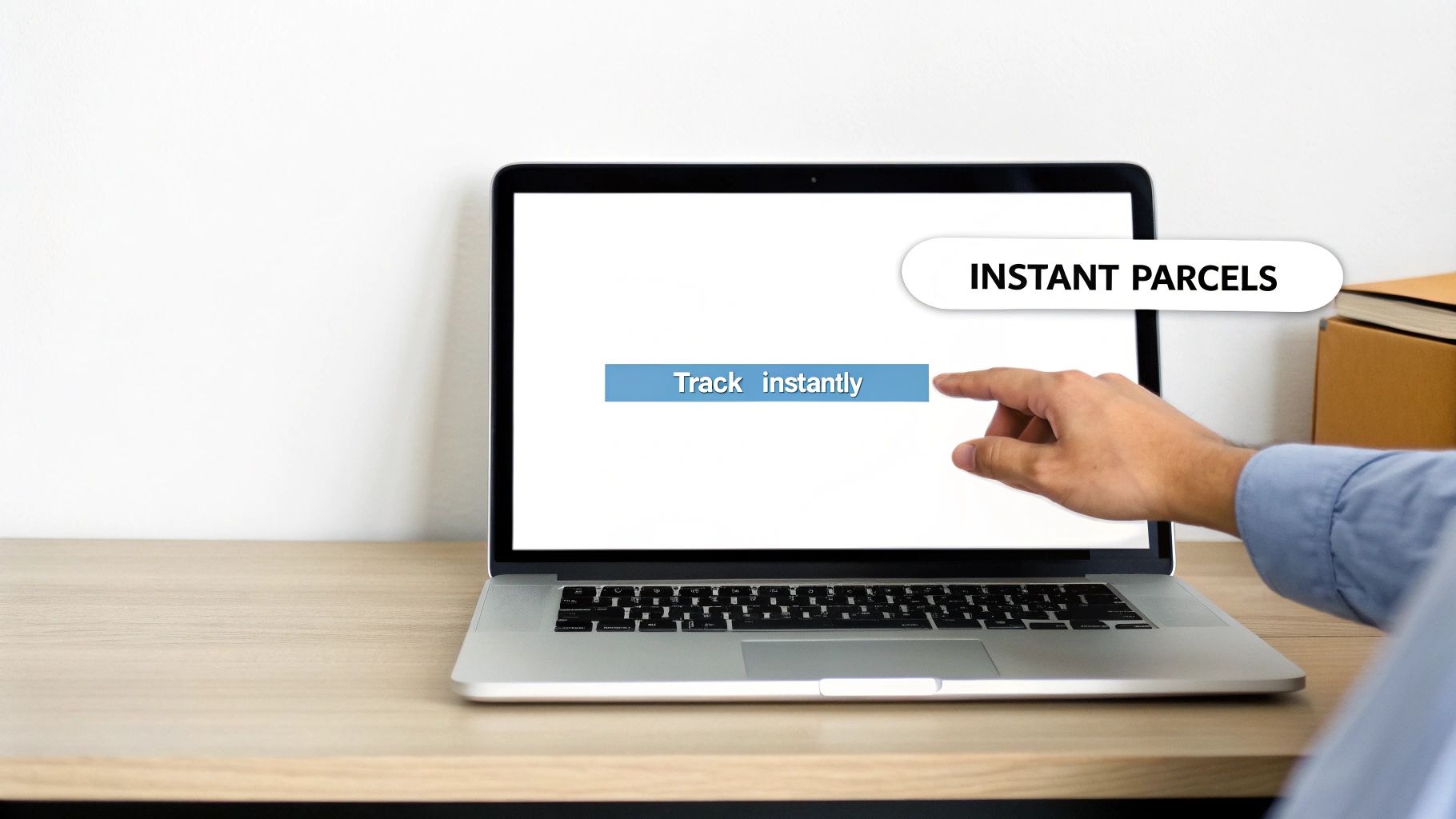
See how the tracking bar is front and center? That’s intentional. The design is all about getting you the information you need, fast, without any fluff or distractions.
Your First Track in Four Simple Steps
Getting started is as easy as sending a text. The whole platform is built for speed, cutting out all the extra steps to get you right to the good stuff: your package’s location.
Here’s all it takes:
- Head to the Website: Just open your browser and go to the Instant Parcels homepage. You can’t miss the tracking field.
- Grab Your Tracking Number: You'll find this in your order confirmation email or on the retailer's website. If you're stuck, our guide on how to find your tracking number has you covered.
- Copy and Paste: Paste the number right into the search bar. Don't worry about figuring out the carrier—the system does that for you automatically.
- Click 'Track': Hit the button and watch the results pop up almost instantly.
That's it. Seriously. In just a few clicks, you’ve used a universal package tracker to find exactly where your shipment is.
Making Sense of Your Tracking Results
Once you click 'Track', you land on a results page that lays out all the important details in a clean, easy-to-understand format. This is where you see the data aggregation working its magic, turning a mess of logistics jargon into a clear, simple story.
Here's a quick rundown of what you’ll see:
- Auto-Detected Carrier: Right at the top, you'll see the carrier's name and logo (like FedEx, USPS, or DHL), confirming the system got it right.
- Current Status: A simple summary of where your package is, like "In Transit" or "Out for Delivery."
- Estimated Delivery Date: The carrier's best guess for when your package will arrive, so you know when to be on the lookout.
- Complete Transit History: A play-by-play log of every scan and update, showing your package’s entire journey from the warehouse to you.
The whole point of the results page is to give you a complete picture at a glance. You get the full story of your shipment's journey without having to decode confusing codes or jump between different carrier websites.
Tracking Multiple Packages at Once
So, what happens when you’re waiting on more than one delivery? Instant Parcels handles that just as easily.
Just enter each tracking number into the search bar, either separated by a comma or on a new line. The system will process all of them and show you a neat, consolidated list. This simple feature turns the tool from a one-off lookup into your personal command center for managing every single package you have on the way.
Integrating Universal Tracking into Your Business Workflow
When you move beyond tracking a single personal purchase, a universal package tracker becomes an engine for business efficiency. For any business shipping products, the real win isn't just watching one package get to its destination. It’s about building that visibility right into your daily operations so you can proactively manage dozens, or even hundreds, of shipments at once. Suddenly, a simple tool becomes a cornerstone of your customer experience strategy.
Think about it. You could start your day with a quick scan of every single outbound shipment. Instead of waiting for a customer to email you asking where their order is, you can spot a delay while it's still in transit and let them know before they even realize there’s a problem. That's how you turn a potential negative into a moment of incredible customer care.
Empowering Teams with Centralized Data
The true power of a universal tracker in a business environment is how it gives everyone a single source of truth. Your customer support, logistics, and marketing teams can all work from the same real-time information. This cuts out the confusion and helps everyone solve problems faster, creating a much more buttoned-up and responsive operation.
To really get the most out of a universal package tracker, the key is a smooth integration of applications with the tools you already use. When your tracking tool "talks" to your other systems, its value skyrockets across the entire company.
This can look different depending on your business's size and needs.
For Customer Support: Agents can finally stop juggling a dozen carrier websites. With a universal tracker, they can answer any "Where Is My Order?" (WISMO) question in seconds, giving customers the right answer, right away, every time.
For Marketing and Sales: Your team can drop shareable tracking links directly into post-purchase email flows. This does more than just cut down on support tickets; it creates a branded, professional experience that keeps customers engaged long after they've clicked "buy." We cover more on how this can improve the e-commerce customer experience in our detailed guide.
From Manual Checks to Automated Workflows
If you're a small business, your workflow might start out manual, but it's still a game-changer. Your daily routine could be as simple as pasting all of today's shipped tracking numbers into an Instant Parcels dashboard. Just like that, you have a bird's-eye view of every single order on its way to a customer.
As your business scales, however, you can start automating this process. This is where API integrations come into the picture.
An API is what allows your own software—like your e-commerce platform or customer relationship management (CRM) system—to automatically pull tracking data from the universal tracker. This means your internal systems are always updated in real-time without anyone having to lift a finger.
This level of integration unlocks some seriously powerful capabilities:
- Automated Customer Alerts: You could set up a rule to automatically send an email or SMS to a customer the moment their package is marked "Out for Delivery."
- Internal Delay Flags: You could create a workflow that automatically flags any shipment that’s been stuck in the same status for more than 48 hours, pinging your support team to look into it.
- Performance Analytics: You can pull data on average delivery times from your different carriers, helping you make smarter decisions about which shipping partners to use.
By weaving a universal package tracker into the fabric of your operations, it stops being a passive lookup tool and becomes an active, intelligent part of how you do business. It helps you manage customer expectations, smooth over potential friction, and build a reputation for being a reliable company that people want to buy from again and again.
Choosing a Secure and Reliable Universal Tracker
Handing over your shipping details to an online tool requires a bit of trust, especially when that information is tied to your online orders. If you're thinking about using a universal package tracker, it's completely natural to have questions about the safety of your data. The truth is, not all trackers are built the same, and knowing how to spot a secure service is the key to protecting your information.
Think of a reliable service like Instant Parcels as a secure window. It pulls data directly from official carrier APIs without needing to store your personal information. Your tracking number is just a key used to unlock the shipment status—it’s not used to build a profile on you. This is a critical difference that separates trustworthy platforms from the riskier ones.
Key Security Features to Look For
When you're sizing up any universal tracker, your privacy has to come first. There are a few non-negotiable features that will tell you everything you need to know about how seriously a platform takes your security.
Here’s what to keep on your checklist:
- Secure Connection (HTTPS): Before you do anything else, look for that little padlock icon in your browser's address bar. This confirms the site uses an encrypted HTTPS connection, which scrambles the data sent between you and the website so no one can snoop on it.
- Clear Privacy Policy: A legitimate service won't hide its privacy policy in the fine print. It should be easy to find and written in plain English, explaining what data they collect and—just as important—what they don't.
- Direct Carrier Data: The best trackers get their information straight from the source by using official carrier APIs. This not only guarantees the tracking data is accurate but also shows the tracker is playing by the rules instead of scraping information in sketchy ways.
Choosing a universal package tracker is an act of trust. A secure platform earns that trust by being transparent about its data practices and prioritizing user safety above all else, using your tracking number only for its intended purpose.
The Hidden Risks of Some Browser Extensions
You also need to be a little wary of browser extensions that offer universal tracking. While some are perfectly fine, others can be wolves in sheep's clothing. A poorly designed extension might be quietly monitoring your browsing habits or collecting personal details that have nothing to do with tracking your packages.
This is where a dedicated, web-based tool like Instant Parcels offers a much safer approach. By sticking to a single job—package tracking—it minimizes data exposure and delivers a secure, dependable service. You get all the convenience of a universal package tracker without having to gamble with your digital privacy, giving you peace of mind from the moment you click "buy" to the second it lands on your doorstep.
Still Have Questions? Let's Clear Things Up
Even after seeing how a universal tracker works, you might still have a few questions floating around. That's perfectly normal. Here are some quick, no-fluff answers to the things people most often ask.
Think of this as the final piece of the puzzle, designed to help you start tracking with total confidence.
Just How Accurate Is This Information?
It’s spot-on. The data you see is the exact same information you’d get by digging through a carrier’s official website. A high-quality tracker like Instant Parcels isn’t making educated guesses; it's pulling real-time data directly from the carrier's own system using a secure API connection.
Basically, you're getting the official story straight from the source. The only difference is that it's presented in one clean, easy-to-read format instead of being spread across a dozen different carrier sites.
Can I Really Track a Package From Any Carrier?
Pretty much! The best platforms can connect with hundreds of carriers all over the globe, which covers almost any package you’ll ever send or receive. We’re talking about the big international players and the national postal services you use every day.
- Global Giants: Think FedEx, DHL, UPS, and their peers.
- National Mail: From USPS and Royal Mail to Canada Post and countless others.
While the coverage is massive, it’s always a good idea to double-check if you're using a very small or regional courier. That said, these platforms are always adding new carriers to their network to get as close to 100% coverage as possible.
The real magic of a universal package tracker is its massive, interconnected network. It takes the chaos of the global shipping world and filters it into one simple, clear view for you.
Is It Safe to Put My Tracking Number on a Third-Party Site?
Absolutely, provided you stick with a trusted service. A reputable tracker uses your tracking number for one thing and one thing only: to fetch your package’s status. It never connects that number to your name, address, or other personal details.
Your best bet is to choose a provider that has a straightforward privacy policy and uses a secure connection (look for the little padlock icon in your browser’s address bar). At Instant Parcels, we built our platform around security and trust, so you can be sure your information is handled the right way.
Do I Have to Sign Up for an Account?
Not at all. Many of the best services, including Instant Parcels, let you track a package right away with no account needed. It's perfect when you just need a quick update on a single delivery.
But if you find yourself tracking packages often, creating a free account is a game-changer. It usually unlocks some great perks, like saving a history of all your shipments, giving packages custom nicknames ("Mom's birthday gift"), and seeing everything on one simple dashboard. For regular online shoppers or small business owners, it’s a no-brainer.