
What is difference between ups and usps: A Quick E-commerce Shipping Guide
The real difference between UPS and USPS comes down to what they were built to do. At its heart, UPS is a private, for-profit logistics machine. It’s engineered for guaranteed, time-sensitive deliveries and handling heavy packages, which is why it's a staple for B2B and high-value e-commerce. On the flip side, USPS is a federal agency with a universal service mandate, making it the undisputed champ for affordable, lightweight residential deliveries to literally every address in the country.
UPS vs USPS: The Core Differences for E-commerce
When you're running an online store, picking between UPS and USPS isn't just a matter of preference. It's a strategic decision that directly shapes your shipping costs, delivery speed, and ultimately, your customer's happiness. Think of it less as choosing a "better" carrier and more as selecting the right tool for the job.
UPS operates as a global powerhouse built for businesses that can't afford a missed deadline. Their services are often guaranteed, backed by incredibly detailed tracking and solid options for those bulky or oversized items. This makes them the obvious choice for time-critical shipments where a delay could cost you a customer.
Meanwhile, the United States Postal Service (USPS) is legally required to serve every single household in America, no matter how remote. This massive, built-in network makes them exceptionally efficient and cheap for the small, lightweight packages that make up the bread and butter of most e-commerce shipments.
Market Share Tells the Story
You can see this difference in their market share. While USPS handles an incredible volume of 6.9 billion pieces annually, grabbing about 31% of the market, UPS is laser-focused on profitability. They shipped fewer packages at 4.7 billion but pulled in a commanding 35% of the total market revenue. This really shows how UPS nails the higher-value, premium shipping game. You can dig deeper into shipping market dynamics to see how these giants compete.
Key Takeaway: USPS is all about volume and affordability for small stuff, thanks to its public service role. UPS dominates in revenue and reliability by focusing on guaranteed, business-centric logistics. The right choice boils down to a simple question: is cost or speed your top priority for this shipment?
This high-level view is just the starting point. The best carrier for your online store will change depending on what you sell, where your customers are, and what they expect. To make it clearer, here’s a quick summary of their main differences.
Quick Comparison: UPS vs. USPS Key Differentiators
This table gives you a snapshot of what truly sets these two carriers apart, helping you see where each one shines.
Feature | UPS (United Parcel Service) | USPS (United States Postal Service) |
|---|---|---|
Primary Role | Private logistics company focused on profit and guaranteed services. | Federal agency with a universal service obligation to every US address. |
Best For | Heavy/large packages, time-sensitive deliveries, B2B shipments, detailed tracking. | Lightweight packages (under 5 lbs), residential deliveries, cost-effective shipping. |
Cost Structure | Generally higher base rates with surcharges for residential delivery. | Often the most affordable for small parcels, with fewer surcharges. |
Weekend Delivery | Saturday delivery is available for an extra fee on many services. | Saturday delivery is standard for most services at no additional cost. |
Understanding these core strengths and weaknesses is the first step toward building a shipping strategy that saves you money and keeps your customers happy.
Comparing Domestic Shipping Services and Price Models

When you're trying to figure out the real difference between UPS and USPS, you have to look beyond the logos and get into the nitty-gritty of their domestic services and pricing. Each one offers a menu of options built for different needs, from slow-and-steady ground shipping to critical overnight deliveries. The choice you make hits your bottom line and your customer’s happiness directly.
As a private company, UPS structures its services around business needs, offering a clear hierarchy of speed-based tiers. For most e-commerce sellers, UPS Ground is the workhorse service for reliable, day-definite delivery when speed isn't the absolute top priority. It really hits the sweet spot between cost and performance, especially for heavier packages.
Need it there faster? UPS 3 Day Select and UPS Next Day Air offer guaranteed delivery windows. You'll pay a premium for these, but they are absolutely essential for high-value goods or when a delivery promise is a core part of your brand's reputation.
Decoding the Price Models
The true puzzle of shipping costs lies in how each carrier calculates its rates. UPS pricing is notorious for its surcharges—you’ll see extra fees for residential delivery, fuel, and shipping to remote areas. If you're not paying attention, these can quickly inflate your shipping budget.
USPS, on the other hand, generally offers a simpler pricing model with fewer surprise fees, which is why it's so popular for businesses shipping straight to customers' homes. Their services are designed for accessibility and affordability, particularly for smaller packages.
USPS Priority Mail is the go-to for many, delivering in 1-3 business days. Its flat-rate boxes are a game-changer for shipping heavy but small items across the country for one predictable price.
USPS First-Class Mail is practically unbeatable for anything under one pound. It’s the most economical way to send light items like t-shirts, accessories, or books.
USPS Ground Advantage (which absorbed Parcel Select Ground) is your budget-friendly option for larger, non-urgent shipments, though you trade cost savings for slower delivery times.
Key Insight: UPS pricing is built for guaranteed speed and business-critical shipments, but watch out for those extra fees. USPS focuses on affordable, simpler rates for common e-commerce packages, especially those headed to a residential mailbox.
The Impact of Dimensional Weight
One of the sneakiest factors in shipping costs is dimensional (DIM) weight. Both UPS and USPS use it, but how it's applied can make a huge difference to your final bill. DIM weight is a formula that calculates a theoretical weight based on a package's dimensions (length x width x height). If that "dimensional weight" is higher than the package's actual weight, you pay the higher price.
This is where the difference between UPS and USPS really comes into focus. UPS tends to use a more aggressive DIM factor, which means you're more likely to be billed based on a package's size instead of how much it actually weighs.
Real-World Scenario: Shipping Pillows
Let's say you're shipping a big, fluffy box of decorative pillows. The box is large at 24x18x12 inches, but it only weighs 5 pounds.
With UPS, the dimensional weight could easily calculate to 31 pounds. You'd be charged the 31-pound rate, which is a massive jump in cost.
With USPS, the same package might get a more favorable calculation. Even better, if it fits into a flat-rate box, you sidestep the DIM weight issue altogether.
On the flip side, if you're shipping something small and heavy like a dumbbell, the actual weight will dictate the price for both carriers. In this case, UPS's rates for heavy items often become more competitive. When looking at domestic shipping costs, it's also worth noting how global trends, such as the Royal Mail price increases, can signal wider shifts in the logistics industry.
Ultimately, mastering the services and pricing models of both carriers is crucial. It’s not about finding the one "cheapest" option, but about knowing which service to use for each specific shipment to keep your costs low and your customers happy.
Evaluating Delivery Speed and Performance Reliability
When it comes to customer satisfaction, it often boils down to one simple question: “When will my package get here?” The answer highlights a crucial difference between UPS and USPS—the distinction between a guaranteed delivery date and an estimated delivery window.
UPS has built its global brand on time-definite, guaranteed services. If you pay for UPS Next Day Air or 2nd Day Air, you’re paying for a firm commitment. This makes UPS the clear choice for businesses sending things that absolutely, positively have to be there on time, like urgent legal documents, high-value electronics, or perishable goods.
USPS, on the other hand, provides delivery windows that are more like estimates than guarantees. Services like Priority Mail aim for delivery in 1-3 business days, but that’s a target, not a money-back promise. This is a perfectly acceptable trade-off for countless e-commerce sellers, as long as they set the right expectations with their customers.
On-Time Performance and Handling Disruptions
Both carriers get hit by bad weather and holiday chaos, but how they react is different. UPS operates its own massive, privately-owned logistics network. This gives them incredible control over their planes and trucks, allowing them to dynamically reroute shipments when disruptions pop up. It’s a big reason they can maintain such high on-time delivery rates, even when things get crazy.
As a federal agency, USPS has a universal service obligation, meaning it has to serve every single address in the country. While its performance is generally solid, its sheer scale can make it more vulnerable to regional delays during major storms or the avalanche of packages during the holiday season.
Key Takeaway: Go with UPS when a delivery date is a hard promise to your customer. Stick with USPS when you need a dependable, affordable service where a day's difference in arrival time isn't a deal-breaker.
Recent performance data shows how each carrier is adjusting. UPS saw its parcel volume dip by 10.3% in a recent fiscal year but smartly increased its B2B market share to 42.3% of its U.S. volume by focusing on more profitable services. Meanwhile, USPS handled a staggering 6.6 billion parcels, though its volume also saw a decline. For international shipping, UPS’s 99.5% sort accuracy—thanks to its advanced RFID hubs—often results in more reliable delivery timelines. You can dig into more carrier performance trends at DigitalCommerce360.com.
A Closer Look at Weekend Deliveries
The ability to deliver on weekends is another major dividing line between UPS and USPS. For many online retailers, getting packages to customers on a Saturday or Sunday is a huge competitive edge.
USPS Saturday Delivery: This is a standard, built-in feature for most of their services, like Priority Mail and Ground Advantage, and it comes at no extra cost. This makes USPS an invaluable partner for e-commerce shops that are busy fulfilling orders all weekend.
USPS Sunday Delivery: While not yet universal, USPS has a growing Sunday delivery operation, mostly for Amazon packages and their premium Priority Mail Express service.
UPS Weekend Options: UPS does offer Saturday delivery for many services, but it almost always costs extra. Sunday delivery is much more limited and is typically only available for certain high-volume corporate accounts.
For a lot of sellers, this makes the decision pretty simple. If your business runs seven days a week and your customers are accustomed to seeing their packages move over the weekend, USPS offers a cost-effective, built-in solution that UPS just can’t match without tacking on significant fees.
Decoding Tracking Systems and International Shipping Options
For an e-commerce seller, a package’s journey doesn’t end when it leaves the warehouse. The customer experience really comes down to two things after they click "buy": how clear the tracking is and, if you sell globally, how smoothly it gets across borders. This is where you see some of the starkest differences between UPS and USPS, and the choice you make can directly affect your support tickets and customer satisfaction.
UPS has always been the gold standard for tracking. Their system gives you a play-by-play, with detailed, real-time updates from the first scan to the final drop-off. Customers can see exactly when their package is on the truck for delivery, which is a huge plus for reducing those anxious "where's my order?" emails.
USPS has come a long way with its tracking, but it can still be hit-or-miss. It’s not unusual to see fewer scans in the early stages of transit. Sometimes, there’s a lag in updates right at the end, when the package hits the local post office for that final mile of delivery.
Why Standardized Tracking Matters
This difference in tracking detail is precisely where a universal platform like Instant Parcels can be a lifesaver. It aggregates tracking data from both UPS and USPS and presents it in one clean, consistent format. For your customer, the experience is the same no matter which carrier you chose for their order, which eliminates a ton of confusion.
Key Insight: UPS hands-down offers a more detailed tracking experience, making it a great fit for high-value shipments where visibility is key. But you can close the gap by using a universal tracking tool, giving your customers a unified and predictable view, even when you ship with USPS.
Of course, having a valid tracking number is just step one. Knowing what to do with it when a customer has a question is crucial. Our guide on how to find a UPS tracking number dives into the details, helping you support your customers more effectively.
Comparing International Shipping Capabilities
When you start selling to a global audience, the carrier decision gets even more serious. UPS and USPS approach international shipping from completely different angles, each tailored to different needs for speed, cost, and reliability.
UPS runs its own massive, privately-owned logistics network around the world. This gives them complete control over the entire journey, from your facility to a customer's doorstep in another country.
UPS Worldwide Express & Saver: These are their top-tier services, offering guaranteed, time-specific delivery to over 220 countries and territories. If you have an urgent international shipment that absolutely must arrive on time, this is your best bet.
Customs Clearance: One of the biggest perks of using UPS is their in-house customs brokerage. They handle the complex paperwork, which smooths out the process, but keep in mind this service comes with brokerage fees that you or your customer will need to cover.
USPS, on the other hand, partners with local postal services in the destination country to handle the final delivery. This model makes their international services much more affordable, but it often means they're slower and less predictable once the package leaves the U.S.
USPS Priority Mail International: This is a popular, budget-friendly option for international shipping, with an estimated delivery window of 6-10 business days. It includes tracking, but the level of detail often drops off once the package is handed over to the foreign postal system.
The fundamental difference here is global infrastructure. As a private company, UPS has poured resources into building a premium international network. In fact, their air cargo operation is so efficient that USPS sometimes outsources its own air transport to them. While USPS is the undisputed giant for universal domestic service in North America, its international model is based on partnerships. For sellers, that often means UPS provides a smoother customs experience and more reliable delivery dates.
Ultimately, your choice depends on your products, your margins, and what your customers expect. For high-value goods where a premium delivery experience is part of your brand promise, UPS is the clear winner. For lower-cost items where shoppers are happy to wait a little longer to save on shipping, USPS provides a solid, economical alternative.
When a package gets lost or damaged, you really see the difference between UPS and USPS. How they handle insurance, claims, and customer support can save a bad situation or make it much worse, directly impacting your customer's experience and your brand's reputation.
Both carriers give you a little peace of mind right out of the gate. Most UPS Ground and USPS Priority Mail shipments automatically come with $100 of declared value coverage. It’s a nice built-in safety net for the everyday stuff you send out.
Of course, if you're shipping something more valuable, you'll need to buy extra insurance. You can declare a higher value with both UPS and USPS for an additional fee, but this is where their paths diverge. UPS typically offers much higher coverage limits, making it the go-to for anyone shipping high-ticket items.
The Claims Process: A Practical Comparison
Filing a claim is where you feel the operational difference between a private company and a government agency. The UPS process is generally more streamlined and geared toward business accounts, which often means they resolve things faster.
USPS has definitely improved its systems over the years, but you can still run into some bureaucratic red tape. The time it takes to get a resolution can be unpredictable, and they are very strict about the documentation you provide.
Here’s a quick look at what you’re in for when filing a claim:
UPS Claims: You’ll start the process online through your UPS account. Get your documents ready: tracking info, proof of value (like an invoice), and pictures of any damage. UPS then kicks off an investigation, which might include inspecting the package, and you can usually expect a decision in about 8-15 business days.
USPS Claims: This is also done online at USPS.com. The required paperwork is similar—tracking number, proof of value, and evidence of damage. The timeline, however, can be a bit of a moving target, so it’s critical to keep detailed records and stay on top of it.
Key Takeaway: UPS tends to offer a smoother, more business-friendly claims process with much higher insurance limits. USPS gets the job done, but you might find it takes longer and requires more hands-on follow-up.
Getting Someone on the Phone
When you actually need to talk to a human, the experience is again quite different. If you have a business account with UPS, you get access to dedicated support lines. This usually translates to shorter wait times and agents who are equipped to handle more complex shipping issues.
Getting a hold of someone at USPS can sometimes feel like a test of patience. Because they’re a government agency serving the entire country, phone lines can get swamped, and navigating their system to find the right person can take some persistence.
Beyond claims for lost packages, it's also vital to know how to handle customer disputes to avoid expensive shipping chargebacks. Keeping solid records and communicating clearly with customers are your best tools. Knowing what to expect from each carrier’s support team helps you manage these situations and solve problems without pulling your hair out. To see what kind of proof you'll need, it helps to understand https://instantparcels.com/what-is-delivery-confirmation and how it works as evidence.
How to Choose the Right Carrier for Your E-commerce Business
Deciding between UPS and USPS isn't about crowning one "best" carrier for everything. It’s about picking the right partner for each specific shipment. The best choice always comes down to the package itself—its weight, value, how fast it needs to get there, and what your customer expects. This decision is strategic, directly hitting your shipping costs and your brand's reputation.
Take an Etsy seller shipping a handmade necklace that weighs less than a pound. In nearly every case, USPS Ground Advantage is going to be the unbeatable low-cost champion. Its rates for packages under 13 ounces are practically made for this type of small-scale e-commerce.
On the other hand, if you're shipping high-value electronics that absolutely must arrive the next day, UPS Next Day Air is the only way to go. You’re paying a premium for rock-solid tracking and guaranteed on-time delivery, which is a smart investment to protect your inventory and keep customers happy.
Making the Call: Scenario-Based Choices
To really nail down the differences, let's walk through a few common e-commerce scenarios. Each one shows how a package's specific needs point you toward one carrier over the other.
Subscription Boxes: If you're sending out monthly boxes with a mix of lightweight items, USPS Priority Mail strikes a great balance between speed and predictable pricing. Its flat-rate boxes are a game-changer here, letting you lock in costs no matter where in the country you're shipping.
B2B Suppliers: For businesses that ship heavier equipment or bulk inventory to other companies, UPS Ground is the industry go-to. Their network is built for business-to-business logistics, offering solid rates on heavier packages and reliable, day-definite delivery schedules.
Local Small Businesses: A local shop shipping to customers in the same city might find that both carriers get the job done. However, USPS usually has a slight cost advantage for short-haul residential deliveries, while UPS offers more precise delivery windows for customers who need to plan their day.
This decision tree helps visualize the choice when your main concern is dealing with the risk of a lost package or protecting a high-value item.
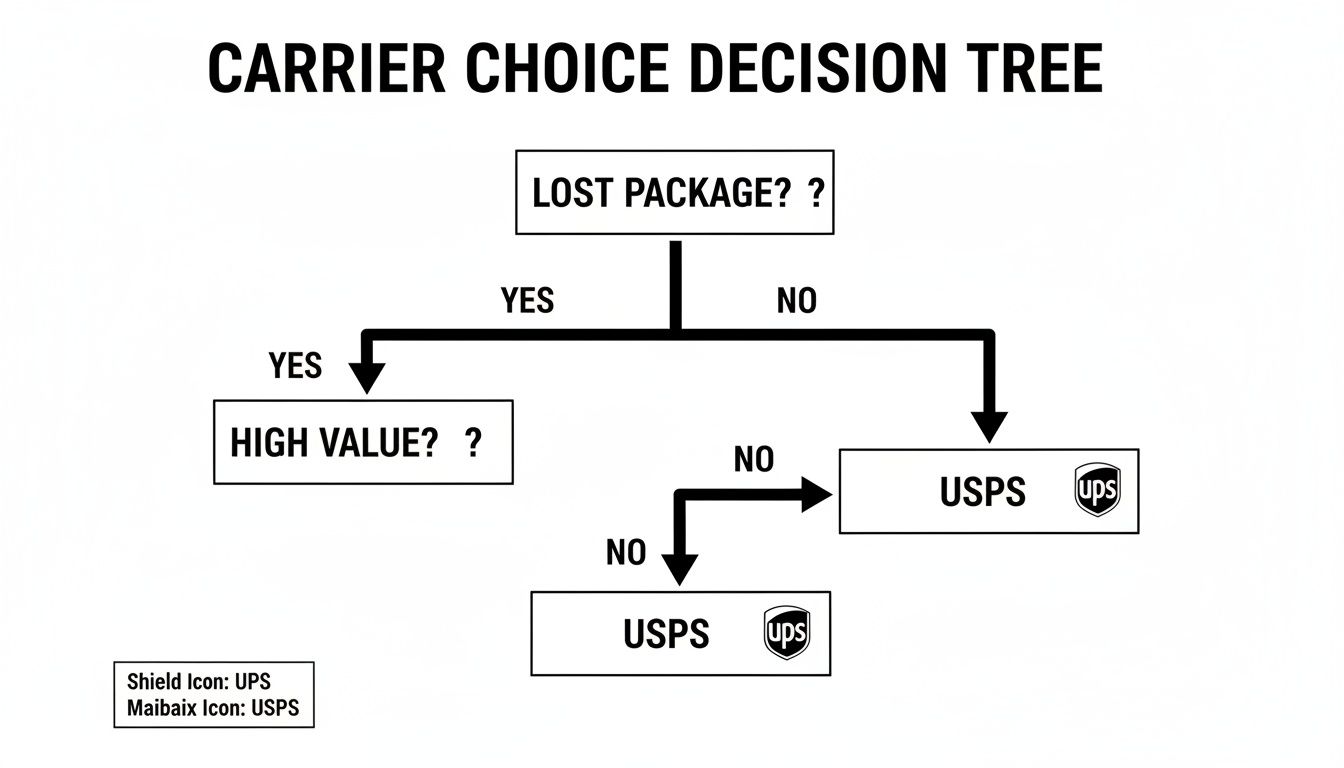
As you can see, UPS is often the safer bet for expensive items because of its superior tracking and higher standard insurance limits. For everyday, lower-value goods, USPS offers a perfectly reliable and more affordable alternative.
Practical Tips for Lowering Your Shipping Costs
No matter which carrier you end up using most, there are always ways to trim your shipping expenses and protect your profit margins. Smart shipping is about more than just picking a carrier—it’s about optimizing your entire process from start to finish.
Key Insight: The single biggest mistake you can make is paying retail shipping rates. E-commerce sellers of any size can get major discounts through shipping software or by negotiating directly with carriers, making your business more profitable overnight.
Here are a few proven ways to start saving:
Use Shipping Software: Platforms like PitneyShip or Easyship unlock commercial pricing for both UPS and USPS, with potential savings of up to 91%.
Embrace Flat-Rate Packaging: Got something heavy but small? The USPS Priority Mail Flat Rate boxes are your best friend. They let you ship up to the weight limit for one fixed price, taking the guesswork out of your shipping costs.
Negotiate a Carrier Contract: Once you have consistent shipping volume, don't be shy about talking to UPS directly for a custom contract. Regular business gives you the leverage you need to secure better rates.
Ultimately, your carrier choice is a critical piece of your fulfillment strategy. By matching the right service to each shipment, you can create a better e-commerce customer experience and build a healthier, more successful online business.
Frequently Asked Questions
Even after comparing the nuts and bolts, you probably still have a few specific questions. Let's tackle some of the most common ones that pop up for e-commerce sellers trying to decide between UPS and USPS.
Getting these details right can make all the difference in your shipping workflow.
Is UPS or USPS Better for Heavy Packages?
For anything with some real heft to it, UPS is almost always your best bet. Their entire system, especially for UPS Ground, is designed to handle heavier, bulkier items at a reasonable cost. This is one of the fundamental differences between the two carriers.
While the post office can technically take packages up to 70 lbs, their rates start to skyrocket once you get past a certain weight. The tipping point is usually around the 5-10 lb mark. After that, UPS's pricing becomes far more competitive, making it the go-to for shipping heavier goods.
Which Carrier Has More Reliable Tracking?
Hands down, UPS has the more reliable and detailed tracking system. You get frequent, granular updates as your package moves from point to point, which gives you and your customer a much clearer picture of its journey.
USPS tracking has gotten a lot better over the years, but it's not uncommon to see frustrating gaps between scans or lags in updates, especially on that final-mile delivery. If you're shipping something high-value where pinpoint visibility is crucial, UPS has the clear advantage.
Key Insight: If your customers are constantly asking "Where's my order?", switching to UPS might be worth it. The superior tracking can dramatically cut down on those support tickets and improve customer confidence.
Can I Use a UPS Box to Ship with USPS?
Absolutely not. This is one of those hard and fast rules in shipping that can create a real mess if you ignore it. Each carrier’s branded packaging is exclusively for their own network.
UPS boxes are only for shipping with UPS.
USPS Priority Mail boxes must be used for USPS Priority Mail.
If you try to cross-pollinate, you're asking for trouble. The package will almost certainly be rejected and returned to you, or you’ll get hit with unexpected charges. The simple solution? Stick to the right branded box for the carrier, or just use a plain, unbranded box for either.
Does USPS Deliver on Sundays?
Yes, and this is a huge advantage for USPS. They deliver on Sundays in many areas, while UPS largely takes the day off.
This isn't for every single piece of mail, though. Sunday delivery is mainly for Priority Mail Express packages and, famously, for Amazon parcels. Your standard Ground Advantage shipment will likely wait until Monday. Still, if you need to get something into a customer's hands over the weekend, USPS is the clear winner.