
A Practical Guide to EMS International Mail Tracking
Waiting for an international package can sometimes feel like you’ve sent it into a void. EMS international mail tracking is your window into that journey, letting you follow your parcel as it moves through a massive global network of national postal services. The key thing to remember is that updates come from multiple places—the origin country's post, the destination's, and the main EMS portal—which is why the information can occasionally look a bit disjointed.
Why Getting a Grip on EMS Tracking is So Important
In a world where we can order something from halfway across the globe with a few clicks, knowing how to track it isn't just a nice-to-have; it's essential. The Express Mail Service (EMS) works a bit differently than private couriers like DHL or FedEx. It's not one company but a cooperative created by the Universal Postal Union. Think of it as a partnership linking the express mail services of over 180 national postal operators, from the USPS in America to Malawi Post in Africa.
This unique structure is both a huge advantage and, honestly, the source of most tracking headaches.
- Goes Everywhere: EMS taps into local postal networks, giving it incredible reach. It can get a package to a remote address that a private courier might not even service.
- Often Cheaper: Because it uses existing public infrastructure, EMS is usually a more budget-friendly choice for international shipping, particularly for smaller parcels.
- Fragmented Tracking: Here’s the catch. Your tracking data gets handed off from one country's postal system to the next. This is where you can get those dreaded "scan gaps," where it looks like your package has vanished for a few days.

Keeping Up with a Global Mail System
As e-commerce has exploded, so has our reliance on services like EMS. We’re all shipping more stuff across borders, and with that comes the demand for clear, reliable tracking. This is changing how postal services operate. Global trade is more connected than ever, with the average distance a product travels recently hitting a record of nearly 5,000 kilometers. At the same time, trade within specific regions has actually dropped. This shift makes robust, multi-carrier tracking systems absolutely critical for keeping an eye on packages making these longer journeys. You can dig into more of this data in this DHL report on international commerce.
Here's the best way to think about it: tracking an EMS package is like following a global relay race. Each country's postal service is a different runner, and knowing this helps you make sense of the tracking timeline when the baton is passed.
This guide is here to pull back the curtain on that process. I'll walk you through how to find the most accurate updates, what those confusing status messages actually mean, and how to handle the inevitable delays. Whether you're a small business owner juggling dozens of shipments or just waiting on a single order, mastering EMS international mail tracking brings a lot of clarity and peace of mind. By the end, you'll know exactly where your package is and what's happening next.
How to Find and Use Your EMS Tracking Number
Think of your EMS tracking number as the passport for your package. It's the unique code that lets you follow its journey across borders. Before you can start your EMS international mail tracking, you’ve got to find this number first.
It’s always a 13-character code. You can usually spot it because it starts with the letter 'E' (which stands for Express) and ends with a two-letter country code. For instance, a package from China might have a number like EX123456789CN.
Where to Look For Your Tracking Number
Getting your hands on this number is usually pretty easy. The sender will almost always give it to you as soon as the package is officially shipped.
Here are the most common places to check:
- Shipping Confirmation Email: This is the number one spot. When a seller ships your order, they'll send an email, and the tracking number is almost always in there.
- Online Order Page: If you ordered from a marketplace like AliExpress or eBay, just log into your account. The tracking number will be right there in your order history.
- The Physical Receipt: If you’re the one who sent the package, the tracking number is printed directly on the receipt you got at the post office.
Still can't find it? Your best bet is to reach out to the sender. We cover a few more a more in-depth guide on how to find your tracking number that walks through other possible scenarios.
The Real Challenge: Where to Actually Track It
Okay, you have the number. Now what? The big question is where to plug it in to get the most reliable updates. With EMS, you have a few choices, and honestly, each has its pros and cons.
- The Origin Country's Postal Website: Let's take that
EX123456789CNexample. The China Post website is going to give you the most detailed, real-time scans while the package is still making its way through China. - The Destination Country's Postal Website: As soon as that same package hits the United States, the USPS website becomes your go-to source. It'll have all the local scans, from clearing customs to being out for delivery.
- The Official EMS Portal: There's also a central EMS Cooperative website that tracks packages. It’s useful, but it works by pulling data from the other postal services, so there can sometimes be a bit of a lag.
Here's the catch: a scan might pop up on the USPS site hours—or even a full day—before it ever shows up on the China Post site, or vice versa. To get the full story, you're stuck checking multiple websites and trying to piece the timeline together yourself.
This is exactly the kind of tracking headache that a universal platform like Instant Parcels was designed to fix. Instead of juggling browser tabs and comparing different tracking logs, you just enter the number once. Our system automatically fetches data from every carrier involved—the origin post, the destination post, and anyone in between—and organizes it into one clean, easy-to-read timeline. It takes the guesswork out of EMS international mail tracking and gives you the complete picture without any of the hassle.
Decoding Common EMS Tracking Updates
An EMS tracking history can look like a mess of confusing jargon, leaving you wondering where your package actually is. Learning to translate these updates is the key to understanding your shipment's journey and knowing when to expect it.
Let's break down what these statuses mean in the real world. For instance, seeing "Origin Post is Preparing Shipment" just means the sender has created the shipping label online. The package hasn't actually been dropped off or scanned into the postal system yet. It's the digital handshake before the physical hand-off.
The basic process, from getting your number to checking its status, is pretty straightforward.
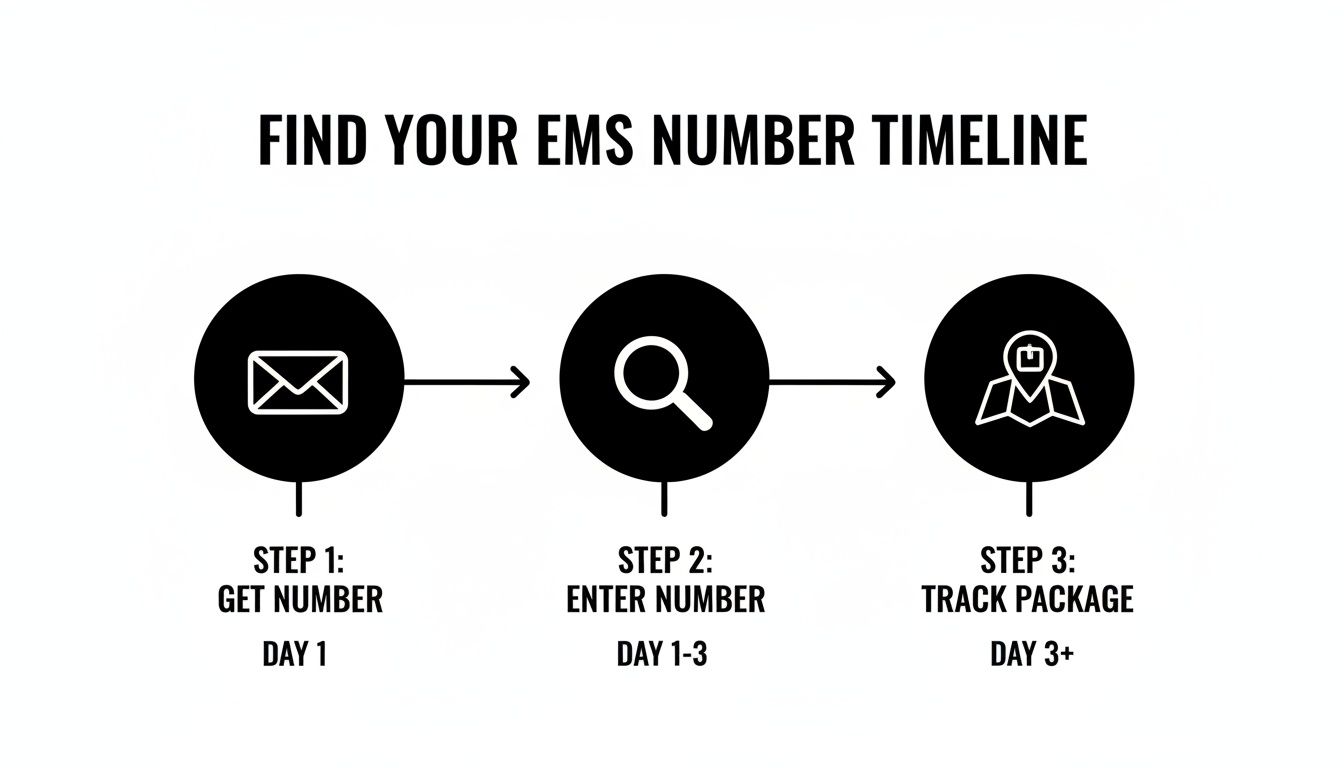
This just shows the simple path: get the number, enter it into a tracker, and watch its progress.
From Origin to Destination
Once your package is officially on the move, the updates become much more meaningful. Each new scan represents a real-world step forward.
- "Posted" or "Item Accepted at Post Office": This is the one you want to see first. It confirms your package has been physically scanned into the postal system in the origin country. The clock has officially started.
- "In Transit to Destination": This is a broad but important update. It can mean anything from your package being on a truck headed to an airport, being loaded onto a plane, or already flying across the ocean.
- "Arrival at Destination": Great news! Your package has landed in the destination country. It's now waiting to be handed over to the local postal service and, crucially, to customs.
Even when there are long gaps between scans, understanding these milestones helps you picture where your package is in the global supply chain.
The key thing to remember is that tracking events are sequential. You'll never see "Presented to Import Customs" before "Arrival at Destination." This logic helps you follow the package's path, even if the details are sparse.
The Customs and Delivery Phase
This part of the journey is where most of the anxiety—and delays—can happen. When you see "Item Presented to Import Customs," it means exactly that: your package is now with the authorities for inspection. This is a standard procedure for every international shipment, so don't panic.
However, a status like "Held by Customs" is one to watch. This could be a simple request for more information, or it might mean that import taxes and duties need to be paid. If this status doesn't change for more than a few days, it's a good idea to contact your local post office for more information.
Finally, you'll see the updates that signal the end of the journey.
- "Out for Delivery": Your package is on the local delivery truck. It should arrive that day.
- "Attempted Delivery": The driver tried to deliver the package but couldn't. Maybe no one was home to sign, or there wasn't a safe place to leave it. You'll usually need to reschedule the delivery or pick it up from a local depot.
Package tracking isn't just a "nice-to-have" feature anymore; it’s a critical part of the entire customer experience. The data backs this up—a staggering 91% of consumers actively track their packages. In fact, providing clear, real-time updates is so important that 73% of online shoppers say they won't buy from a store if they don't trust the delivery provider's tracking. You can find more fascinating stats like these in this breakdown of last-mile delivery statistics at SmartRoutes.io.
Common EMS Tracking Statuses and What They Mean
To help you quickly decipher your tracking history, here's a quick-reference guide. It breaks down the most common EMS statuses, what they actually mean for your package, and what you should do (if anything).
| Tracking Status | What It Really Means | Recommended Action |
|---|---|---|
| Origin Post is Preparing Shipment | A shipping label has been created, but the postal service doesn't have the package yet. | Wait for the "Posted" or "Accepted" scan. Contact the sender if this status doesn't change for several days. |
| Posted / Item Accepted | The package has been physically dropped off and scanned into the postal system. It's officially on its way. | None. This is the official start of the journey. |
| In Transit to Destination | The package is moving between facilities, either within the origin country or internationally. | None. This is a normal part of the process. |
| Arrival at Destination | The package has landed in the recipient's country and is awaiting customs processing. | None. The next step is customs clearance. |
| Presented to Import Customs | The package is being reviewed by customs authorities. This is a standard step. | None, unless the status changes to "Held by Customs." |
| Held by Customs | Customs needs more information, or taxes/duties are due. | Watch for a notification via mail or check the tracking for instructions. Contact your local post office if the status is unchanged for a week. |
| Out for Delivery | The package is on the local delivery vehicle and is scheduled to arrive today. | Be ready to receive the package. |
| Attempted Delivery | The carrier tried to deliver the package but was unsuccessful. | Check the tracking or notice left by the carrier for instructions on how to reschedule or pick up your package. |
Having this cheat sheet handy can take a lot of the guesswork out of international shipping and help you set realistic expectations for your delivery.
Troubleshooting Customs Delays and Other Issues
Even with a system as reliable as EMS, sometimes a package just seems to… stop. You keep refreshing the EMS international mail tracking page, but the status is frozen. It’s a frustrating feeling, but don’t panic. This is almost always a solvable problem, and the usual suspect is a customs delay.
When you see a status like "Held by Customs" or "Awaiting Customs Clearance," it means your package is in line for inspection. This is a completely normal part of the process for any international shipment. However, if that status doesn’t budge for more than 3-5 business days, you might need to step in.
Understanding and Navigating Customs Holds
Think of customs agencies as the official gatekeepers for everything coming into a country. Their job is to check for prohibited items, make sure goods aren't undervalued to avoid taxes, and verify that all the paperwork is in order.
A hold could be something as simple as a random spot-check, especially during busy shipping seasons. Or, it could be a small issue with the customs declaration form the sender filled out.
If your package is held, here’s what typically happens:
- A customs officer reviews the package and its contents against the declaration.
- If they need more information or if import taxes are due, you’ll usually get a letter from the destination country's postal service (like USPS or Royal Mail). Sometimes, the tracking status itself will update with instructions.
- Once you provide the needed info or pay the fees, customs will release the package back to the postal service to complete the delivery.
The key thing to remember is that once a package is in the hands of a customs agency, neither the sender nor the postal service can speed things up. The timeline is entirely up to the customs officials and their current workload.
So, what should you do? First, try to be patient for a few days. If you don't see any movement or get a notification, give your local post office a call. They often have access to more detailed information than what you can see on the public tracking site.
Resolving Other Common Tracking Problems
Customs isn't the only hurdle a package can face. A simple typo in the address is a common reason for a "Failed Delivery Attempt." At other times, a logistical jam or bottleneck in the destination country can cause a temporary pause that the tracking updates don't always explain well.
This map from the official EMS site gives you a sense of the massive network of postal operators involved.
Every single one of these postal partners has its own system and operational rhythm, which can occasionally lead to confusing or inconsistent tracking scans. If you run into a situation where your EMS tracking just isn't updating for a long time, resources that help you troubleshoot common tracking issues can be a lifesaver.
Here’s a quick game plan for the most common scenarios:
- Stuck at "Held by Customs" for 5+ days? It’s time to contact your local post office with your tracking number.
- See "Incorrect Address" or "Failed Delivery"? Call your local post office right away. You can often correct the address or schedule a redelivery over the phone.
- No updates at all for 10+ days? Get in touch with the sender. They’re the only ones who can file an official inquiry or investigation with the post office where the package originated.
Since EMS often hands off packages to local carriers, it helps to understand their systems too. For items heading to the U.S., for instance, you can learn how to track USPS Priority Mail International, as it's the service that usually handles the final leg of the journey. Staying proactive is the best way to get your package back on track.
Why a Unified Tracker Just Makes Sense
If you've ever tracked a single international package, you know the drill. You check the origin country's postal site, then you have to figure out when to switch over to your local post's website. Now, imagine doing that for dozens, or even hundreds, of packages at once. It's a mess of open tabs and conflicting timelines. This is exactly why a unified platform like Instant Parcels isn't just a nice-to-have; it's a game-changer for anyone dealing with international shipping.
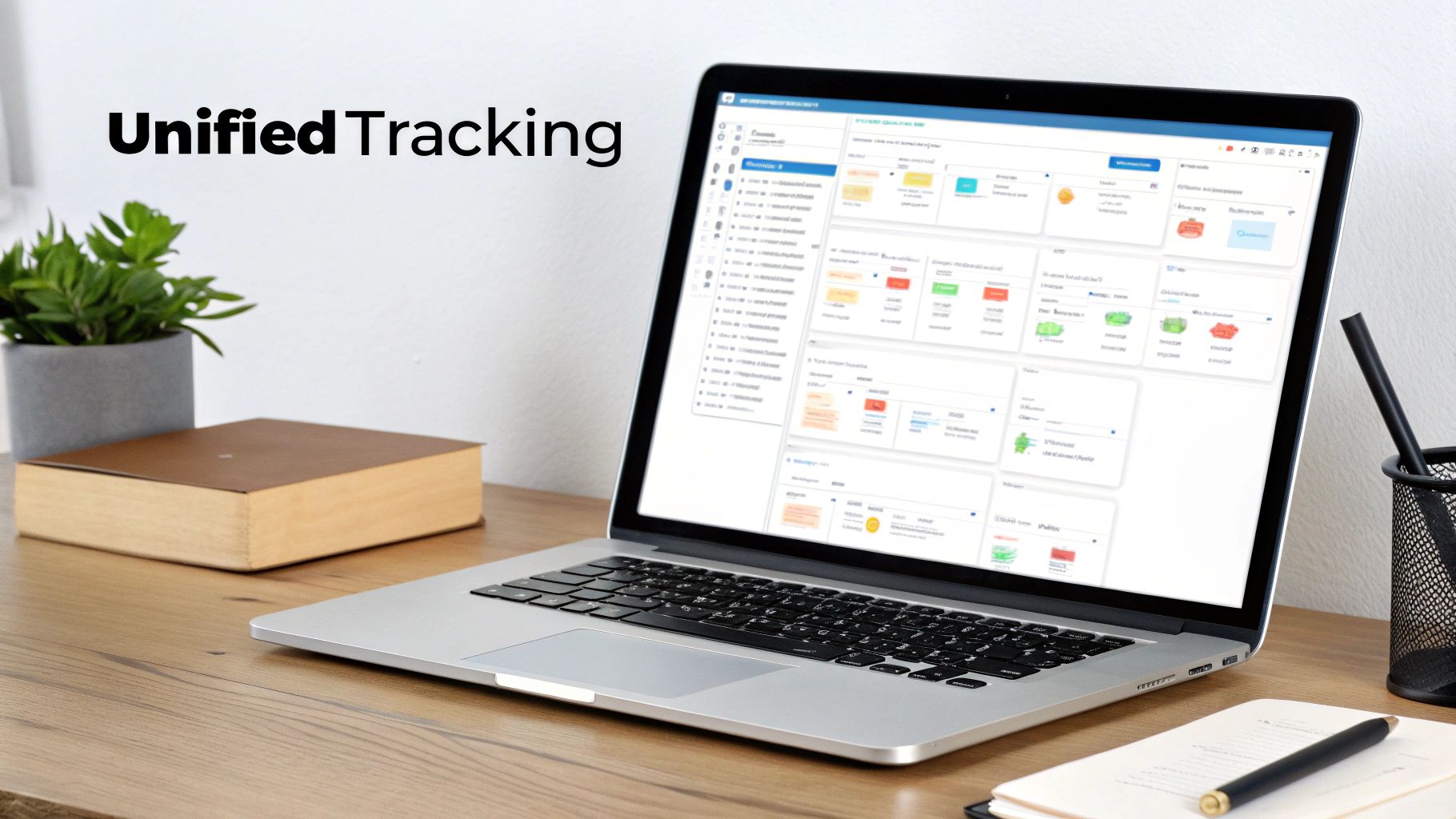
The idea is straightforward but incredibly effective. You take any tracking number, drop it into one search bar, and the system does the heavy lifting. It recognizes it as an EMS shipment and starts pulling in tracking data from every single carrier that touches the package—from the moment it leaves the sender to the second it hits your local mail truck. Everything gets organized into one clean, easy-to-read timeline.
One Dashboard, Total Control
For anyone running an e-commerce business, this goes way beyond simple convenience. Having a single dashboard gives you a bird's-eye view of your entire shipping operation. You're no longer just reacting to customer emails; you can actually get ahead of problems.
This centralized view brings some serious advantages:
- Fewer "Where's my order?" emails: You can generate a single tracking link to share with your customers. They get the same clear, step-by-step view you do, which means they won't need to ask you for updates.
- Spotting trouble early: When all your shipments are in one place, it's easy to see which ones are getting held up in customs or facing weird delays. You can jump on these issues before the customer even knows something is wrong.
- Saving serious time: Forget logging into five different carrier websites. All your EMS international mail tracking is consolidated, freeing up time you can spend on growing your business.
This concept of centralized monitoring isn't unique to parcel delivery. The same principles are used in larger-scale logistics, where companies rely on sophisticated asset tracking software to keep an eye on valuable goods as they move across the globe.
Keeping Up in a World of Packages
The need for better tracking tools is exploding right alongside global e-commerce. A recent report showed an estimated 407 billion packages were shipped worldwide in a single year, with forecasts suggesting that number could hit 498 billion by 2028. Think about it—the average person now gets about 42 packages a year. Shipping has become a massive part of our daily lives.
A unified tracker takes a process that is naturally fragmented and confusing and makes it simple and transparent. It puts you back in control of your logistics.
At the end of the day, whether you're anxiously waiting for one special delivery or managing a full-scale e-commerce operation, using a universal parcel tracker is the smarter way to handle EMS international mail tracking. It gathers all the scattered data points into one place, giving you clarity, saving you time, and offering some much-needed peace of mind.
Got Questions About EMS Tracking? We've Got Answers
When you're shipping something important across the globe, a few questions are bound to pop up. Let's be honest, international tracking can be confusing. Below, I've tackled some of the most common headaches and frustrations people run into with EMS international mail tracking, based on years of experience in the industry.
Why Has My EMS Tracking Gone Dark for a Week?
It’s the worst feeling, right? You check your tracking, and... nothing. For days. While it's easy to assume the worst, this is actually a very normal part of the process, especially for international shipments.
This "scan gap" almost always happens when your package is in transit between countries. It's been scanned out of its origin country but hasn't yet landed and been processed by the postal system in the destination country. Think of it as being in a temporary blind spot while it's on a plane or a container ship crossing the ocean.
So, when should you worry? If you see no updates for more than 7-10 business days, it's time to take the next step. Your best bet is to contact the seller first. They can launch an official inquiry with the origin post, which can often shed more light on the situation than you can see from the public tracking page.
Which Website Is the Most Accurate for EMS Tracking?
This is a trick question because there's no single "best" site for the entire journey. The most accurate source of information completely depends on where your package is at that very moment.
- At the beginning: The origin country's postal website (like China Post or Japan Post) is your go-to. It will have the most detailed, up-to-the-minute scans from pickup until the package leaves the country.
- Towards the end: Once the package lands and clears customs, the destination country's postal service (like USPS or Canada Post) takes over. Their site will have the most reliable info on local transit and the final delivery scan.
This is exactly the problem a universal tracker like Instant Parcels solves. It pulls data from both the origin and destination postal carriers and stitches them together. You get one seamless timeline without having to jump between different websites to piece the story together yourself.
My Package Says "Delivered," But I Don't Have It. What Now?
Okay, first, take a deep breath. This happens more often than you'd think, and it's usually not a lost cause. Before you panic, do a thorough check of all the usual spots: the front porch (behind a plant?), the back door, with your neighbors, or even with a building manager or mailroom.
Sometimes, a postal worker will scan all packages as "Delivered" at the start or end of their route, and your parcel might not actually show up until the next business day.
If it’s still nowhere to be found, contact your local post office directly—not the generic national hotline. Give them the tracking number and explain what happened. If they can't locate it, the final step is to reach out to the sender. As the official customer of the postal service, they're the only ones who can file a formal lost package claim.
Can I Just Use My Order Number to Track an EMS Shipment?
Unfortunately, no. An order number (like #SKU-12345 or #9876) is purely an internal reference for the store you bought from. It means nothing to the postal system.
The only code that works for EMS international mail tracking is the official 13-character EMS tracking number. It’s a unique format that almost always starts with the letter 'E'. If you didn't get this number in your shipping confirmation email, you'll need to contact the seller and ask for it.