
How to Track Packages from China: how to track packages from china for beginners
The simplest way to track a package from China is to grab the tracking number from the seller and pop it into a universal tracking site like Instant Parcels. Just paste the number in, and you'll see the entire journey—from the warehouse in China all the way to your local post office. It's the fastest way to get a clear, consolidated view without having to jump between different carrier websites.
Why Is Tracking a Package from China So Confusing
If you’ve ever felt like you need a detective to find your package from China, you’re not alone. The journey from a warehouse in Shenzhen to your front door is almost never a straight line handled by one company. It’s more like a complex relay race, with your package being passed between multiple logistics partners, each with its own tracking system.

This multi-carrier handoff is the biggest source of the headache. A package might start with a local consolidator like Cainiao or Yanwen, then get handed to a major player like China Post or SF Express. Once it lands in your country, it's passed off yet again to your national postal service—think USPS in the U.S. or Royal Mail in the U.K. Every single transfer is a potential blind spot in the tracking data.
The Fragmented Journey
The result of this piecemeal process is a list of frustrations that almost every international shopper has run into. You might find your tracking number doesn't work for the first day or two, or you'll see days of complete silence with no updates. Then there are the cryptic statuses like "Hand over to airline" that don't really tell you much.
Don't panic—this doesn't mean your package is lost. It's just a normal part of the global shipping machine. And the scale of this machine is mind-boggling. China is expected to account for over 60% of global courier parcel growth between 2021 and 2025, topping out at nearly 200 billion parcels a year. With that kind of volume, understanding the system is crucial.
This complexity isn't just about distance; it's about systems. Each carrier in the chain—from the local handler in China to the final-mile delivery driver in your town—uses a different system. A universal tracker acts as a translator, pulling all these different "languages" into one coherent timeline.
Overcoming the Information Gaps
Understanding this complex journey is the first step toward tracking your packages without pulling your hair out. A lot of the confusion is baked into the very nature of import and export trade, where customs, carrier agreements, and international rules create checkpoints that can slow things down.
Here are a few of the key challenges you’re likely to face:
Multiple Tracking Numbers: It's not uncommon for a package to get a brand new tracking number once it enters the destination country.
Translation Issues: Status updates are often in Chinese or are so poorly translated they’re nearly impossible to understand.
Lack of Real-Time Updates: If you chose an economy shipping option, your package might only get scanned at major hubs, leading to long gaps between updates.
Thankfully, modern tools were built to solve these exact problems. In this guide, we'll walk you through actionable steps to cut through the noise and find out where your package is, every step of the way.
Finding and Understanding Your Tracking Number
Before you can track your package, you need its digital passport: the tracking number. Without this string of letters and numbers, you're flying blind. Luckily, finding it is usually straightforward.
Your first move should be to check your email. Look for an order confirmation or a separate "Your Order Has Shipped!" email from the seller or marketplace. Most sellers send this out right after they hand the package over to the carrier.
If it's not in your inbox, head over to the marketplace where you made the purchase—like AliExpress, Temu, or Shein. Log in, go to your "My Orders" or "Shipments" section, and you'll find the tracking number right there next to the order details.
What Your Tracking Number Reveals
That tracking number isn't just a random code. Its format is packed with clues about the shipping service and what kind of journey your package is on. Many numbers, especially from China Post, follow a 13-character standard that tells a story.
The first two letters are the most telling part. They signal the mail class. For example, a tracking number starting with an ‘L’ almost always means it's an ePacket—a popular, faster choice for smaller items. A number starting with ‘R’, on the other hand, typically points to registered mail, which is more secure but often takes its sweet time.
At the very end, you'll see two letters like ‘CN’, which is simply the code for the country of origin—China. The nine digits sandwiched in the middle are the unique ID for your parcel. Learning to spot these patterns helps you set the right expectations from day one.
A tracking number is like a package's passport. The letters and numbers on it tell a story about where it's from, the type of journey it's on, and how quickly it's expected to arrive. Learning to read it gives you a head start in the tracking process.
Decoding Common Chinese Tracking Number Formats
Recognizing the format of your tracking number can immediately tell you which carrier first handled your shipment in China. Each logistics company has its own signature style.
This table breaks down some of the most common formats you'll come across, helping you quickly identify the service and what to expect.
Common Chinese Tracking Number Formats and What They Mean
Tracking Number Prefix (Example) | Common Carrier/Service | What It Means for Tracking | Typical Speed |
|---|---|---|---|
RR...CN or CD...CN | China Post Registered/Air Mail | Full tracking from origin to destination. Reliable but can be slow. | 2-5 weeks |
LK...CN or LV...CN | ePacket (EMS) | Faster and fully tracked. The 'L' is a strong indicator of ePacket. | 1-3 weeks |
LP... (followed by 14 digits) | Cainiao Standard/Economy | Basic tracking, often only within China. May stop updating after export. | 3-6 weeks |
SY... or SYA... | SunYou Economic Air Mail | Very basic, limited tracking. Best for low-value, non-urgent items. | 4-8 weeks |
UN...CN | China Post Unregistered Mail | No real tracking available. The number just confirms shipment. | 4-8 weeks |
Seeing these patterns helps you manage expectations. An 'LP' number from Cainiao won't give you the same detailed, door-to-door updates as an 'LK' ePacket number.
One common mistake is confusing an order number with a tracking number. The seller uses an order number for their internal records, and it’s useless for tracking. If your number doesn't fit any of the typical formats and you can't get any results, reach out to the seller to confirm you have the correct tracking code. Once you're sure you have the right one, you’re ready to plug it into a tracking tool and see where your package is.
The Best Way to Track Your International Shipment
Let's be honest, the old way of tracking a package from China was a nightmare. You’d start on some obscure Chinese carrier's website, frantically trying to figure out when to jump over to USPS or Royal Mail. It wasn't just clunky; it was a surefire way to lose track of your shipment and your sanity.
Thankfully, those days are over. The modern, and frankly only, way to do this now is with a universal tracking platform. These tools pull every single scan from every carrier involved into one clean, simple timeline. It's the single biggest game-changer for anyone trying to figure out how to track packages from China.
Instead of trying to piece together a fragmented story, you get the whole journey laid out in front of you. You just copy your tracking number and paste it into one search bar. That’s it. The system handles all the heavy lifting in the background, grabbing data from every logistics partner that touches your box.
Here’s a look at the interface for a modern tracker like Instant Parcels. Notice how clean and simple it is—everything revolves around that single search bar.
The key takeaway is that it’s built for simplicity. No confusing menus, no multiple fields to fill out. Just one place to paste your number and get an instant, complete history of your shipment.
The Power of a Single Timeline
The biggest headache with international tracking has always been the "handoff." Your package might get passed between three, four, or even five different companies before it lands on your doorstep. A universal tracking tool seamlessly bridges those gaps.
Here’s what that actually looks like in practice:
Initial Pickup: You’ll see the very first scan from the consolidator in China.
Export Center: Updates from the Chinese export hub will pop up.
In Transit: You get flight details and arrival scans in your country.
Customs Clearance: The tool shows precisely when it's been processed by customs.
Local Handoff: It will clearly show the exact moment your local postal service, like USPS or Canada Post, takes over.
Final Delivery: You'll see "Out for Delivery" and "Delivered" statuses from your local mail carrier.
This unified view completely eliminates the guesswork. You no longer have to wonder if your package is stuck somewhere or if you're just looking in the wrong place. Every piece of the puzzle is laid out chronologically.
The real magic of a universal tracker isn't just convenience—it's clarity. By translating and standardizing statuses from dozens of global carriers, it turns a chaotic stream of logistics jargon into a coherent story about your package's journey.
Why This Matters in a Booming Market
The need for a better way to track is more critical than ever. The China Courier Express and Parcel (CEP) market is seeing absolutely explosive growth, on track to hit an estimated USD 131.84 billion in 2025. From there, it’s projected to soar to USD 201.81 billion by 2030, with international parcels alone growing at a steady 7.47% each year.
This incredible volume is great for us as shoppers, but it creates a massive tracking challenge that only specialized tools can handle. You can dig into more of the market trends and their implications for global shipping if you're curious.
What this explosion in volume really means is more packages flooding the system, making manual tracking even more of a lost cause. A universal tool like Instant Parcels is built specifically to handle this scale, connecting with thousands of carriers worldwide to give you accurate, up-to-the-minute information.
Eliminating Language Barriers and Jargon
Another huge hurdle when you track packages from China is the language barrier. The first few tracking updates are often in Mandarin or are so poorly translated they’re practically useless. We’ve all seen those nonsensical status descriptions.
A good universal platform solves this instantly by translating and standardizing these updates on the fly. For instance, a common Chinese status like "揽收" is automatically converted into a clear and simple "Package received by carrier." It’s a small detail that makes a world of difference.
This process turns cryptic messages into information you can actually use. You can finally stop relying on guesswork and clunky web translators and start getting updates you can understand and trust.
Decoding Common Tracking Statuses and What They Mean
Once you've got your tracking number plugged into a universal tracker, you'll see a timeline of your package's journey pop up. But let's be honest, those updates can feel like they're written in another language. "Origin Post is Preparing Shipment" or "Hand over to airline" are common, but they don't tell you much.
Learning to translate this logistics jargon is the key to truly understanding where your package is and, more importantly, why it might be taking a while. It’s the difference between anxiously hitting refresh and having the confidence to know things are moving along as they should.
This visual timeline gives you a great overview of the entire process, showing just how far we've come from the old days of juggling multiple carrier websites.
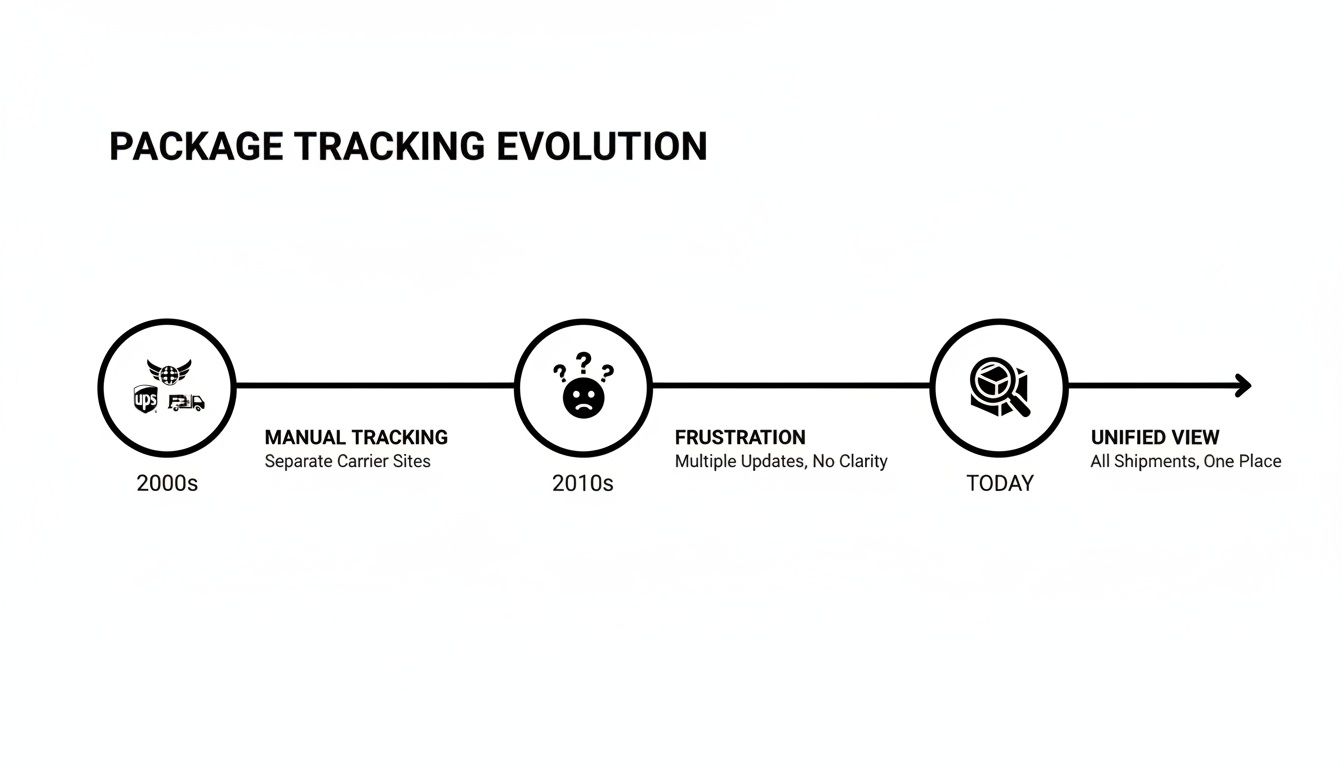
It really highlights the shift from a frustrating, fragmented process to the unified view we can get today, which thankfully cuts out a ton of the guesswork.
To give you a clearer picture, let's walk through the entire journey. I've broken down the key stages, common status messages, and what's actually happening behind the scenes.
The Journey of Your Package from China to Your Door
Shipment Stage | Common Tracking Statuses | What's Happening | Estimated Timeframe |
|---|---|---|---|
Seller's Warehouse |
| The seller has created a shipping label and assigned a tracking number, but the package hasn't been physically picked up by the carrier yet. | 0-2 days |
First Mile in China |
| The carrier has your package. It's moving from a local facility to a major international airport hub like Shanghai or Shenzhen. | 1-3 days |
International Transit |
| The package is loaded onto a plane and is flying to your country. This is often where the longest "no update" gaps happen. | 3-10 days |
Customs Clearance |
| Your package has landed and is being inspected by customs officials before it can be released into the local delivery network. | 1-5 days |
Local Handoff |
| After clearing customs, the package is handed over to a local carrier (like USPS, Royal Mail, etc.) and sent to a regional sorting hub. | 1-3 days |
Final Mile Delivery |
| It's on the truck! The package is with your local mail carrier and will arrive at your address today. | 1-2 days |
This table should give you a solid baseline for what to expect. Now, let's dig into a few of those stages in more detail.
The First Steps In China
Before your package even thinks about getting on a plane, it has to navigate China's massive domestic logistics network. This is where you'll see the very first updates.
Order Information Received / Pre-advised: This is ground zero. It just means the seller printed a shipping label. The carrier doesn't actually have your package yet.
Accepted by Carrier / Package Received: This is the first real sign of movement! It confirms the carrier has your package and has scanned it into their system at a local depot.
In Transit to Export Center / Departed from Sorting Center: Your package is on the move, making its way from that initial drop-off point to a huge international export hub in a city like Shenzhen, Guangzhou, or Shanghai.
Don't be surprised if these first few steps take a couple of days, especially if you ordered during a big sale. It’s a volume game, so a little patience here goes a long way.
The International Journey and Customs
Here comes the part that causes the most anxiety: the international leg. Once your package leaves China, it might seem to fall off the radar completely. It's flying across the world, and you won't see a new scan until it physically lands in your country.
Seeing no updates for a week or even longer is completely normal. Don't panic.
A "stuck" status doesn't always mean there's a problem. Often, it's just a normal part of the process, like waiting for the next available flight or for a customs agent to clear a large batch of shipments. The key is knowing what's normal and when to be concerned.
After it lands, it heads straight for the next big hurdle: customs.
Hand over to airline / Departed country of origin: The package has officially been loaded onto a plane and is on its way.
Arrived at destination country: Touchdown! The plane has landed, and your package is waiting to be processed by customs.
Held by customs / In customs clearance: This is a standard procedure for every international package. Delays can happen if there's high volume, missing paperwork, or if customs questions the declared value of the item.
Most packages fly through customs in 24-48 hours, but this can vary. For a deeper dive into the jargon, this guide on decoding common delivery tracking statuses is a fantastic resource.
Final Mile Delivery In Your Country
Once customs gives the green light, your package is handed off to your local postal service or a courier for the final stretch. This is where a universal tracker really shines, as it automatically picks up the new tracking information from the local carrier.
Arrived at local distribution center: Your package is now in a warehouse in your city or region, getting sorted for its final route.
Out for Delivery: This is the one we all wait for! It means your package is on the local delivery truck and should be at your door by the end of the day. If you're curious about what that really means for timing, check out our guide explaining https://instantparcels.com/what-does-out-for-delivery-mean.
Delivered: Success! The journey is officially complete.
How to Solve Common Tracking Problems
Even with the best tools, tracking a package from China can sometimes hit a snag. You might see a confusing status, an error message, or worse, just radio silence for days. Before you start to worry, you should know that most of these issues are pretty common and usually have a simple explanation.
Think of this section as your troubleshooting guide. We'll walk through the most frequent headaches you'll encounter and give you a clear action plan for each one. This way, you can figure out what's going on instead of just waiting anxiously by the door.
Tracking Number Shows No Results
So you’ve got your tracking number, you eagerly punch it into a tracker, and… nothing. You get an error like "Tracking number not found" or "No information available." This is easily the most common issue people run into, and it's almost always just a matter of timing.
It often takes 24 to 72 hours after the seller creates a shipping label for the tracking number to actually go live in the carrier’s system. The package needs to be physically picked up and get its first scan at a sorting facility before any data shows up online.
Here's your action plan:
Give it at least 48 hours. This is the golden rule. Resist the urge to contact the seller after just a few hours. Patience is key here.
Double-check the number. Make sure you didn't accidentally copy an extra space or mix it up with your order number. It happens to all of us.
If 72 hours pass with zero results, then it's time to reach out. Politely message the seller and ask them to confirm the tracking number and verify that your order has actually been shipped.
My Package Status Hasn't Updated in a Week
You see your package leave a warehouse in Shenzhen, and then... crickets. Days go by, maybe even a week or two, with no new updates. This can be nerve-wracking, but it's incredibly common for international shipments, especially if you chose an economy shipping option.
Long gaps in tracking updates usually happen during two specific phases:
International Transit: While your package is on a plane or a cargo ship crossing the ocean, there are no scanning points. You simply won't see an update until it lands and gets processed in your country.
Customs Clearance: Packages can sometimes sit in a customs facility for several days, particularly during busy seasons or if there's a hang-up with the paperwork.
If your package seems to be stuck in limbo, don't assume it's lost. For most standard shipping methods, a 10 to 14-day gap between scans during transit is completely normal.
Keep in mind that economy shipping options are often deprioritized. A package might literally be waiting for available space on a flight, which can add several days to the journey before you ever see another update. It's the trade-off for that lower shipping cost.
It's Marked Delivered but I Can't Find It
This is probably the most frustrating scenario of all. The tracking status triumphantly says "Delivered," but the package is nowhere to be found. More often than not, a premature scan is the culprit.
Here’s what you should do immediately:
Check everywhere: Do a thorough search around your property. Look behind planters, near side doors, or check with your building's front desk or mailroom.
Ask your neighbors: It’s very common for packages to be delivered to the wrong address by mistake.
Wait one more business day: Sometimes, a driver will scan all packages as "delivered" when they load them onto the truck for the day's route. It might still show up later that afternoon or even the next day.
If 24 hours go by and it's still missing, it's time to take action. Contact the local carrier that handles the final delivery (like USPS in the US or Royal Mail in the UK), not the original seller in China. Give them the tracking number and explain what happened. They often have internal GPS data from their scanners and can pinpoint exactly where the package was when it was marked as delivered.
Got Questions About Tracking Packages from China? We've Got Answers.
When you're waiting on a package from halfway around the world, it's natural to have a few questions. Even with the best tracking tools, some situations can be confusing. This section tackles the most common head-scratchers that pop up when you’re tracking a shipment from China.
Think of this as your quick-reference guide for those moments of uncertainty. We’ll get straight to the point on everything from realistic delivery times to what to do when your package seems to have vanished into thin air.
How Long Does It Really Take for a Package to Get Here from China?
This is the big one, isn't it? The simple answer is: it all comes down to the shipping method the seller used. The timeframes you see on a product page can sometimes be a bit... optimistic. A little patience goes a long way.
Here’s a more realistic breakdown based on what we see every day:
Economy Shipping (Cainiao, SunYou, etc.): This is the snail mail of international shipping. Be prepared to wait 30 to 60 days. Tracking updates can be few and far between, and they often stop once the package leaves China.
Standard Shipping (ePacket, China Post Registered Mail): This is the sweet spot for most orders, balancing cost and speed. You can generally expect your package in 15 to 30 days, with much more reliable, end-to-end tracking.
Expedited Shipping (EMS, SF Express): If you paid a bit more for speed, you'll see a big difference. These shipments typically arrive within 7 to 15 days.
Express Couriers (DHL, FedEx, UPS): The top-tier option. If your package is coming via one of these carriers, you'll likely have it in your hands within 3 to 7 business days. It's fast, but it costs a premium.
Keep in mind, these are just averages. Big shopping events or holidays like Chinese New Year can easily tack on another week or two to any of these estimates.
What If I Can't Find My Tracking Number?
Without a tracking number, you're flying blind. It’s the single unique code that lets any system pinpoint your package among the millions zipping around the globe. If you don't have one, your options are limited, but don't panic just yet.
First, go back and scour your order confirmation email and check the order details page on whatever marketplace you used. The tracking number is almost always posted there. If you’ve looked everywhere and come up empty, your next step is to contact the seller directly. Any decent seller will provide it to you within a day or so.
A quick heads-up: Your order number is not your tracking number. The order number is just for the seller's internal system and won't work in any tracking tool. You need the specific number assigned by the shipping carrier.
What if the seller is unresponsive or says they sent it without tracking? At that point, your only real option is to fall back on the buyer protection policy of the marketplace (like AliExpress or eBay). Make a note of the estimated delivery window and get ready to file a "non-received item" claim as soon as that deadline passes.
When Should I Actually Worry That My Package Is Lost?
It’s easy to jump to conclusions when your tracking status hasn't budged in a week. But a package that is truly, permanently lost is much rarer than you’d think. More often than not, it's just stuck in a logistical jam.
As a rule of thumb, only start considering a package lost after a significant amount of time has passed with zero updates. For economy or standard shipping, give it at least 60 days from the last scan. For faster services, you might start the process after 30 days of silence.
Before you hit the panic button, follow this game plan:
Dig into the Tracking History: Where was it last seen? Is it stuck in customs? Was it handed off to your local postal service? That last update is your most important clue.
Reach Out to the Seller: Let them know the package is well past its delivery estimate and that tracking has stalled.
File an Official Dispute: If the seller can't help, it's time to use the marketplace's buyer protection program. Use screenshots of the tracking history as your evidence and formally ask for a refund or for them to reship the item.
Following these steps gives the system plenty of time to work out its kinks before you escalate the problem.