
How Can I Track a Package from China The Definitive Guide
So, you've ordered something from China and now you're playing the waiting game. That cryptic string of letters and numbers in your order confirmation is the key to knowing where your package is, but figuring out what to do with it can feel like a puzzle.
Don't worry, it's easier than it looks. You don't need to guess whether your parcel is with China Post, Cainiao, or Yanwen. The secret is using a universal tracking tool that does all the heavy lifting for you.
Your Essential First Steps for China Parcel Tracking
Whether you've ordered from a massive marketplace like AliExpress or a smaller independent seller, the initial steps are always the same. Let's break down exactly what you need to do to get started.
Action | Where to Look | Why It Matters |
|---|---|---|
Find Your Tracking Number | Your order confirmation email or the "My Orders" section of the website/app. | This is the unique ID for your package. Without it, you can't track anything. |
Choose a Universal Tracker | A dedicated service like Instant Parcels. | These tools recognize hundreds of carriers automatically, so you don't have to. |
Paste & Track | The search bar on the universal tracking website. | This single action pulls updates from every carrier handling your shipment. |
Getting these first steps right saves you a ton of headaches down the line. It's the difference between a clear, consolidated view and a confusing mess of different carrier websites.
Unraveling the Global Shipping Maze
It helps to understand why tracking can feel so disjointed. The sheer volume of packages leaving China is mind-boggling. In 2022 alone, China shipped an incredible 111 billion parcels, which accounted for over 40% of global e-commerce logistics.
This massive scale means your package likely passes through several hands. It starts with a local Chinese logistics partner, gets handed off to an international carrier, clears customs, and is finally given to a local service like USPS or FedEx for the "last mile" delivery to your door. A universal tracker brings all those separate updates together.
If you happen to be a frequent shopper on one of the biggest platforms, you might find more specific instructions in this a simple guide to tracking your order on AliExpress.
My Pro Tip: The single best thing you can do is ignore the individual carrier sites. Seriously. Using a universal tracking service from the start is the most efficient way to track a package from China. It consolidates everything into one simple, easy-to-follow timeline.
Here’s a quick summary of what to do:
Grab Your Tracking Number: First, find that code. It’s usually 13 to 20 characters long and is always in your order confirmation details.
Use an All-in-One Tool: Head over to a universal tracker like Instant Parcels. These platforms are specifically designed to identify tracking formats from hundreds of global carriers on the fly.
Paste and Go: Just copy your number, paste it into the search field, and hit enter. The system will then pull all the tracking data from both the origin and destination carriers.
Decoding Your Chinese Tracking Number and Carrier
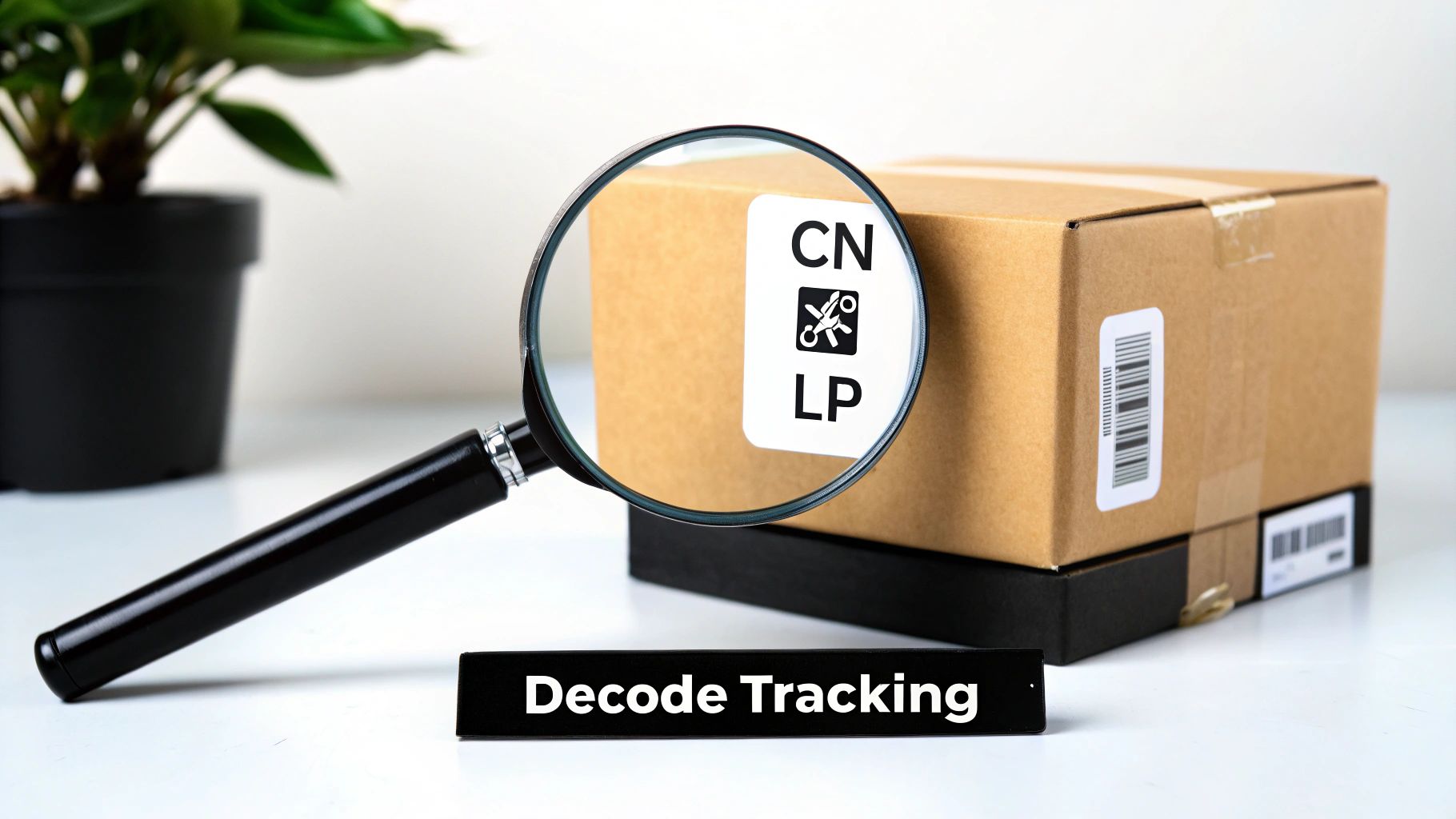
So you’ve got that long string of letters and numbers from the seller. It might look like a random jumble, but it’s actually packed with clues about your package's journey. Tracking numbers from China have specific patterns that can point you to the company handling the first leg of its trip.
Think of it as a secret code. For instance, a classic China Post registered mail number is always 13 characters long. It usually kicks off with an 'R' or 'L' and, most importantly, ends with 'CN'. That 'CN' is your first big giveaway, confirming its origin and the carrier.
But you don’t have to memorize every single format. While knowing the patterns is interesting, the easiest way forward is using a tool that does the decoding for you.
Cracking the Code on Common Tracking Number Formats
If you’ve ever shopped on AliExpress, Temu, or similar sites, you know they use a whole network of different shipping partners. Each one has its own style of tracking number, and getting familiar with a few can help you know what to expect.
I've put together a quick reference table to help you identify the likely carrier just by looking at the number.
Common Chinese Carrier Tracking Number Formats
Carrier | Example Format | Commonly Used By |
|---|---|---|
China Post | RA123456789CN | Major e-commerce platforms, individual sellers |
Cainiao | LP12345678901234 | AliExpress's logistics arm, often for standard shipping |
Yanwen Express | UG123456789YP | Sellers of small, lightweight items (e.g., electronics, accessories) |
ePacket | LK123456789CN | Sellers offering a faster, more reliable shipping option |
As you can see, the variety is what makes tracking tricky. You might start on Yanwen’s website, only to find the trail goes cold when it leaves China. That's because it's probably been handed over to USPS, Canada Post, or Royal Mail for the final delivery, meaning you now have to check a totally different site.
If you want to get into the nitty-gritty of how these numbers are built, our guide explains in more detail what is a tracking number and why it's structured the way it is.
Here’s the key takeaway: Your package will almost always be handled by at least two couriers—one in China and your local postal service. A good universal tracking tool is the only thing that connects those two separate journeys into one seamless timeline.
Let the Tools Do the Heavy Lifting
At the end of the day, you don’t need a degree in international logistics just to find your package. The smartest move is to skip the guesswork altogether.
When you drop your tracking number into a universal platform like Instant Parcels, the system immediately recognizes the format. It doesn’t matter if it’s a Cainiao, China Post, or some other carrier’s code; it automatically starts pulling the latest updates from every courier involved.
This gives you the full story, from the seller’s warehouse to your front door, all in one place. It’s the simplest way to get the answers you need without the headache.
So, Where Do You Actually Track Your Parcel?
You've got the tracking number, which is half the battle. But now, where do you plug it in? The obvious first stop for most people is the official carrier's website, like China Post or Yanwen. And for the first few days, that works just fine.
But then, something frustrating often happens. The updates stop. The trail goes cold. This usually happens right after the package leaves mainland China and is handed over to an airline. This is the dreaded tracking "black hole," and it’s a classic problem when tracking anything coming from China.
The Dead End of Single-Carrier Websites
Sticking with the original carrier’s website gives you a choppy, incomplete story of your package's journey. Once it hits your country's soil, a local service like USPS, Canada Post, or Royal Mail takes over for the final leg. The Chinese carrier’s site? It has no idea what's happening anymore.
That leaves you stuck trying to:
Figure out which local company even has your package.
Manually copy and paste the tracking number into one new website after another.
Stitch together two completely separate tracking histories to make sense of it all.
It's a huge waste of time and a recipe for confusion, especially if you're a business owner trying to keep anxious customers in the loop.
My Two Cents: The single biggest mistake I see people make is trying to track an international package on just one website. A shipment from China is a relay race involving multiple companies. You need a tool that can see the whole race, not just the first runner.
Why All-in-One Trackers Are the Only Real Solution
This is exactly why universal tracking platforms were created. A good all-in-one tool like Instant Parcels is built specifically to bridge these information gaps. Instead of being locked into one carrier's system, it taps into a massive network of both global and local couriers all at once.
You just pop in your tracking number one time. The system does the heavy lifting, automatically figuring out every single carrier that will touch your package—from the warehouse in Shenzhen to the delivery driver on your street.
It's as simple as it looks. You just need the number to get started.
From there, the platform pieces everything together into a single, easy-to-read timeline. No more guesswork, no more dead ends.
This unified approach is a lifesaver, especially when you think about the sheer volume of stuff being shipped. In the U.S. alone, the average person gets about 66 parcels a year, part of a tidal wave of over 22.3 billion total shipments. A huge chunk of that comes from China, traveling thousands of miles and navigating complex customs checks. Having a tracker that pulls from over a thousand different couriers is the only sane way to keep tabs on it all. For a deeper dive into these numbers, Coherent Market Insights has some great data on the market.
Ultimately, picking the right tool saves you headaches and gives you clarity. If you've ever asked, "how can I actually track a package from China?" without pulling your hair out, a universal platform is your answer. To see what makes a great one, check out our guide on the best package tracking app.
Understanding Common Tracking Statuses and Timelines
Once you've got your tracking number plugged in, you'll start seeing a series of updates that map out your package's long journey. At first, the logistics jargon can feel a bit confusing, but once you know what to look for, these statuses tell a pretty clear story. Understanding them is key to setting realistic expectations for when your order will actually show up.
The first few updates almost always happen within China. You’ll likely see something like "Accepted by carrier" or "Origin Post is preparing shipment." This just means the shipping company has picked up the package from the seller. From there, you'll see it move through a few sorting facilities inside the country.
This visual gives you a good idea of a typical timeline for a package making its way from a warehouse in China all the way to your local delivery service.
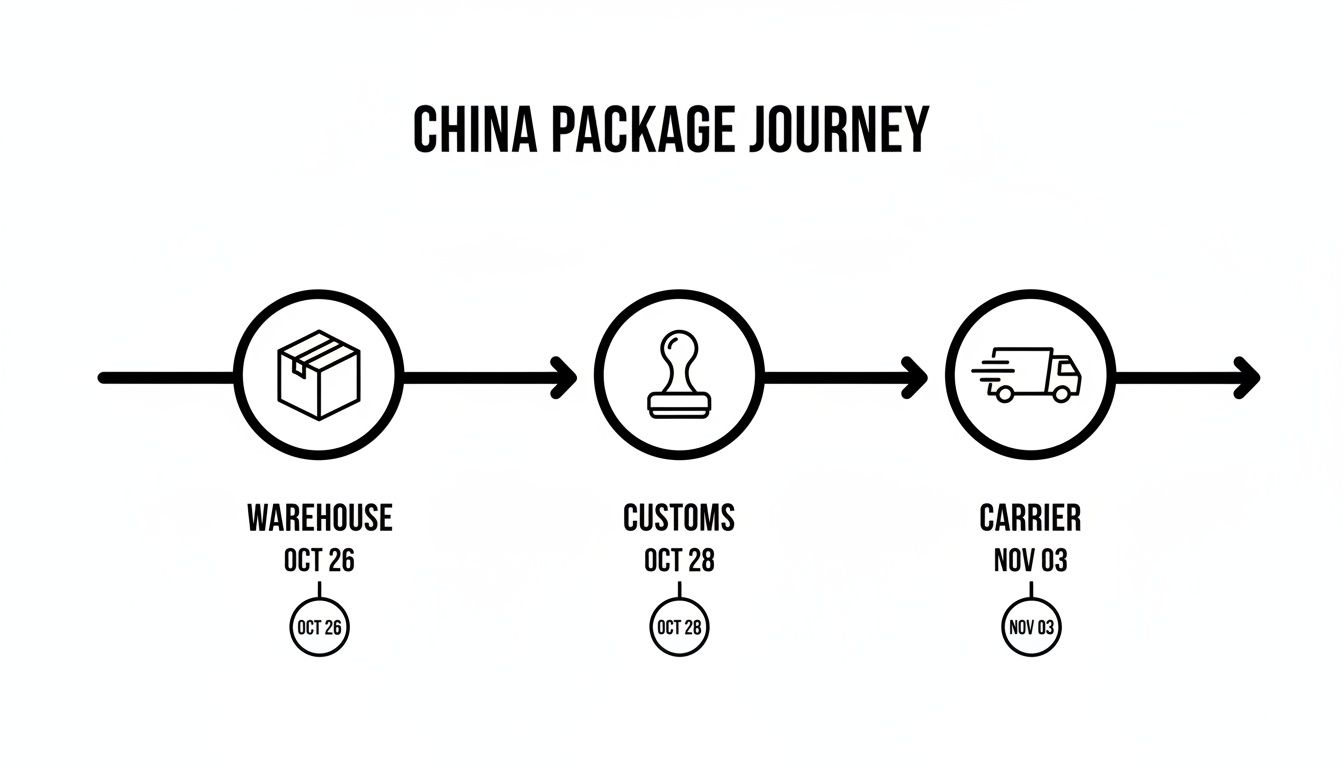
As you can tell, the whole thing is a multi-step process. Each handoff is a point where delays can happen, and customs is a big one.
Decoding Key Transit Milestones
After your package leaves that initial sorting center, it gets prepped for its international flight. Seeing an update like "Hand over to airline" or "Departed from origin country" is a great sign. It's officially on its way across the globe.
The next major checkpoint is its arrival in your country. Statuses like "Arrived at destination country" or "Submitted to customs" mean it has landed and is now in line for clearance. This is the spot where packages often seem "stuck" for a few days, and it's completely normal. Customs can take anywhere from a single day to over a week, really depending on how busy they are and what's inside your package.
A Quick Reality Check: Patience is your best friend when tracking a package from China. Standard economy shipping can take anywhere from two to six weeks. Don't panic if your tracking goes dark for 5-10 days—this radio silence is common after it leaves China but before your local postal service scans it in.
Once it's through customs, the tracking will show it's been handed off to a local partner like USPS, Canada Post, or Royal Mail. From this point on, the updates usually become more frequent and familiar, showing its progress to your local delivery hub. The last updates you'll see are the ones you've been waiting for: "Out for delivery," and finally, "Delivered."
Common Tracking Statuses Explained
Here’s a quick rundown of the most common updates you'll see and what they actually mean:
Order Information Received/Pre-shipment: The seller printed a shipping label, but the carrier doesn't physically have the package yet.
Package Received/Accepted: The logistics company has officially scanned the package into their system at the starting point.
In Transit/En Route: This is a broad term meaning the package is moving between facilities. For a deeper dive, check out our guide on what does in transit mean for a full breakdown.
Held at Customs: The package is being inspected by customs officials, either in China before it leaves or in your home country upon arrival. This is a standard step.
Arrival at Destination Country: Your package has landed in your country, but it hasn't cleared customs or been scanned by the local postal service.
Delivery Attempt Failed: The local courier tried to deliver the package but couldn't. They'll typically try again the next business day or leave a note with instructions.
What to Do When Tracking Stalls or Goes Missing
It's a sinking feeling we've all had. You eagerly check your tracking status, only to see it hasn't moved in days. Even worse, it might claim "Delivered," but your doorstep is empty. When you're waiting on a package from China, these moments can be especially frustrating, but don't panic just yet.
Most of the time, a stalled update is just a normal part of the international shipping marathon. It’s incredibly common for a package to show no new scans for 5-10 business days. This usually happens after it leaves China but before it gets processed by your local postal service—a limbo period many of us call the "tracking black hole."
Your First Moves When Tracking Goes Silent
If your tracking seems stuck in time, the best first step is simply to wait. Seriously. Give it at least another week before you start to worry. If the silence stretches beyond that, it’s time to do a little digging.
Here’s a quick action plan to get you started:
Double-Check Your Tracking Number: You'd be surprised how often a simple typo is the culprit. Instead of retyping it, copy and paste the number directly from your order confirmation to be sure.
Try Another Universal Tracker: Sometimes one tracking service just has a better data feed than another. Pop your number into a couple of different all-in-one platforms to see if a different source has a more recent scan.
Confirm the Shipping Method: Go back and look at your order details. If you chose an economy or standard shipping option, the tracking might be limited or stop altogether once the package leaves China. Updates can be sparse until it's nearly at your door.
When It's Time to Escalate
If more than two weeks have passed with zero updates and your package is way past its estimated delivery window, it’s time to reach out to the seller. They have a direct line to the shipping company and can often start an internal investigation or access details you can't see.
While the cost of shipping from China has dropped, the reality is that tracking lags are a huge headache, causing 20-30% of all customer complaints. Shipments sent through services like ePacket are notorious for going dark mid-journey, which is why a good universal tracker is a lifesaver. You can find more data on this topic by exploring these package delivery statistics on clickpost.ai.
Pro Tip: Always keep an eye on the buyer protection deadline on whatever platform you used (like AliExpress or PayPal). If your package is a no-show and the seller isn't helping, you must open a dispute before that deadline expires to get your money back.
If all else fails and the package is officially declared lost, your final move is to file a claim. Make sure to provide screenshots of your tracking history and any conversations you've had with the seller. This documentation is your best protection if your package truly vanishes on its long trip.
Got Questions About Tracking Your Package from China? We've Got Answers.
When you're waiting for a package to travel halfway across the world, it's natural to have a few questions. From confusing tracking statuses to unexpected delays, international shipping has its quirks. Let's walk through some of the most common issues people run into and how to solve them.
Why Is My Tracking Number from China Not Working?
That "tracking number not found" error is a classic, and it's almost always a false alarm. More often than not, it's just a timing issue. After a seller prints a shipping label, it can take anywhere from 24 to 72 hours for the package to get its first scan at the logistics facility. Until that happens, the number exists, but it won't show any information.
Another common culprit? You're looking in the wrong place. A package might start with a local consolidator like Yanwen or Cainiao before getting handed off to a different carrier for the international leg of its journey. The easiest way to sidestep this confusion is to pop the number into a universal tracking platform like Instant Parcels. It automatically figures out which carrier has your package, saving you the guesswork.
And, of course, there's always simple human error. Double-check that you copied the number perfectly—it's easy to miss a digit or add an extra space.
Key Takeaway: A "not found" status is rarely a cause for alarm within the first three days. Before you do anything else, try a universal tracker. It usually solves the mystery instantly by finding the right carrier.
How Long Does It Usually Take for a Package to Clear Chinese Customs?
Typically, you can expect a package to clear Chinese customs within 1 to 5 days. This is the standard export process where officials give the contents and paperwork a final check before sending it on its way.
But that timeline isn't set in stone. Things can slow down considerably during massive shopping events like Singles' Day on November 11th or in the weeks leading up to Chinese New Year. Customs facilities get absolutely buried in parcels, so a few extra days of delay are completely normal and nothing to worry about.
If your tracking is stuck on a "Held by Customs" status for over a week with no movement, that’s when it’s a good idea to reach out to the seller. They can often get more detailed information from their shipping partner on the ground.
What Should I Do if My Package Has Been In Transit for Weeks?
Seeing that "In Transit" status for what feels like forever can be nerve-wracking, but for packages crossing oceans, it's often just part of the waiting game. It's not unusual for a shipment to sit in this status for 10 to 15 days—or even longer. This usually means it's on a ship or waiting for a spot on a cargo plane.
The tracking usually won't click over to the next status until the package is scanned in your own country. So, a long "In Transit" period just means it's making its long journey between major hubs.
However, if you're looking at 20-30 days with zero updates, it’s time to be proactive.
Contact the Seller: This is your first and best move. They have a direct line to the original carrier and can launch an official inquiry to find out what's going on.
Know Your Deadline: Check the buyer protection deadline on the platform you ordered from (like AliExpress). This date is your safety net.
File a Dispute: If the seller is unresponsive or the package is still MIA, don't let that deadline pass. Open a "package not received" dispute to protect your money.
My Package Says Delivered but I Haven't Received It. What's Next?
This is easily the most frustrating scenario, but don't panic. Run through this checklist first.
Start by doing a full sweep of your property. Look behind planters, on the back porch, or any other spot a delivery driver might try to hide a package from view.
Next, check in with your neighbors. It’s incredibly common for a well-meaning neighbor to grab a package for you, especially if you weren't home. If you live in an apartment, check the mailroom or front desk. And while you're at it, pull up your order confirmation and make sure the shipping address is 100% correct.
If the package is still missing, call your local post office or the final delivery service (like USPS or Royal Mail). Give them the tracking number—they often have internal GPS data that can pinpoint exactly where the "Delivered" scan took place.
If all else fails, get in touch with the seller immediately to let them know what happened. You'll need to file a claim through the e-commerce marketplace to get the issue resolved.