
Top Picks: Discover the best parcel tracking app for effortless shipments
If you've ever found yourself juggling a dozen open browser tabs just to keep an eye on packages from different carriers, you know the frustration. The solution is a universal platform like Instant Parcels. It’s designed to be your single source of truth for every shipment, cutting through confusing carrier jargon and giving you clear, simple updates. It’s a game-changer for online shopping and business logistics.
Why You Need a Universal Parcel Tracking App
A list of tracking numbers from UPS, FedEx, USPS, and DHL can look like a recipe for chaos. Each one lives on a different website, with its own quirky layout and strange status updates. This old-school way of tracking forces you to manually check every single site to get the full picture of what’s coming and going. It’s a huge time-sink.
A universal parcel tracking app is the master key that unlocks all of them at once. Instead of hopping between a dozen carrier pages, you get a single, clean dashboard. Everything is there, no matter who's delivering it. It’s like finally ditching a bulky wallet stuffed with plastic loyalty cards for one simple app on your phone.
A Much-Needed Shift to Centralized Control
Moving from manual checking to automated oversight isn't just a nice-to-have anymore; it’s essential. Customers today expect to know exactly where their order is from the moment they click "buy." That feeling of the unknown—what some call "delivery anxiety"—is a major source of frustration.
The need for clear, real-time information is undeniable. Shopper expectations have completely changed the game for delivery logistics. Today, 91% of consumers actively track their packages, and almost 20% check for updates multiple times a day.
This behavior shows just how important transparent tracking has become. For any business, providing this visibility is the best way to build customer trust and slash the number of "Where is my order?" emails flooding your support inbox.
From Chaos to Clarity
Think about how messy and inconsistent tracking can be. Carrier updates are often cryptic—"in transit," "out for delivery," and "exception" can mean slightly different things depending on the service. A good tracking app doesn't just pull that data; it translates it into plain, easy-to-understand language.
Here's a quick look at how much smoother things get when you switch.
The Old Way vs The Smart Way
| Tracking Method | Manual Tracking (Multiple Websites) | Universal Tracking App |
|---|---|---|
| Time Spent | 10-15 minutes per day logging into multiple sites | Under 1 minute to see everything on one dashboard |
| Mental Load | High stress, have to remember which carrier has which package | Low stress, everything is organized and automated |
| Clarity | Confusing, inconsistent status updates from each carrier | Standardized, easy-to-understand updates for all packages |
| Efficiency | Inefficient, repetitive, and prone to missing key updates | Highly efficient, provides a clear overview to spot issues fast |
The difference is night and day. Moving to a unified platform delivers some immediate wins:
- Less Stress: You no longer have to keep a mental tally of which package is with which carrier.
- More Time: All those minutes spent checking websites add up. Now, that time is yours again.
- Better Oversight: A bird's-eye view of all your shipments makes it easy to catch delays before they become big problems.
By bringing all your tracking information into one organized space, a universal tracker gives you back a sense of control. Whether you’re an avid online shopper or a growing e-commerce seller, it’s a simple tool that makes a massive difference.
Core Features of a Top-Tier Tracking App
On the surface, most tracking apps look the same. But once you start using them, you quickly realize not all are created equal. While any basic tool can tell you a package's last known location, a truly great parcel tracking app does so much more. It's built on a foundation of smart features that work together to turn a clunky, frustrating process into something simple and even automated.
Think about it like this: a basic map shows you the roads, but a modern GPS gives you real-time traffic updates, turn-by-turn directions, and reroutes you around accidents. A top-tier tracking app offers that same level of intelligence and dynamic support for your deliveries.
Universal Carrier Support
First things first: the app has to speak the language of logistics fluently. That means universal carrier support isn't just a nice-to-have; it's essential. A solid app needs to connect with hundreds of couriers across the globe, from the usual suspects like FedEx and UPS to regional postal services and smaller, niche carriers you might not have even heard of.
Without it, you're right back where you started—juggling multiple apps and browser tabs for that one international order or a package sent with a less common service. Real convenience is knowing you have one tool that can handle anything you throw at it, no matter where it's from or where it's going.
Automatic Carrier Detection
This feature is a game-changer. Imagine having a key that just knows which lock it fits. That's automatic carrier detection in a nutshell. You shouldn't have to decipher whether a tracking number belongs to DHL, Aramex, or Canada Post. The best apps let you paste any tracking ID, and they instantly figure out the carrier and start pulling in the data.
It's a small detail that saves a surprising amount of time and mental energy, especially if you’re a small business managing dozens of shipments a day. It completely removes the guesswork.
A truly great parcel tracking app should feel effortless. The goal is to eliminate manual steps, reduce friction, and provide clear answers instantly, so the user never has to play detective just to find out where their package is.
This smart detection is really the front door to a user-friendly experience, making every other feature that much easier to access.
A Unified Dashboard
Once your packages are tracked, you need a place to see them all. A unified dashboard is your command center, laying out all your inbound and outbound shipments in one clean, organized screen. This is what transforms tracking from a reactive, one-by-one chore into a proactive, at-a-glance overview.
For an online shopper, this means seeing all your recent purchases lined up and knowing what to expect and when. For a small business owner, it’s an indispensable tool for monitoring customer orders, spotting delays before they become problems, and managing expectations.
Standardized Status Updates
Let's be honest, carrier updates can be ridiculously confusing. What does "Tendered to delivery service provider" or "Arrival at inward office of exchange" even mean? A superior app acts as a translator, converting that industry jargon into simple, standardized status updates that anyone can understand.
It doesn't matter who the carrier is; the information is presented in a consistent, easy-to-read format:
- In Transit: Your package is on the move.
- Out for Delivery: It's arriving today.
- Delivered: It made it!
- Delivery Exception: There’s a snag that needs your attention.
This kind of clarity is crucial. It cuts down on customer anxiety and makes the whole process feel more transparent and less stressful for everyone involved.
Proactive Notifications
Finally, the best apps don't wait for you to check on your package; they bring the updates directly to you. Proactive notifications, whether through push alerts on your phone or emails, are a must. You should get a real-time ping for every important step—when a label is created, when the package is out for delivery, and the moment it's been delivered.
This is what frees you from constantly hitting refresh on a tracking page. The demand for these kinds of powerful, automated tools is actually driving huge growth in the logistics world. In fact, the global shipping software market is projected to jump from USD 14.26 billion in 2025 to USD 22.23 billion by 2030, largely because of the explosion in e-commerce. You can dig into these market trends over at Mordor Intelligence.
Advanced Tools for E-Commerce and Power Users
If you're running a growing e-commerce store or you're a power user juggling a ton of shipments, the basic features of a tracking app just won't cut it. To really get ahead, slash manual work, and build a brand that looks professional, you need tools that go way beyond just watching dots on a map. These advanced features are what separate simply monitoring packages from actually managing your entire post-purchase experience.
Think of it like this: a basic app is a hammer. It's good for one thing. But an advanced platform is the whole toolbox, packed with power tools that automate the tricky stuff and get the job done right. For a business, that means unlocking efficiencies that directly boost your bottom line by saving time and keeping customers happy.
Automate Everything with API Access and Webhooks
For any serious business, the real game-changer is API access. An API (Application Programming Interface) is essentially a secure language that lets different software programs talk to one another. When it comes to a parcel tracking app, this means your own systems—your Shopify store, your warehouse software, your custom dashboard—can automatically pull in tracking data.
No more manually copy-pasting tracking numbers into order records. An API integration handles it all for you, creating a smooth, constant flow of information. Your team gets the latest package status without ever having to switch tabs.
Webhooks take this automation to the next level. While an API pulls data when you ask for it, a webhook pushes updates to your system the second they happen.
- API: Your system asks, "Hey, what’s the status of this package?"
- Webhook: The tracking app shouts, "Hey, this package was just delivered!"
This real-time communication lets you set up automatic actions, like sending a custom "Your Order Has Arrived!" email the moment a package hits the customer's doorstep. It’s the engine that powers a truly responsive and automated customer experience.
Own the Customer Journey with Branded Tracking Pages
When a customer asks for their tracking info, where do you send them? If it's to a generic carrier page cluttered with ads and confusing jargon, you're throwing away a massive branding opportunity. The best parcel tracking apps let you create branded tracking pages.
This means when a customer clicks the link in their shipping email, they land on a page with your logo, your brand colors, and maybe even a banner for your latest sale. Instead of a jarring handoff to FedEx or UPS, you keep them wrapped in your brand experience from the moment they buy to the moment the box arrives.
A branded tracking page turns a moment of customer anxiety—"Where is my order?"—into a positive brand interaction. It reinforces trust, keeps customers in your ecosystem, and adds a professional polish that your competitors probably lack.
These pages don't just look better; they work better. They show tracking updates in a clean, simple format that's easy for anyone to understand, cutting through the carrier-specific confusion. It’s a small change that makes a huge difference in how customers see your brand and is a vital step in how to improve e-commerce customer experience.
Optimize Logistics with Shipment Analytics
You can't fix what you can't see. Advanced tracking platforms offer shipment analytics, turning a sea of raw tracking data into clear, actionable insights. A solid analytics dashboard gives you a bird's-eye view of your entire shipping operation.
Suddenly, you can answer critical questions:
- Which of our carriers are actually delivering on time?
- Which ones are causing the most delays or problems?
- What's our average transit time to the West Coast versus the East Coast?
- Are we living up to the promises we make in our shipping policy?
By digging into this data, a logistics coordinator can spot trends, flag underperforming carriers, and make smart decisions to refine their shipping strategy. This is the kind of insight you need to negotiate better rates and ensure you're always picking the most reliable service for your customers.
How to Choose the Right App for Your Needs
Picking the right parcel tracking app is a bit like choosing a new tool. A simple hammer is perfect for hanging a picture, but you wouldn't use it to build a house. The “best” app isn't some one-size-fits-all solution; it's the one that perfectly fits the job you need it to do, whether you're tracking a single birthday gift or a thousand customer orders.
The trick is to look beyond a long list of flashy features and think about how you'll actually use the tool day-to-day. An online shopper has completely different needs than a customer service agent or a logistics coordinator. By first figuring out which camp you fall into, you can zero in on the features that will solve your real-world problems and skip the ones that just add clutter.
For the Casual Online Shopper
If you’re mainly tracking your own online purchases, your needs are pretty straightforward. The biggest headaches are usually juggling orders from different stores without your inbox turning into a mess, and getting simple, clear updates so you know when to be home for a delivery.
You don't need fancy analytics or developer tools. You just need a clean, reliable app that acts like a personal assistant, keeping you in the loop without any fuss.
Look for these core features:
- Simplicity and Ease of Use: The app should be intuitive, with a clean interface that lets you add tracking numbers in a snap.
- Unlimited Carrier Support: Your packages come from all over, so the app needs to handle everything from major couriers like FedEx and UPS to smaller regional or international postal services.
- Real-Time Push Notifications: Timely alerts for statuses like “Out for Delivery” and “Delivered” are crucial for peace of mind and preventing porch pirates.
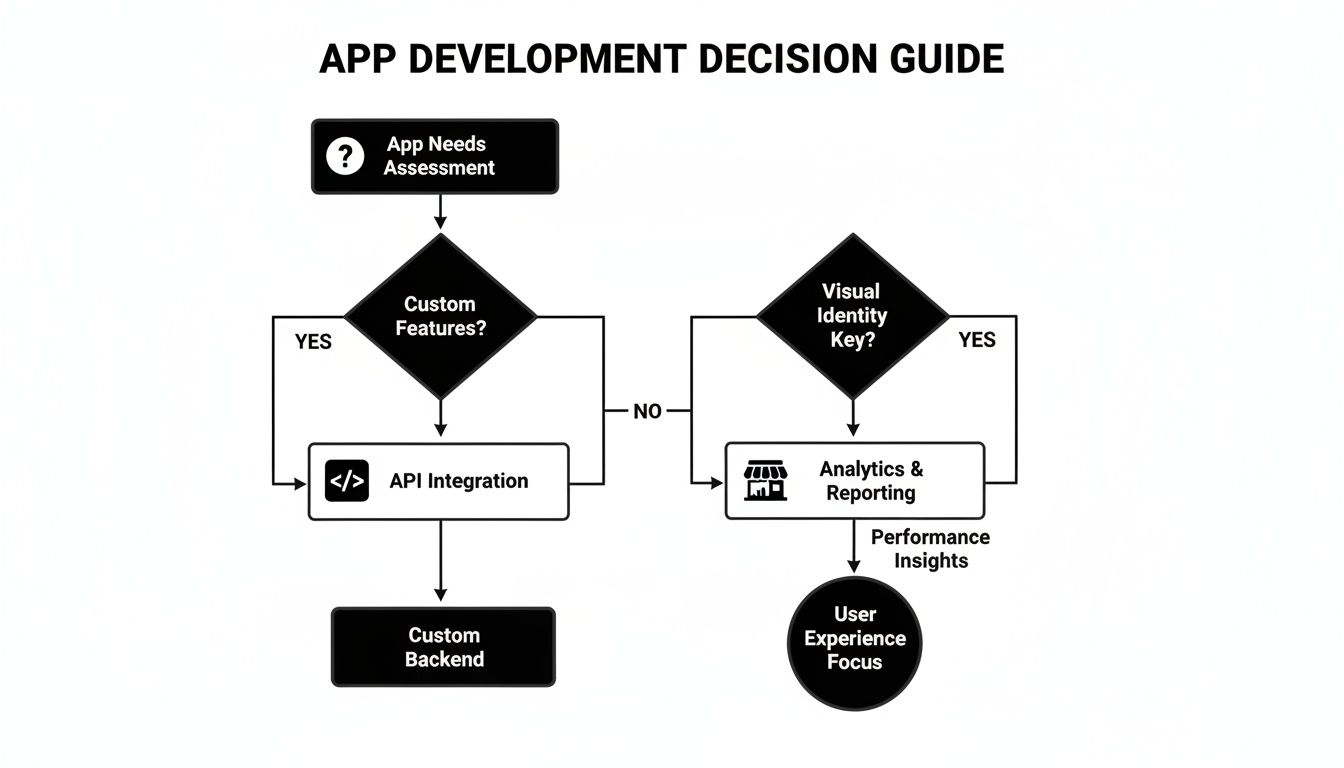
As this flowchart shows, different goals lead to different solutions. While a developer might prioritize API access, an e-commerce owner is more focused on branding and analytics to create a better customer experience.
For the E-commerce Business Owner
As a small business owner, you’re already wearing multiple hats. Managing shipments is a big one. Your main goal here is to provide a professional and transparent experience after a customer clicks "buy," which builds trust and cuts down on "where's my order?" emails.
Sending customers to a generic carrier website just doesn't cut it. It feels disconnected from your brand and you lose a valuable opportunity to engage with them.
Every customer touchpoint is a chance to reinforce your brand. A custom tracking page isn't just a utility; it's a marketing asset that keeps your customers engaged with your business, not the shipping company's.
Your ideal app is a command center that not only tracks packages but also strengthens your brand. It's also worth exploring how a dedicated platform compares to a simple best parcel tracking website to see which makes more sense for your workflow.
Key features for your business include:
- Branded Tracking Pages: Create a seamless experience by sending customers to a tracking page that features your logo, colors, and branding.
- Multi-Package Dashboard: Get a bird's-eye view of all your shipments in one place to proactively spot delays and manage exceptions.
- CSV Import/Export: Easily upload and manage tracking numbers in bulk, saving you from hours of tedious manual data entry.
For the Customer Service Agent
When a customer asks, “Where is my order?” you need an answer, and you need it fast. As a support agent, your job is to resolve problems quickly and confidently. Fumbling between different carrier websites while a customer is on hold is inefficient and frustrating for everyone involved.
You need a tool built for speed and clarity. For a support team, the best app is a single source of truth, giving you instant access to accurate, easy-to-understand shipping info. This empowers you to turn a potentially negative interaction into a positive one.
Prioritize these functionalities:
- Fast and Powerful Search: Instantly find any order by tracking number, customer name, or order ID.
- Standardized Statuses: Get clear, consistent updates you can share with customers without having to translate confusing carrier jargon on the fly.
- Easy Sharing Options: Quickly send a direct tracking link to the customer so they can stay updated after the call or chat is over.
For the Logistics Manager
If you oversee your company's entire supply chain, your needs are far more complex. You aren't just tracking packages; you're managing carrier performance, optimizing routes, and making sure the whole operation runs like a well-oiled machine. Manual tracking simply isn't an option.
Your world revolves around data, automation, and integration. The right app for you is less of an app and more of a powerful data platform that plugs directly into your existing systems (like a WMS or ERP) and gives you the high-level insights needed for strategic decision-making.
Your non-negotiable features are:
- Full API Access and Webhooks: Automate the flow of tracking data across all your internal systems, from the warehouse floor to your financial software.
- Detailed Shipment Analytics: Get the data you need to analyze carrier performance, measure on-time delivery rates, and pinpoint logistical bottlenecks.
- Robust Security and Reliability: You need a platform that is 100% secure, stable, and capable of handling a massive volume of tracking requests without breaking a sweat.
Feature Priority Checklist for Different Users
To make it even clearer, here’s a quick summary of which features tend to matter most to each type of user. Use it as a checklist to guide your evaluation.
| Feature | Online Shopper | E-commerce Owner | Support Agent | Logistics Manager |
|---|---|---|---|---|
| Simple, Clean UX | High | High | High | Medium |
| Broad Carrier Coverage | High | High | High | High |
| Real-Time Notifications | High | Medium | Low | Low |
| Branded Tracking Pages | Low | High | Medium | Low |
| Multi-Tracking Dashboard | Low | High | High | High |
| Powerful Search | Low | Medium | High | Medium |
| Standardized Statuses | Medium | High | High | High |
| Bulk Import/Export (CSV) | Low | High | Low | High |
| API & Webhook Access | Low | Medium | Low | High |
| Performance Analytics | Low | Medium | Low | High |
| High Security | Low | Medium | Medium | High |
This table highlights how priorities shift. While an online shopper just needs a simple interface, a logistics manager's entire operation depends on robust API access and deep analytics. Knowing where you fit helps you find the perfect tool for the job.
A Closer Look at the Instant Parcels Experience
It’s one thing to talk about what makes a great tracking app, but it's another to actually experience it. This is where we built Instant Parcels to bridge the gap between powerful features and a genuinely easy user experience. We took all the common frustrations and designed a platform from the ground up to solve them.
Our entire approach is built on a simple idea: tracking shouldn’t be a chore. The second you land on our dashboard, you'll see a clean, uncluttered interface. No confusing menus, no distracting ads—just one powerful search bar waiting for your tracking number. This is intentional. We want you to get from A to B in just a few seconds.
The Magic of Effortless Tracking
Your first interaction with Instant Parcels shows you exactly what we mean. Forget trying to guess if your package is with Aramex, Royal Mail, or some obscure regional courier. Just copy any tracking number and paste it in.
Our automatic carrier detection kicks in instantly, identifying the right courier from a network of over 1,100 global carriers. Think of it like a universal key that fits any lock, saving you the headache of playing detective. This one feature turns a tedious task into a simple, one-step process.
Once we find your shipment, it’s added to a central dashboard. Here, you can see all your packages—both past and present—in one organized view. It’s your mission control for deliveries, giving you a clear picture of everything you have in transit.
Instant Parcels was designed to deliver clarity. We translate chaotic logistics data into a simple, standardized format, empowering you with information you can actually use. This turns delivery anxiety into confident anticipation.
This philosophy really shines when it comes to status updates. Carrier jargon like "Inward office of exchange" is just confusing. We translate these cryptic phrases into plain English so you always know exactly what's happening with your delivery, no guesswork required.
Turning Data into Actionable Insights
Getting clear information is great, but getting it proactively is what sets the best parcel tracking app apart. Instant Parcels keeps you in the loop with real-time notifications for every key milestone in your package's journey. You'll get alerts for critical events:
- Info Received: The carrier has the shipping details.
- In Transit: Your package is on the move.
- Out for Delivery: It should arrive today.
- Delivered: The shipment has reached its destination.
- Exception: There’s an issue that might need your attention.
This proactive system means you can stop constantly refreshing a tracking page. You’re not alone in wanting this kind of visibility. The global delivery tracking platform market was valued at USD 11.3 billion in 2025 and is projected to nearly triple to USD 31.4 billion by 2035. This massive growth shows just how essential transparent logistics have become. You can find more data on this market trend from Future Market Insights.
For businesses, Instant Parcels offers tools that go beyond basic tracking. Our platform lets you create branded tracking pages, keeping your customers engaged with your brand even after they’ve checked out. It’s a professional touch that builds loyalty and dramatically cuts down on "Where is my order?" support tickets.
Our goal is to give you a solution that grows with you. Whether you're tracking a single online order or a small business managing hundreds of shipments, our platform is built to deliver the same level of clarity, speed, and reliability. By focusing on a clean interface, smart automation, and clear communication, Instant Parcels delivers an experience that just works.
Got Questions About Parcel Tracking Apps? We Have Answers.
Jumping into any new tool brings up a few questions. And when it comes to keeping an eye on your packages, you want to be sure you have the full story. Let’s clear up some of the most common questions people have about parcel tracking apps, from how they work to whether they’re safe.
Is It Safe to Use a Third-Party Tracking App?
This is the big one, and for good reason. The short answer is: yes, as long as you stick with a reputable app. A good tracking app is designed to access only one thing: the public tracking data tied to your tracking number.
Think of it like this: when you look up a tracking number on a carrier's website, you're viewing a public record. A tracking app does the same thing, just for multiple carriers and all in one place. It doesn't need—and shouldn't ask for—your name, address, payment info, or what’s inside the box. It just uses the tracking ID you give it to ask the carrier for an update.
The whole process is as secure as using the carrier’s own website. The app acts like a helpful messenger, fetching the tracking updates for you without ever peeking at your personal information. It’s a tool for convenience, not a risk to your privacy.
Can a Tracking App Make My Delivery Faster?
While an app can't magically make a delivery truck drive faster, it can help you get your package sooner by letting you jump on problems the second they happen. Shipping is a complex dance with lots of moving parts, and things can go wrong—from a simple typo in an address to a holdup at customs.
Without a good tracker, you might not know there’s an issue for days. A great app, on the other hand, sends you an alert the moment a "delivery exception" pops up.
Getting an instant notification about a shipping problem is the difference between a small hiccup and a huge delay. It means you can call the carrier or seller right away to sort things out, potentially saving days your package would have spent sitting in a warehouse.
This kind of visibility changes the game. You go from passively waiting to actively managing the situation. By catching and fixing issues like a failed delivery attempt or a package on hold, you can get things moving again far more quickly.
What Is the Difference Between Free and Paid Apps?
The split between free and paid apps really comes down to who they're built for. Both are useful, but they solve different problems.
- Free Apps: These are usually perfect for online shoppers and casual users. They handle the basics well—tracking a few packages at a time and sending simple notifications. To keep the lights on, they're often supported by ads, which can sometimes get in the way.
- Paid Apps: These are professional-grade tools built for e-commerce sellers, support teams, and logistics managers. They offer a clean, ad-free experience packed with powerful features designed to handle high volumes of shipments efficiently.
Upgrading to a paid plan unlocks a whole new set of capabilities that are non-negotiable for a business. You get features like:
- Unlimited Tracking: Keep an eye on hundreds or even thousands of shipments at once.
- API & Webhooks: Feed tracking data directly into your own business software for total automation.
- Branded Tracking Pages: Give your customers a professional, on-brand post-purchase experience.
- Advanced Analytics: Get real data on carrier performance to make smarter shipping decisions.
For any business, the small monthly cost is a no-brainer when you consider the time saved, the drop in "Where's my order?" emails, and the boost to your brand's reputation.
How Do Universal Tracking Apps Get Their Information?
Universal tracking apps are masters of information gathering. They don't own trucks or warehouses; instead, they plug into a vast, global network of carrier systems.
The main way they do this is by integrating with carrier Application Programming Interfaces (APIs). An API is just a set of rules that lets different software systems talk to each other. Big carriers like FedEx, UPS, and DHL offer APIs that allow trusted partners to request tracking data automatically.
Here’s a look behind the curtain at what happens when you enter a tracking number into an app like Instant Parcels:
- First, the app’s smart system identifies the carrier just by looking at the format of the tracking number.
- Next, it sends a secure, real-time request to that specific carrier's API asking for the latest updates.
- The carrier’s system shoots back the raw tracking data.
- Finally, the app cleans up and standardizes this information, translating confusing carrier-speak into simple, clear language and displays it in a neat, consistent timeline.
This entire process takes just a few seconds, pulling together data from hundreds of different carriers around the world to give you one simple, unified view of all your shipments.