
The Ultimate Guide to Universal Parcel Tracker Tools
Ever felt like you need a detective's degree just to figure out where your package is? You've got a tab open for FedEx, another for USPS, and a third for some international carrier you’ve never even heard of. It’s a common frustration, and it’s exactly the problem a universal parcel tracker was built to solve.
Tired of Juggling Tracking Numbers Across Multiple Sites?

A universal parcel tracker is essentially a master key for all your shipments. Instead of bouncing between different websites, you use one single, clean dashboard to see the entire journey of any package, regardless of the carrier. It brings order to the chaos.
This isn't just about convenience; it's about clarity. Think of all the time you've wasted digging through emails to find the right tracking number and then figuring out which carrier's site to visit. A universal tracker cuts through all that noise, giving you a single source of truth for all your deliveries.
The Problem of Scattered Information
The root of the issue is that every shipping carrier—from DHL to your local post office—operates in its own little world. Each has its own tracking system, its own terminology, and its own website. This fragmentation forces you to act as the go-between, constantly translating and consolidating information in your head.
A tool like Instant Parcels does that heavy lifting for you. It taps into each carrier's system, pulls the relevant data, and presents it in one easy-to-understand format. It saves time, sure, but more importantly, it reduces the mental load of keeping tabs on everything you've ordered.
A universal tracker doesn't physically move your package; it just gives you a crystal-clear window to watch its journey, no matter who's carrying it. It’s about visibility, not logistics.
Who Benefits From a Centralized View?
This unified approach isn't just a lifesaver for individuals waiting on a single, important order. It's a game-changer for anyone who manages multiple shipments. If you're struggling to even locate your tracking codes, you might find our guide on how to find your tracking number a helpful place to start.
Here’s who really gets the most out of it:
- Online Shoppers: Track all your purchases from different stores in one spot. No more trying to remember if that new gadget is coming via UPS or FedEx.
- E-commerce Sellers: Give your customers a simple, branded tracking page and watch the "Where is my order?" support tickets disappear. It's a win-win.
- Small Businesses: Get a bird's-eye view of every package you've sent out. This lets you spot potential delays early and manage customer expectations before they turn into complaints.
What Is a Universal Parcel Tracker, Really?
Let’s get one thing straight: a universal parcel tracker isn’t a new shipping company or some magical delivery service. It’s much simpler and, honestly, more practical than that.
Think of it like a personal finance app, such as Mint, that pulls all your different bank accounts, credit cards, and investments into one place. A universal parcel tracker does the exact same thing, but for your packages. It’s a smart technology layer that sits on top of the messy, complicated world of global logistics.
It hooks directly into the systems of hundreds of different couriers, from giants like FedEx and DHL to the local postal service down the street. It then yanks all that scattered tracking information into one clean, unified dashboard for you to see.
This completely eliminates the headache of bouncing between a dozen different carrier websites, each with its own quirky interface and confusing terminology. The goal is simple: take the chaotic journey of a package and turn it into a single, easy-to-follow story.
The Central Hub for All Your Shipments
At its core, a universal parcel tracker is a data hub. The moment you plug in a tracking number, its first job is to figure out which carrier it belongs to. Once it knows, it "talks" to that carrier's system through a secure pipeline called an API (Application Programming Interface) to fetch the latest updates.
This direct line to the source means the information is always as accurate and up-to-the-minute as what the carrier itself has. The real magic, though, is its ability to do this for hundreds of different couriers at the same time.
A universal tracker doesn't just show you a pin on a map. It creates a single source of truth for all your deliveries, no matter where they came from or who's carrying them, simplifying the entire post-purchase journey.
The logistics world is getting bigger and more complex every year. The global courier market was valued at a staggering USD 461.69 billion in 2023 and is expected to nearly double to USD 925.48 billion by 2030. With more and more packages flooding the system, a unified tracking solution isn't just a nice-to-have; it's becoming a necessity. You can dive deeper into the data on the global courier market to see just how fast things are growing.
How It Stacks Up Against Traditional Tracking
To really get why this matters, let's compare the old way with the new way. The traditional method is a manual, repetitive, and often frustrating game of cat and mouse, especially when an international shipment gets passed from one carrier to another. A universal parcel tracker brings order to that chaos.
Let's break down the differences.
Traditional Tracking vs. Universal Parcel Tracker
| Feature | Traditional Method (Multiple Websites) | Universal Parcel Tracker (e.g., Instant Parcels) |
|---|---|---|
| Process | You have to manually visit each carrier's website, one by one. | Just enter any tracking number into a single search bar. Done. |
| Carrier Identification | You need to know exactly which carrier is handling the shipment. | Automatically figures out the correct carrier from the number alone. |
| Updates | You're stuck constantly refreshing multiple browser tabs for news. | You get a single, unified feed of real-time updates for all packages. |
| Clarity | You're left decoding confusing jargon like "In transit to facility." | It translates vague statuses into simple, understandable language. |
| Convenience | Disjointed and a huge time-sink, especially if you have many orders. | All your shipments are neatly organized on one streamlined dashboard. |
The difference is night and day. One approach is fragmented and requires constant work from you, while the other is automated, centralized, and designed for clarity and peace of mind.
How These Tracking Tools Work Behind the Scenes
Ever wondered how a single website can instantly figure out your package is with FedEx just by looking at the tracking number? It's not magic, but a clever combination of smart technology and data integration. Think of a universal parcel tracker as a master interpreter, taking in chaotic logistical data from hundreds of different couriers and translating it into a simple, clear story for you.
This whole process kicks off the moment you paste in a tracking number. From there, a series of automated steps work to turn scattered, raw information into a clean, easy-to-read update on one screen. To really get it, it helps to understand where these tools fit within the larger e-commerce supply chain.
Carrier Autodetection: The First Spark of Intelligence
The first, most critical step is carrier autodetection. Every tracking number has a unique format—a specific pattern of letters and numbers that acts like a fingerprint for the courier that issued it. A USPS tracking number, for instance, looks completely different from one assigned by DHL.
A universal tracker uses powerful algorithms to analyze this structure in a fraction of a second. It cross-references the format against a massive, constantly updated database of carrier patterns to find an instant match. This is precisely how platforms like Instant Parcels can pinpoint the right courier without you ever needing to pick it from a list.
Data Aggregation and Status Normalization
Once the carrier is identified, the tracker opens a secure line of communication with that carrier's system using an API (Application Programming Interface). You can picture this as a direct, authorized phone line. The tracker "pings" the carrier's server to pull the latest raw data for your specific package.
But that raw data is often a mess of confusing jargon like "In transit to destination facility" or "Manifested for transit." This is where status normalization becomes essential.
The system acts as a universal translator, converting vague industry terms into simple, human-readable language like "On its way" or "Out for delivery." This ensures you get a clear, consistent experience no matter which carrier is handling the shipment.
The demand for this kind of clarity is exploding. The live package tracking market is projected to be worth USD 4.92 billion in 2025 and is expected to more than double to USD 10.95 billion by 2032. This shows just how much customers now expect and demand continuous, easy-to-understand visibility from the moment an item ships to the second it lands on their doorstep.
This flowchart breaks down how a universal parcel tracker pulls information from all those different carriers and funnels it into a single, user-friendly dashboard.
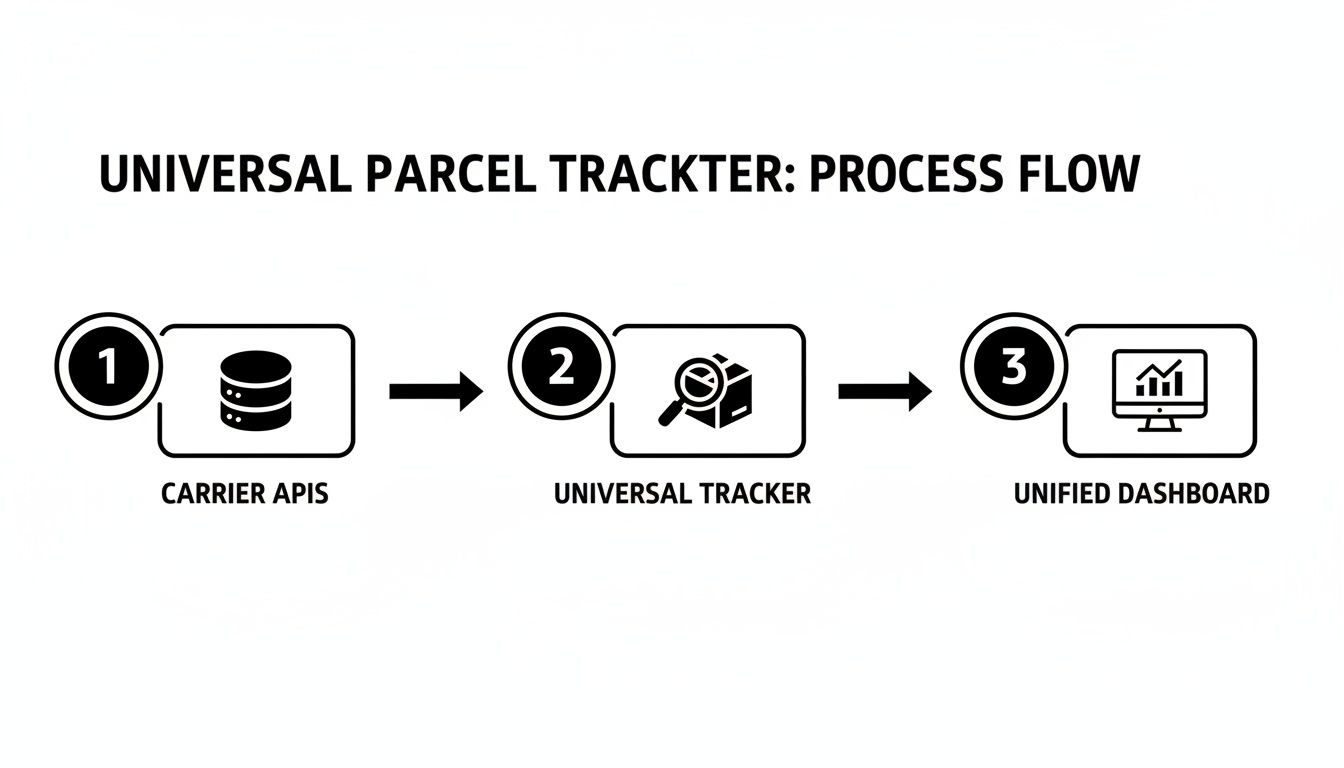
The system efficiently grabs data through APIs, processes it centrally, and then presents it in one unified view, making life much simpler for the user. This technical backbone is what makes a universal tracker such a powerful tool for everyone, from casual online shoppers to large e-commerce businesses.
Why This Matters for Shoppers and Business Owners
A universal parcel tracker is much more than just a neat gadget. Its real value is in how it solves the specific, nagging problems that crop up after you click "buy" — whether you're the one waiting for the package or the one who sent it.For shoppers, the biggest win is getting rid of that nagging "package anxiety." We've all been there. You order from a few different online stores, and suddenly you're juggling a handful of tracking numbers from carriers you've barely heard of. It’s a mess of bookmarks and buried emails.
A universal tracker cuts right through that chaos. It pulls everything into one clean, simple dashboard where you can see all your orders at a glance. That simple act of bringing everything together turns the stressful question of "Where is my stuff?" into a calm, quick check.
Empowering the Modern Shopper
The perks for shoppers go beyond simple organization. Let's be honest, carrier websites can be clunky and full of confusing jargon. A good tracker is built for you, not for a logistics professional.
- Clarity and Simplicity: It translates vague updates like "In transit to next facility" into plain English you can actually understand.
- Time Savings: No more bouncing between different carrier sites. You check one place, and you're done. It's a small thing that saves a ton of frustration.
- Proactive Alerts: Many trackers can send you a notification the moment your package is out for delivery or if, heaven forbid, there's a delay.
For an individual, a universal parcel tracker is like a personal logistics assistant. It tidies up the mess, gives you straight answers, and just takes the guesswork out of waiting for a delivery.
A Competitive Edge for Business Owners
For anyone running an e-commerce business, the benefits go from personal convenience to a serious operational advantage. The single biggest impact? Slashing the time you spend on customer support. "Where Is My Order?" (WISMO) questions can absolutely swamp a support team.
By giving your customers a simple, branded tracking page, a universal parcel tracker lets them find the answers themselves. This one proactive step can drastically cut down on WISMO tickets, freeing up your team to focus on more complex problems that actually need a human touch.
It also gives you a complete operational picture of every package you've sent out. Instead of logging into five different carrier portals, you get a bird's-eye view of your entire fulfillment operation. This lets you spot potential delays before they become problems, manage customer expectations, and turn what could be a logistical nightmare into a smooth, professional experience. To see how different tools stack up, check out some of the best parcel tracking websites on the market.
How to Choose the Right Universal Tracking Tool

Let's be honest—not all universal trackers are built the same. With a ton of options out there, it's easy to get lost. The trick is to look past the simple search bar and dig into the features that actually make your life easier and keep customers happy.
Think of it like this: your first and most important filter is carrier coverage. A tracking tool is pretty useless if it doesn't support the couriers you rely on, whether that’s a global player like DHL or a niche, regional delivery service.
Once you’ve confirmed the coverage fits your needs, the next big thing to check is the user experience. Is the interface clean and simple, or a confusing mess? You want to see the status of all your packages at a glance, without needing a manual to figure it out.
Core Features That Cannot Be Compromised
Beyond the absolute basics, a truly great universal tracker needs to have a few non-negotiable features. These are the details that separate a merely functional tool from a genuinely powerful one.
- Real-Time Updates: The data has to be fresh. The tool should pull the latest scans from carrier systems the moment they happen, so you're not making decisions based on old information.
- Advanced Organization: If you're a power user or running a business, you need more than just a list. Look for the ability to save, name, and archive shipments to keep your active orders tidy and separate from the ones that have already been delivered.
- Mobile Accessibility: We're all on the move. A solid mobile app or a well-designed mobile site is a must-have for checking a package status from anywhere. You can check out some of the best package tracking app options to see what a great mobile experience looks like.
The best universal parcel tracker feels less like a utility and more like a command center. It provides not just data, but organized, actionable intelligence about every shipment in your pipeline.
Evaluating for Business and Scalability
This isn't just a niche tool anymore; it’s becoming essential. In fact, the tracking-as-a-service market is expected to jump from USD 9.96 billion in 2025 to a massive USD 41.55 billion by 2034. That massive growth, detailed in a report from Precedence Research, highlights just how critical these platforms have become for businesses looking to grow.
When you're picking a tool for your business, think long-term. Does it offer API access so you can plug it into your other systems? Can you create branded tracking pages to give your customers a professional, consistent experience? Does it provide analytics to help you spot delivery bottlenecks? Choosing a tool that can grow with you is a smart investment that will pay off down the road.
Your Universal Parcel Tracker Questions Answered
As you get into the world of unified tracking, a few questions are bound to come up. It's a technology that simplifies a pretty tangled process, so it’s worth taking a moment to understand what it is, how it really works, and what you should expect.
Let's clear up some of the most common questions to give you a clearer picture. Getting these details straight will help you see exactly where a universal parcel tracker can fit into your life, whether you're just tracking personal orders or using it as a serious business tool.
Is a Universal Parcel Tracker a Shipping Company?
This is easily the biggest point of confusion, and the answer is a firm no. A universal parcel tracker like Instant Parcels isn't a courier. It doesn’t have trucks, it doesn’t employ drivers, and it never physically touches your packages.
Here's a good way to think about it: the weather app on your phone isn't the weather. It’s just a tool that pulls data from all sorts of sources—satellites, weather stations—and organizes it into a simple, easy-to-read forecast.
A universal parcel tracker does the same thing for shipping. It’s a technology platform that connects directly to hundreds of actual shipping companies like FedEx, USPS, and DHL. It acts as a data hub and a translator, not a delivery service. Its only job is to give you a clean, consolidated view of the information the carriers are already providing.
How Reliable Is the Tracking Information?
The information is incredibly reliable because it’s coming straight from the horse's mouth. The data you see on a universal tracker is the very same data the carrier has in its own system. The tracker syncs with the carrier’s API, pulling in every scan and status update almost as soon as it happens.
The accuracy of a universal parcel tracker is a direct mirror of the carrier's own data. If FedEx scans a package in Memphis, the tracker shows that scan moments later. It doesn't invent or interpret information; it just relays it.
This means the updates are just as trustworthy as if you went to the carrier’s website and punched in the tracking number yourself. The huge difference is that the tracker does this for all your packages, across all carriers, automatically. You get the same level of accuracy without any of the manual work. If there's ever a delay or a weird update, it's almost always an issue with the carrier's scanning, not the tracker.
Are These Tracking Tools Actually Free?
It surprises a lot of people, but yes, many powerful universal tracking tools are completely free to use, especially for individuals. The business model for platforms like Instant Parcels is usually what’s called "freemium."
Here’s how that breaks down:
- For Individuals: If you're an online shopper who just needs to keep an eye on a few packages here and there, you can typically use the service without paying a dime. This gets you all the core features, like automatic carrier detection and real-time updates.
- For Businesses: For those with bigger needs—like e-commerce stores, support teams, or dropshippers—there are paid plans. These unlock more advanced tools like API access for integrating tracking into your own systems, branded tracking pages for your customers, and detailed shipping analytics.
This model lets casual users get a fantastic tool for free, while businesses can pay for the powerful features they need to run and grow their operations.
Can They Handle Complex International Shipments?
Absolutely. In fact, this is where a good universal parcel tracker really shines. International shipping is where the old way of tracking completely falls apart for most people.
Think about it: a single package moving from one country to another might be handled by three or four different companies. It could start with China Post, get passed to a customs agency, and then be handed off to USPS for the final delivery. Trying to follow that chain manually is a complete headache.
A universal tracker automates this entire handoff process. It intelligently follows a package as it moves from one courier to the next, stitching all the different tracking updates into one single, continuous timeline. It turns a confusing, fragmented journey into a simple story you can actually follow, giving you peace of mind no matter how many borders your package has to cross.