
La Poste Tracking Your Complete Guide to Following Parcels
Navigating the world of La Poste tracking is pretty simple once you get the hang of it. It all boils down to two things: finding your unique tracking number and knowing the best place to use it. Let's walk through it.
Your Quick Start Guide to La Poste Tracking
The second your order is confirmed, the waiting game begins. But good parcel tracking isn't just about passively waiting—it's about having a clear window into your shipment's journey from start to finish. This is especially true for a massive carrier like La Poste, which handles an incredible volume of mail every single day.
As the backbone of French and European logistics, La Poste's scale is mind-boggling. To give you an idea, the national postal service processed an astounding 1.3 billion parcels in just the first six months of a recent fiscal year. This volume, mostly fueled by its GeoPost division and the e-commerce explosion, is exactly why a rock-solid tracking system is non-negotiable for senders and receivers alike. You can dig into their impressive numbers in their latest financial report.
With millions of packages in motion at any given moment, that little tracking number is your parcel's unique digital passport. It's what lets you follow it through a sprawling network of sorting facilities, transit hubs, and all the way to the final delivery van.
Finding Your La Poste Tracking Number
So, where is this all-important number? The first step for any La Poste tracking is to locate your specific tracking code. It’s an alphanumeric string that acts as your ticket to real-time updates. Finding it is usually straightforward, but where it lives depends on how your item was shipped.
Tracking numbers for La Poste services, including its popular Colissimo and Chronopost brands, come in a few standard formats. Knowing what you're looking for can make it easier to spot.
La Poste Tracking Numbers and Where to Find Them
Service Type | Typical Tracking Number Format | Common Location |
|---|---|---|
La Poste (Lettre Suivie) | 1L + 11 digits | Post office receipt, merchant shipping email |
Colissimo | 6A or 6C + 11 digits | Retailer’s confirmation email, marketplace app (e.g., Vinted) |
Chronopost | XX + 9 digits + FR (e.g., XY123456789FR) | Shipping confirmation email, post office receipt |
International | Varies (e.g., CC + 9 digits + FR) | E-commerce order details, sender’s notification |
No matter which service was used, the tracking number is almost always found in one of these key places:
Shipping Confirmation Email: This is the most common spot. Once an online seller ships your order, they'll send an email that almost always includes the tracking number.
Retailer or Marketplace App: If you bought something through a platform like Vinted, eBay, or Amazon, you can find the tracking info right inside your order details on the app or website.
Post Office Receipt: If you’re the one who sent the package from a La Poste branch, the tracking number is printed directly on your receipt. My advice? Snap a photo of it, just in case.
How to Actually Track Your Parcel
Once you’ve got that number, you have two main choices. You can head over to the official La Poste website, or you can use an all-in-one tracking platform like Instant Parcels.
The official site works perfectly well, but a universal tracker often makes life easier. It can automatically detect whether your package is with La Poste, Colissimo, or Chronopost, so you don't have to figure it out yourself. Just paste the number in and go.
A centralized tool just takes the guesswork out of it. Instead of juggling different carrier websites, you use one search bar and get clear, consistent updates every time. This is a game-changer for international shipments, where a package might be handled by two or three different couriers before it reaches you.
Getting Your Hands on a La Poste Tracking Number (And What to Do With It)
Think of your La Poste tracking number as the passport for your parcel. It’s the unique code that lets you follow its journey from sender to doorstep. This number is generated as soon as the shipping label is printed, but it won't actually "go live" until La Poste scans the package into their system for the first time.
That first scan is the magic moment. If you try to track the number before that happens, you'll probably see a "Not Found" error. Don't panic—this is completely normal. It just means your parcel is waiting to be officially handed off and start its adventure.
So, Where Is This Tracking Number?
Finding your number depends on whether you're sending the package or waiting for it to arrive. If you're the one eagerly awaiting a delivery, your email inbox is the first place to check.
Shipping Confirmation Emails: This is the most common spot. When you buy something online, the seller will send an email once your order has shipped. Your tracking number will be in there, often as a handy clickable link.
Marketplace Apps: If you bought your item from a platform like Vinted or eBay, the tracking details are usually tucked away in your order history right inside the app.
The Old-Fashioned Receipt: Did you send the package yourself from a post office? Your tracking number is printed on the receipt they gave you. Pro tip: I always snap a quick photo of the receipt with my phone. It's saved me more than once when the original paper went missing.
Sometimes, sellers make it even easier by giving you direct tracking information links in their confirmation messages, saving you a step.
How to Actually Use the Number
Once you’ve got it, you have a couple of solid options. The official La Poste website is a good starting point, especially for packages staying within France. But if you’re dealing with international shipping or just want a simpler experience, a universal tracking tool like Instant Parcels is the way to go.
The real beauty of a universal tracker is how it cuts through the noise. It figures out whether your package is with La Poste, Colissimo, or Chronopost, then pulls all the updates into one clean, easy-to-understand timeline. You won't have to wrestle with a French website or guess which carrier has your package now.
If you run an e-commerce store, being proactive with tracking is a massive customer service win. Don't make your buyers dig around for their number. Put it front and center in your shipping notifications and link them to a tracking page that’s easy to use. It’s a small effort that builds a ton of trust and dramatically cuts down on those "Where's my order?" emails. For more on this, check out our guide on how to find any tracking number.
Cracking the Code: What Your La Poste Tracking Status Really Means
A tracking update is only useful if you actually know what it means. When you’re tracking a La Poste parcel, especially from abroad, you’ll see a string of updates—often in French—that map out your package's journey. Getting familiar with these terms is the key to understanding where your shipment is and what’s happening with it.
Before we dive into the statuses, remember that your tracking journey starts with finding the number itself. You'll typically get it in a shipping confirmation email, on a sales receipt, or directly within a retailer's mobile app.
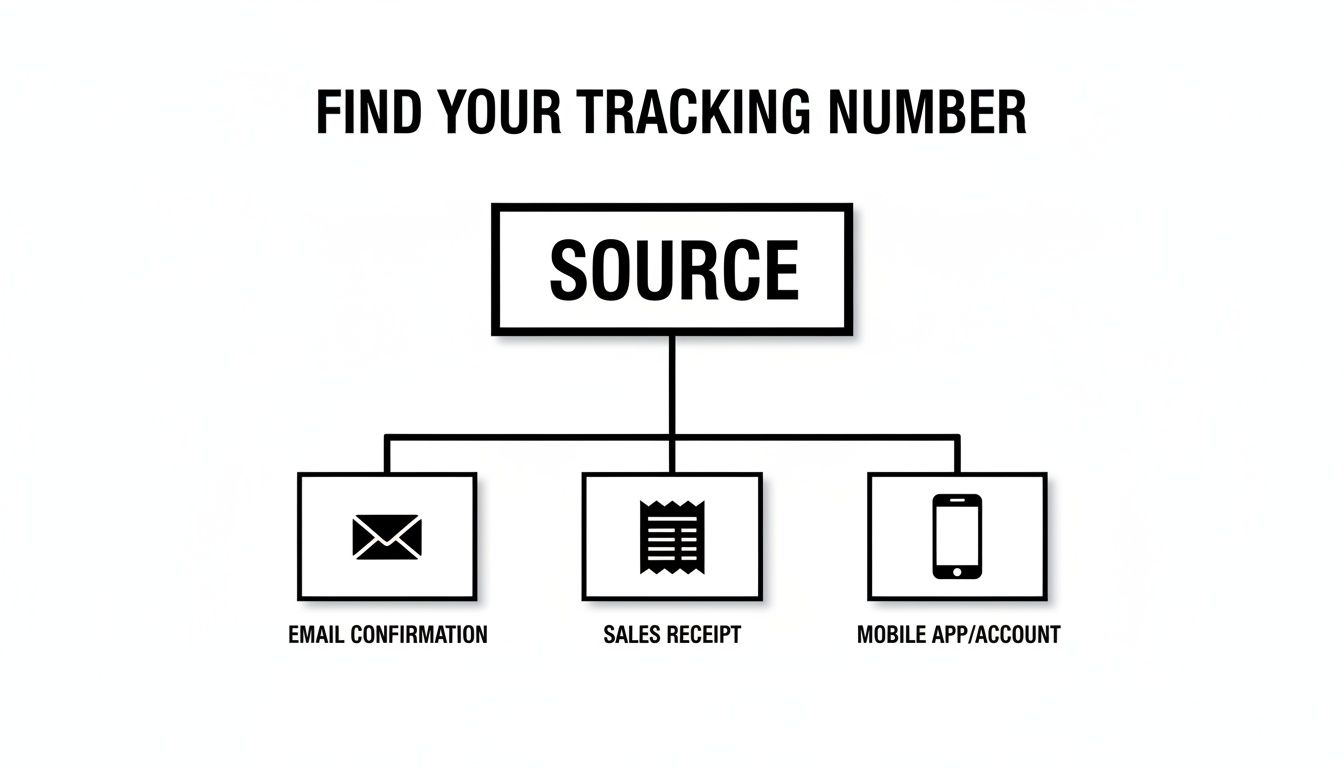
Once you have that number, you're ready to start following along.
From Pickup to Transit: The Early Stages
This is the first part of the adventure, from the moment your package leaves the sender's hands to when it starts moving through the La Poste network.
Pris en charge (Taken in charge): This is the one you want to see first. It's the official confirmation that La Poste has your parcel. It's been scanned into their system, and its journey has officially begun.
En cours d'acheminement (In transit): Your package is on the move. It could be on a truck rattling between sorting facilities or on a plane crossing borders. This status will likely stick around for most of the delivery time, so don't be alarmed if you see it for a few days.
Seeing these statuses means everything is going according to plan. Just sit back and watch its progress.
Through Customs and Local Handovers
If your package is crossing borders, customs is the next big step. This is where things can sometimes slow down, so knowing the terminology is crucial.
En attente de dédouanement (Awaiting customs clearance): Your parcel has landed in the destination country and is waiting to be inspected by customs officials. This is a totally normal part of the process.
Dédouanement terminé (Customs clearance completed): Great news! Customs has cleared your package. It's now free to be handed over to the local delivery partner for the final leg of its trip.
The handoff from La Poste to a local carrier in another country is a classic point of confusion. A universal tracking tool like Instant Parcels is a lifesaver here, as it pulls updates from both carriers into one unified timeline, so you don't have to piece the story together yourself.
The Final Delivery Stretch
This is it—the last mile. Your parcel is close.
Votre colis est en cours de livraison (Your parcel is out for delivery): The package is on the local delivery truck and heading to your address. You can usually expect it to arrive that same day.
Distribué (Delivered): Success! The package has officially been dropped off at the recipient's address.
Understanding the Bumps in the Road
Of course, shipping isn't always smooth sailing. Some statuses signal a problem that might need your attention.
Anomalie (Anomaly/Issue): This is a catch-all term for an unexpected hiccup. It could mean anything from an incorrect address to a damaged label. If you see this status, it's a good idea to contact La Poste customer service to figure out what's going on.
En instance (Pending/Held): This status usually pops up after a failed delivery attempt. It means the driver tried to deliver, but no one was home. The parcel is now safely stored at a local post office or pickup point, waiting for you. Be aware you typically have around 10-15 days to collect it before it’s sent back to the sender.
A Quick Guide to Common La Poste Statuses
To make things even clearer, here’s a quick-reference table translating the most common French statuses you'll encounter. Think of it as your personal La Poste tracking decoder ring.
French Status | English Translation | What It Means For Your Parcel |
|---|---|---|
Pris en charge | Taken in charge | La Poste has officially received your package. The journey has started. |
En cours d'acheminement | In transit | Your parcel is moving between sorting centers or countries. This is normal. |
En attente de dédouanement | Awaiting customs clearance | The package is at customs in the destination country. No action is needed yet. |
Dédouanement terminé | Customs clearance completed | Your parcel has passed customs and will be handed to a local carrier soon. |
Votre colis est en cours de livraison | Your parcel is out for delivery | It's on the local delivery truck. Expect it to arrive today! |
Distribué | Delivered | The package has been successfully delivered. |
Anomalie | Anomaly / Issue | There's an unexpected problem. Contact customer service for details. |
En instance | Pending / Held | A delivery was attempted. You need to pick up your parcel from a local point. |
Keep this guide handy, and you'll always be one step ahead, fully understanding every move your package makes on its way to you.
Navigating International La Poste Shipments
Tracking a package within France is usually a pretty smooth ride. But the moment it crosses an international border, things get complicated. Suddenly, you've got customs inspections and handoffs between different national postal services to worry about. This is where most of the confusion with La Poste tracking for global deliveries comes from.
One of the most frustrating things you can run into is the "tracking black hole." This is what happens when your parcel leaves France and La Poste hands it over to the local postal service in the destination country—think USPS in the United States or Royal Mail in the UK. When that handover occurs, your original La Poste tracking number might just stop updating. In some cases, the local carrier assigns a completely new number.
This carrier switch can leave you feeling completely in the dark, wondering where on earth your package has gone. You're stuck trying to figure out which new company has it and how to find its latest tracking status.
The Problem of Shifting Tracking Numbers
Let's walk through a common scenario. Your La Poste tracking shows your parcel has successfully left France. Great! But then days go by with radio silence. No new updates. This usually means the local delivery partner has taken over, but the information isn't syncing back to La Poste's system. You might even need a whole different tracking number to follow the final leg of its journey.
This is precisely where a universal tracking tool becomes a lifesaver. Instead of you having to manually figure out the new carrier and hunt down their website, a platform like Instant Parcels automatically detects the handoff. It pulls updates from both La Poste and its international partners into one clean, continuous timeline, all under your original number.
E-Commerce and the Surge in Cross-Border Shipments
The challenge of keeping tabs on international packages has only gotten bigger with the explosion of global e-commerce. The sheer volume of parcels coming from online marketplaces has completely changed the game for La Poste. To put it in perspective, major Chinese e-commerce platforms recently made up a whopping 22% of La Poste's total parcel volume in France. That's a massive jump from just 5% five years ago, a trend highlighted in reports on the French parcel delivery market.
This incredible flow of cross-border shipments makes a unified tracking system more essential than ever. It’s not just about convenience anymore; it’s about managing expectations and getting ahead of potential customs delays, which are a frequent headache with international orders. With a clear, end-to-end view, you can see exactly when your parcel clears customs and when it’s out for that final delivery, no matter how many hands it passes through.
If you're new to this, our detailed guide on how to track international packages can help you get more comfortable with the whole process.
Troubleshooting Common Tracking Problems
Even with a system as established as La Poste, tracking a package can sometimes hit a snag. Seeing an error message or a status that’s been stuck for days is frustrating, but it’s rarely a sign that your parcel has vanished into thin air. More often than not, the issue is a minor one that you can solve yourself before you need to pick up the phone.
One of the most common hiccups is the dreaded "Not Found" error. This usually just means the tracking number hasn't had its first official scan into the La Poste network. Give it at least 24-48 hours for the system to catch up before you start to worry.
Your First Steps in Troubleshooting
Before you spend time trying to get help, run through this quick mental checklist. I've found that these simple checks clear up the vast majority of tracking mysteries without ever needing to contact support.
Double-Check for Typos: It sounds obvious, but you’d be surprised how often an 'O' gets typed as a '0' or an 'I' as a '1'. Re-enter the number carefully. The best practice is to copy and paste it directly from your confirmation email.
Give It Time: Patience really is a virtue here. A brand-new tracking number needs time to get into the system. For international packages, it’s also common to see delays of several days, particularly when it's going through customs or being handed over to a local delivery company.
Dig Into the Tracking History: Take a close look at the last known location and status. If it says "En attente de dédouanement" (awaiting customs), the delay is normal and outside of La Poste's direct control. If you see a delivery exception, it might be a clue about a bad address. You can learn more about what a shipment exception means in our detailed guide.
Knowing When to Contact La Poste Customer Service
So, when is it time to escalate? If your domestic shipment hasn't updated in over five business days (or even longer for international ones), it's a good idea to reach out to La Poste. In a market where parcels represent over 62% of all European postal traffic, some delivery issues are simply bound to happen. Knowing the right way to report a problem makes all the difference.
To get the quickest help, make sure you have this information handy before you get in touch:
The complete tracking number
The sender's and recipient's full names and addresses
The original shipping date
A quick description of what's inside and its packaging
Pro Tip: The most direct way to get help is through La Poste's official channels. If you're in France, calling 3631 connects you with an agent. They can often see more detailed internal tracking data than what's available on the public website.
Filing a Claim for a Lost Parcel
If customer service has investigated and confirmed your parcel is lost, the next step is to file a formal claim. This process is almost always initiated by the sender.
If you're the one waiting for the package, you'll need to contact the seller or person who sent it. They will have to provide proof of shipment, like the post office receipt, and describe the contents to get the claims process started. Nobody wants to be in this situation, but having a clear plan can turn a moment of panic into productive action.
Frequently Asked Questions About La Poste Tracking
Even seasoned shippers run into questions now and then, and when it comes to La Poste tracking, getting clear answers fast can make all the difference. I’ve pulled together some of the most common issues people face to give you direct, practical advice.
How Long Does La Poste Take to Deliver Internationally?
This is the big one, and the honest answer is: it depends. Your delivery window with La Poste hinges entirely on the destination and the service you paid for.
But, as a general guide, you can expect:
Parcels within the European Union: These are usually pretty quick, typically arriving in 3-7 business days.
Shipments outside the EU (like to the USA or Canada): The timeline stretches a bit, usually falling in the 5-14 business day range.
Remember, these are just estimates. The real wildcard is customs clearance in the destination country. That process can add a few extra days, completely outside of La Poste's control.
Your tracking history is your single source of truth. It will tell you the moment your package clears customs and gets handed off to a local partner for that final leg of the journey.
Why Is My La Poste Tracking Number Not Working?
That "Not Found" error message can definitely cause a spike in your heart rate, but it’s almost never a reason to worry. In my experience, it usually boils down to one of a few simple things.
First, just double-check the number for typos. It's surprisingly easy to swap a '0' for an 'O' or mix up a couple of digits.
Second, timing is everything. A brand new tracking number often needs 24-48 hours to get scanned into the La Poste system and go live. If you’re checking it moments after getting the number, you’re probably just too early.
If it's an international parcel coming from a marketplace, the number you have might belong to the original courier in the sending country. It won't become active on the La Poste site until the package physically arrives in France and gets its first scan there.
What Should I Do If My Package Is Stuck in Customs?
Seeing a status like "En attente de dédouanement" (Awaiting customs clearance) is completely normal for international shipping. It just means your parcel is in line for inspection by the local authorities. This can be quick—a few hours—or take several days.
Patience is key here. In most cases, you don't need to do a thing. If customs needs more information from you, or if there are duties and taxes to be paid, they or La Poste will reach out directly. The best thing you can do is just keep an eye on your La Poste tracking for any new updates.
Can I Track a Standard Letter from La Poste?
Unfortunately, no. Standard letters, or lettres standard, are the most basic, untracked mail service. Think of it like dropping a regular stamped envelope in the mailbox.
If you need to follow a letter's progress, you have to send it using a service that specifically includes tracking. Your options are:
Lettre Suivie (Tracked Letter)
Colissimo
Chronopost
Only these services will generate the tracking number you need to monitor the item's journey.